MLExpert, a 35B agentic model, lifts MLE-Bench Lite medal rate from 37.9% to 72.7%
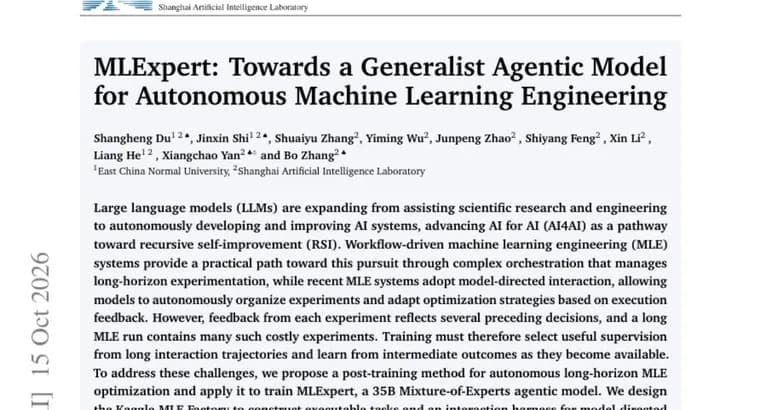
A paper listed on Hugging Face proposes a post-training method for autonomous, long-horizon machine learning engineering (MLE) and uses it to train MLExpert, a 35B Mixture-of-Experts agentic model.
The paper starts from a broader framing: large language models are moving from assisting scientific research and engineering to autonomously developing and improving AI systems. It calls this AI for AI (AI4AI) and describes it as a pathway toward recursive self-improvement (RSI). Workflow-driven MLE systems are presented as a practical route there. Recent ones use model-directed interaction, where the model organizes experiments itself and adapts its optimization strategy based on execution feedback.
The difficulty the authors name is credit assignment. Feedback from each experiment reflects several preceding decisions, and a long MLE run contains many such costly experiments. Training therefore has to pick useful supervision out of long interaction trajectories and learn from intermediate outcomes.
The method has several parts. The Kaggle-MLE Factory is designed to construct executable tasks and an interaction harness for model-directed experimentation. Hierarchical agentic supervised fine-tuning (SFT) transfers general tool-use and coding capabilities to MLE through outcome-guided supervision. Windowed Interaction RL (WIRL) treats the multi-turn decisions between successive experiment results as an execution window and gives that window a shared outcome-based reward. Asynchronous collection and policy correction allow policy updates before a trajectory ends.
On MLE-Bench Lite, MLExpert raises the average medal rate of its base model from 37.9% to 72.7%. The authors say this is performance comparable to larger frontier models such as Kimi-K3 and GLM-5.3. Further experiments show gains on NatureBench Lite, agent scaffold optimization and algorithm optimization, which the authors take to suggest that the learned optimization capability generalizes to other tasks.
Key facts
- MLExpert is a 35B Mixture-of-Experts agentic model trained for autonomous, long-horizon machine learning engineering.
- On MLE-Bench Lite, the average medal rate of the base model goes from 37.9% to 72.7% after post-training.
- The authors call this comparable to larger frontier models such as Kimi-K3 and GLM-5.3.
- The method combines the Kaggle-MLE Factory (tasks and harness), hierarchical agentic SFT, Windowed Interaction RL (WIRL) with a shared outcome-based reward per execution window, and asynchronous collection with policy correction.
- Gains also appear on NatureBench Lite, agent scaffold optimization and algorithm optimization, which the authors say suggests the skill generalizes.
Why it matters
Autonomous ML engineering is a step toward AI systems that build and improve other AI systems, which the paper frames as AI4AI and a pathway toward recursive self-improvement. The technical problem it tackles is real for any long agent run: each costly experiment's result depends on many earlier decisions, so training has to decide which parts of a long trajectory deserve supervision. WIRL's answer is to group the decisions between successive experiment results into one window and reward it jointly. The headline result is a jump from 37.9% to 72.7% in average medal rate on MLE-Bench Lite for a 35B model.
Who it affects
Mainly researchers building agentic models and training pipelines for long-horizon tasks, and teams working on automated ML engineering and Kaggle-style benchmarks. The generalization claims touch people working on agent scaffold optimization and algorithm optimization.
How to use it
The text describes a training recipe rather than a product: build executable tasks and an interaction harness (Kaggle-MLE Factory), run hierarchical agentic SFT for tool use and coding, then apply WIRL with asynchronous collection and policy correction. The text does not mention a release, so there is nothing to download or run from what is described here.
How solid is it
This is a preprint-style abstract, and the numbers are the authors' own. The 37.9% and 72.7% figures are average medal rates on MLE-Bench Lite for the base model and MLExpert. The comparison with Kimi-K3 and GLM-5.3 is stated only as 'comparable', with no scores for those models. No figures are given for NatureBench Lite, agent scaffold optimization or algorithm optimization. The authors describe the generalization as 'suggesting', not proving.
Risks and caveats
The text does not name the base model, does not say whether 35B counts total or active parameters, and does not say how many tasks or runs the medal rate is averaged over, or whether it comes from a single run or repeated runs. It names no authors or institutions and mentions no release of weights, code or the Kaggle-MLE Factory. Independent verification is therefore not possible from this text alone.