MoLRSI agent hits 15.9% in antibiotic screen vs 8.7% for expert workflow
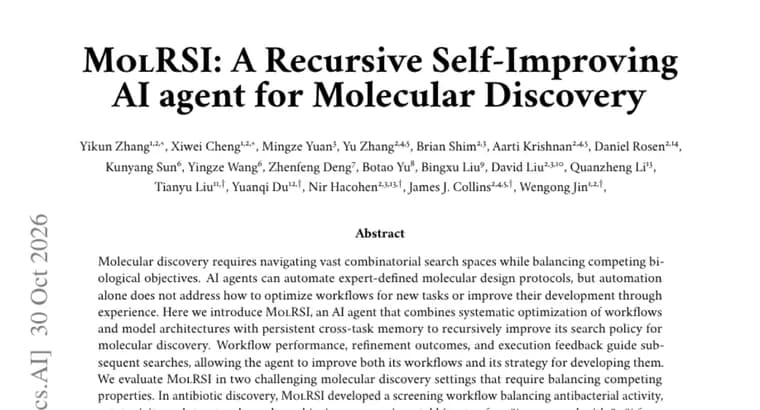
A paper on Hugging Face introduces MoLRSI, an AI agent for molecular discovery. The problem it targets: molecular discovery means searching vast combinatorial spaces while balancing competing biological objectives. AI agents can already automate expert-defined design protocols, but the authors say automation alone does not address how to optimize workflows for new tasks, or how to improve their development through experience.
MoLRSI combines two things: systematic optimization of workflows and model architectures, and persistent cross-task memory. Together they let the agent recursively improve its search policy. Workflow performance, refinement outcomes and execution feedback guide later searches, so the agent improves both its workflows and its strategy for developing them.
The agent is evaluated in two settings that require balancing competing properties. In antibiotic discovery, MoLRSI developed a screening workflow that balances antibacterial activity, cytotoxicity and structural novelty. That workflow reached an experimental hit rate of 15.9%, compared with 8.7% for a previous expert-led workflow that used the same training data and screening library.
In de novo peptide-MHC binder design, MoLRSI developed workflows that jointly consider target binding and specificity. They produced eight experimentally validated hits against MART-1 and SARS-CoV-1 pMHCs, with preferential binding over the tested off-targets. The abstract adds that Claude Science "completely failed" in this task, without saying how it was run or what failure means.
The authors conclude that experience-guided workflow optimization can address competing discovery objectives while improving the search strategies used in later campaigns.
Key facts
- MoLRSI is an AI agent that optimizes workflows and model architectures and keeps persistent cross-task memory to recursively improve its search policy for molecular discovery.
- In antibiotic discovery its screening workflow, balancing antibacterial activity, cytotoxicity and structural novelty, reached an experimental hit rate of 15.9% against 8.7% for a previous expert-led workflow with the same training data and screening library.
- In de novo peptide-MHC binder design it produced eight experimentally validated hits against MART-1 and SARS-CoV-1 pMHCs, with preferential binding over tested off-targets.
- The abstract says Claude Science completely failed in the peptide-MHC task, with no detail on the setup.
Why it matters
AI agents can automate expert-defined molecular design protocols. MoLRSI is pitched as going a step further: it tunes the workflow itself, and carries what it learned into later campaigns through persistent memory. The reported payoff is a wet-lab result, not only a benchmark: 15.9% experimental hits in antibiotic screening against 8.7% for an expert-led workflow on the same data and library.
Who it affects
Drug discovery and antibiotic research groups that run screening campaigns, and teams building AI agents for scientific workflows. The peptide-MHC results (MART-1 and SARS-CoV-1 targets) are relevant to people designing binders for peptide-MHC complexes.
How to use it
The abstract gives no code, release or access details, so there is nothing to run from it. The practical takeaway is the design idea: let an agent score its own workflows, feed performance, refinement outcomes and execution feedback into the next search, and keep that memory across tasks.
How solid is it
The headline numbers are experimental, not purely computational: a 15.9% hit rate versus 8.7% on the same training data and screening library is a like-for-like comparison as described. Eight validated hits are reported for the peptide-MHC task. This is a preprint-style abstract. It gives no significance test or confidence interval for 15.9% versus 8.7%, and no screening library size or number of compounds tested.
Risks and caveats
The Claude Science comparison rests on a single phrase, "completely failed", with no description of how that system was configured or what failure means. No hit rate is given for the peptide-MHC task because the number of candidates tested is not stated. The abstract does not say which base model powers MoLRSI, how many recursive iterations were run, or what the compute cost was. The antibiotic comparison is against one earlier expert-led workflow.