Motif 3 debuts as a 314B-parameter MoE model with new GDLA attention
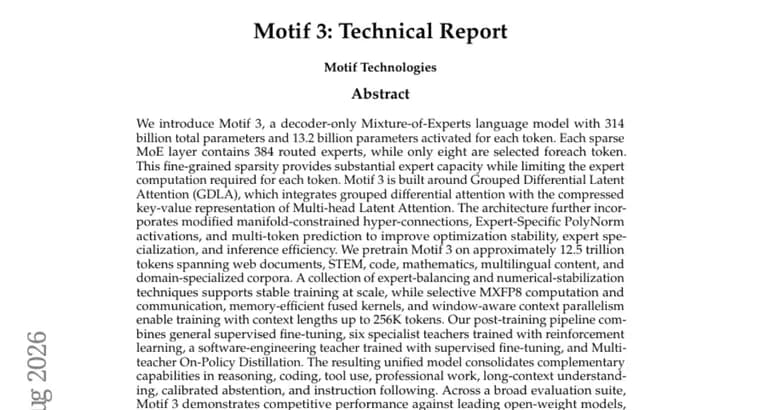
Junghwan Lim and co-authors introduce Motif 3, a decoder-only Mixture-of-Experts (MoE) language model with 314 billion total parameters, of which 13.2 billion are activated per token. Each sparse MoE layer holds 384 routed experts, and the model selects eight of them per token, a fine-grained sparsity pattern meant to give the model large capacity while keeping per-token computation limited.
The model is built around a new attention mechanism called Grouped Differential Latent Attention (GDLA), which combines grouped differential attention with the compressed key-value representation used in Multi-head Latent Attention. The architecture also adds modified manifold-constrained hyper-connections, Expert Specific PolyNorm activations, and multi-token prediction, aimed at improving optimization stability, expert specialization, and inference efficiency.
Motif 3 was pretrained on approximately 12.5 trillion tokens spanning web documents, STEM material, code, mathematics, multilingual content, and domain-specialized corpora. Training relied on expert-balancing and numerical-stabilization techniques for stability at scale, plus selective MXFP8 computation and communication, memory-efficient fused kernels, and window-aware context parallelism, which together let training reach context lengths up to 256K tokens.
Post-training combines general supervised fine-tuning, six specialist teachers trained with reinforcement learning, a software-engineering teacher trained with supervised fine-tuning, and Multi-teacher On-Policy Distillation, merging these into one unified model spanning reasoning, coding, tool use, professional work, long-context understanding, calibrated abstention, and instruction following.
Across a broad evaluation suite, the authors report competitive performance against leading open weight models, citing particularly strong results on long-horizon agentic tasks, mathematical reasoning, scientific knowledge, and hallucination-sensitive evaluation. The paper does not give specific benchmark scores, the names of the models it was compared against, a release date, license terms, or any information on weight availability.
Key facts
- Motif 3 is a decoder-only MoE model with 314 billion total parameters and 13.2 billion activated per token, selecting eight of 384 routed experts per layer.
- It introduces Grouped Differential Latent Attention (GDLA), combining grouped differential attention with Multi-head Latent Attention's compressed key-value cache.
- Pretraining used approximately 12.5 trillion tokens across web, STEM, code, math, multilingual and domain-specific data, with training context length up to 256K tokens.
- Post-training combines supervised fine-tuning, six RL-trained specialist teachers, a software-engineering teacher, and multi-teacher on-policy distillation into one unified model.
- The authors report competitive results against leading open weight models on agentic, math, science and hallucination-sensitive evaluations, but give no specific scores or comparison model names.
Why it matters
Motif 3 combines several architecture ideas into one large-scale system at once: fine-grained MoE sparsity with 384 experts and only 8 active per token, a new attention variant that merges differential attention with compressed latent key-value caching, and multi-token prediction for training efficiency. Paired with training at context lengths up to 256K tokens and a multi-teacher distillation pipeline that folds reasoning, coding, tool use and long-context skills into a single unified model, it is a concrete example of how large MoE systems are being engineered for capacity and efficiency together.
Who it affects
Teams building or evaluating large-scale language models, researchers working on MoE attention or training-efficiency techniques such as MXFP8 computation and window-aware context parallelism, and anyone assessing agentic, coding or long-context model options once independent benchmark numbers become available.
How to use it
The source gives no release date, license terms, or information on whether and how Motif 3's weights are made available, so there is nothing here to point to for direct use yet.
How solid is it
The claims come from the model's own technical report. The authors state competitive performance against leading open weight models across a broad evaluation suite, with strong results specifically on long-horizon agentic tasks, mathematical reasoning, scientific knowledge, and hallucination-sensitive evaluation. No specific benchmark scores or the names of the compared models are given, so the strength of that claim cannot be checked independently from this text.
Risks and caveats
Beyond the missing benchmark figures, the source names no author institution or affiliation and gives no pricing, inference cost, or hardware requirement information. Until those details surface, Motif 3's real-world cost and accessibility remain unknown.
“Across a broad evaluation suite, Motif 3 demonstrates competitive performance against leading open weight models, including strong results on long-horizon agentic tasks, mathematical reasoning, scientific knowledge, and hallucination-sensitive evaluation.”
— Motif 3 technical report