MRTPO paper assigns each reward's advantage to its relevant tokens
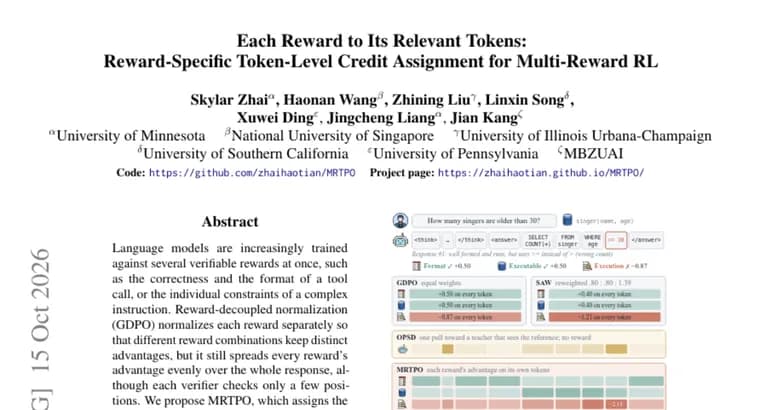
Language models are increasingly trained against several verifiable rewards at once. The paper gives two examples: the correctness and the format of a tool call, or the individual constraints of a complex instruction.
The authors start from an existing method, reward-decoupled normalization (GDPO). It normalizes each reward separately, so different reward combinations keep distinct advantages. But it still spreads every reward's advantage evenly over the whole response, even though each verifier checks only a few positions.
The paper proposes MRTPO, which assigns the advantage of each reward to the tokens relevant to that reward. It uses the information the reward's verifier checks, and it needs no auxiliary models or token-level annotations.
The mechanism works per reward. The policy replays its own response twice, once with and once without that reward's verifier information. The per-token Jensen-Shannon distance between the two next-token distributions then measures how relevant each token is to that reward, and that measure reassigns the advantage.
The authors test MRTPO on text-to-SQL, multi-constraint instruction following and tool calling. They report that it converges faster and achieves better performance than the compared methods. The source text gives no numeric results, and it does not name the compared methods other than GDPO.
Key facts
- MRTPO is a multi-reward RL method that assigns each reward's advantage only to the tokens relevant to that reward.
- It targets a gap in GDPO, which normalizes each reward separately but still spreads every reward's advantage evenly over the whole response.
- Token relevance comes from the policy replaying its own response with and without a reward's verifier information, then taking the per-token Jensen-Shannon distance between the two next-token distributions.
- No auxiliary models or token-level annotations are needed.
- The authors report faster convergence and better performance than the compared methods on text-to-SQL, multi-constraint instruction following and tool calling.
Why it matters
Training against several verifiable rewards at once is becoming common, for example scoring both the correctness and the format of a tool call. The authors point to a weakness in GDPO: it keeps reward combinations distinct but still gives each reward's advantage to the whole response, although a verifier looks at only a few positions. MRTPO tries to put each reward's signal where it belongs, and does so without extra models or token-level labels.
Who it affects
Mainly researchers and engineers who train language models with several verifiable rewards. The tasks tested are text-to-SQL, multi-constraint instruction following and tool calling.
How to use it
This is a method proposal. In the paper's description, each reward's verifier information is used in a replay of the policy's own response, and the resulting per-token Jensen-Shannon distance reassigns the advantage. No code release, license or publication date is stated.
How solid is it
The claims come from the paper's abstract on the Hugging Face papers page, and they are the authors' own. No numeric results (accuracy, speedup, convergence steps) are given. The compared methods other than GDPO are not named. No authors or institutions are named.
Risks and caveats
The reported gains are stated only qualitatively, as faster convergence and better performance. No model sizes, base models or datasets/benchmarks are named. No limitations or compute overhead of the replay step are stated.
“We propose MRTPO, which assigns the advantage of each reward to the tokens relevant to it, using the information its verifier checks, without auxiliary models or token-level annotations.”
— From the paper's abstract, Hugging Face papers page