New autoencoder shares one latent space between 3D perception and video generation
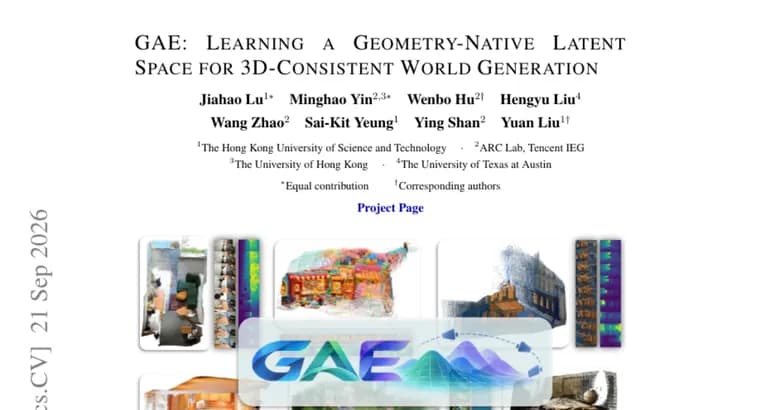
Researchers describe a new way to build the latent space that visual generators work in, aimed at a specific failure mode: video and image generators can produce photorealistic frames while still losing track of a consistent 3D scene, because they typically operate on latents built around appearance rather than geometry. The authors argue this is a representation problem, not just a modeling one: separate perception models already recover geometry in a semantically rich space that encodes structure across different views, but that geometric knowledge is not shared with the generators. Their fix is the geometry-native autoencoder (GAE), which reparameterizes the features of an existing geometry foundation model into a compact latent space built for generation rather than adding geometry as a bolted-on extra output. The resulting latent can be decoded three additional ways beyond a normal image: into depth, camera parameters, and point maps, alongside appearance. Once material is represented this way, a standard conditional flow model can be trained on top of it to support several different generation tasks. To test whether the new latent actually helps, the authors ran controlled comparisons in which the generator architecture and training protocol were held fixed and only the latent space was swapped. Replacing the baseline latent with GAE improved both visual quality and, separately, 3D coherence measured independently of the generator: Frechet Video Distance (FVD), a standard measure of how far generated video departs from real video, fell by 12.7% on the RealEstate10K benchmark and by 23.1% on DL3DV. Camera-trajectory error, which measures how well the geometry implied by generated frames matches a consistent camera path, was halved on RealEstate10K. The paper does not report the absolute FVD or trajectory-error values behind these percentage drops, does not compare against any specific named competing method beyond the fixed baseline latent, and gives no detail on model size, training compute, dataset scale, or a release timeline or code availability.
Key facts
- GAE reparameterizes features from a geometry foundation model into a compact latent space shared by perception and generation, rather than adding geometry as a separate output.
- The GAE latent decodes to appearance, depth, cameras, and point maps, and supports diverse generation tasks via a standard conditional flow.
- With the generator and training protocol held fixed, swapping in GAE cut FVD by 12.7% on RealEstate10K and 23.1% on DL3DV.
- Camera-trajectory error on RealEstate10K was halved when using the GAE latent instead of the baseline.
- The paper reports only relative improvements: no absolute FVD or trajectory-error numbers, model size, compute, or release plans are given.
Why it matters
Generators have gotten good at photorealism while quietly losing 3D consistency: objects and camera geometry can drift across frames even when each individual frame looks convincing. This work locates the cause in the latent space itself, the internal representation a generator learns to work in, rather than in the generator's architecture or training recipe. By building a latent space that already encodes geometry, jointly decodable to depth, camera parameters and point maps alongside appearance, the authors give generation and 3D perception a shared foundation instead of two separate, incompatible representations.
Who it affects
The result targets researchers and engineers building video and image generators, world models, and 3D-aware generative systems, anywhere geometric consistency across frames or views currently has to be patched in after the fact or accepted as a limitation.
How to use it
GAE is presented as a drop-in replacement for the latent space in an existing generation pipeline: the paper's own comparisons keep the generator and training protocol fixed and only swap the latent, which is the same integration path a team adopting it would follow. No code release, model weights, or licensing terms are mentioned in the source, so at this stage it is a method described in a paper rather than a released tool.
How solid is it
The evidence is a controlled ablation, changing only the latent while holding the generator and training setup constant, which is a reasonable way to isolate the latent's contribution. The gains are consistent across two different benchmarks (RealEstate10K and DL3DV) and across two different metrics (FVD for visual quality, camera-trajectory error for geometric consistency), which strengthens the case that the improvement is about the representation rather than a benchmark artifact. That said, the paper only reports relative changes, no absolute FVD or trajectory-error figures, no comparison to other named methods, and no information on model or dataset scale, so how the approach stacks up against the wider field is not established here.
Risks and caveats
All figures come from the authors' own controlled comparison rather than an independent benchmark or third-party replication. The lack of absolute numbers makes it hard to judge how large the underlying errors were to begin with, or how the resulting quality compares to other current generators. No information is given on compute cost, model size, or whether code or trained weights will be released, so practical adoption cannot yet be assessed.