Nvidia open-sources Flora for robot video labeling, claims up to 125x lower cost than GPT-6 Astra
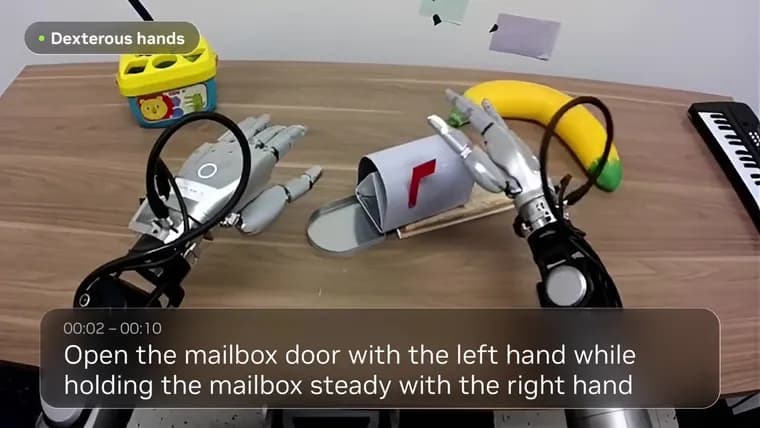
Nvidia has released Flora, an open data engine for labeling robot video. Large AI models for robots learn from videos that need text annotations, and according to Nvidia's GEAR research lab this takes three kinds of labels: descriptions of what action happens when in the video (used to select training data), step-by-step ratings of how well a robot is progressing (so it can learn through trial and error), and judgments on whether a task was completed successfully (used to monitor robots in deployment). Most existing tools provide only one of these. Large language models such as GPT-6 Astra can produce several, but they are too expensive for the volumes of video involved. According to the paper, Flora covers all three.
Nvidia says the system is already running during training of its GR00T models, annotating up to 200,000 hours of video per day across 512 GB300 GPUs. The models are available on Hugging Face.
Flora is made of three fine-tuned Qwen3.5 models. A 9B model splits videos into action segments. A 27B model describes each segment, taking into account what happened before and after. A second 27B model, Flora-Rewarder, takes on three roles depending on the prompt: it rates an episode's success on a scale of 1 to 5, classifies each half-second step as normal, suboptimal or failure, and assigns scores based on self-defined rubrics.
The headline cost claim comes from Nvidia's own estimate. In a test with 50 videos, Flora scored slightly better than GPT-6 Astra according to Nvidia, even though OpenAI's model was allowed to use its full reasoning capacity. Labeling one hour of video costs about 72 cents with Flora, against roughly $88.50 with GPT-6 Astra. Claude Opus 5 scored much worse in the same test and still cost about $42 per hour. The Decoder stresses that these are projections, not production measurements, calculated from an assumed rental price of $10 per GPU per hour.
The benchmark picture is mixed. On the public WGO-Bench, Flora is best at detecting action boundaries but trails Astra in overall score and falls behind Gemini 3.8 Flash in pure description accuracy; the researchers say the gains come mainly from temporal localization. On Nvidia's own DenseCaptionBench, Flora leads across all metrics for human recordings, but for robot videos it comes second behind Astra. The researchers acknowledge a methodological catch: GPT-6 Astra evaluates the descriptions while also being one of the models under test.
On RoboRewardBench, Flora's error rate is 27.8 percent lower than Astra's. The paper attributes the gap to partially completed tasks. When a robot only tips a bottle over instead of knocking it off the table, Flora gives 3 out of 5 points, matching the human reference, while Astra gives one. Flora-Rewarder catches 53.3 percent of failed steps within an episode; no competitor gets above 11.7 percent, and Astra catches none. The tradeoff is that Flora falsely flags about 11 percent of normal steps as errors. Astra still leads on rubric-based scoring and trajectory ranking.
In a video with many short hand movements, Flora identifies 34 of 37 individual actions while Astra catches four. Flora also has faults: it sometimes splits longer actions into too many small steps and occasionally gets descriptions wrong. In one video a robot hand wipes a plate with a cloth, and Flora describes it as folding a napkin.
Nvidia positions Flora as an open alternative to commercial services such as Scale AI's Physical AI Data Engine. Researchers can use it to scale their own robotics datasets and to test approaches like transferring human demonstrations to robots. The Decoder reads it as part of Nvidia's strategy of covering the whole robotics chain, from hardware and training data to simulation and models, and of investing in open models to keep developers in its hardware ecosystem. At GTC earlier this year Nvidia showed a data pipeline that prepares, multiplies and scores training material; Flora adds detailed labels and reward signals from video to it. Google's recently announced Gemini 4 Argon targets a similar part of robotics training, also identifying work steps in training videos and flagging failed actions.
Key facts
- Flora is three fine-tuned Qwen3.5 models (a 9B segmenter, a 27B describer and a 27B Flora-Rewarder) that produce action descriptions, step-wise progress ratings and task-success judgments for robot video; the models are on Hugging Face.
- Nvidia estimates about 72 cents per hour of video for Flora versus roughly $88.50 for GPT-6 Astra, and about $42 for Claude Opus 5; these are projections based on an assumed $10 per GPU per hour, not production measurements.
- In a 50-video test Flora scored slightly better than GPT-6 Astra according to Nvidia; on RoboRewardBench its error rate is 27.8 percent lower, and Flora-Rewarder catches 53.3 percent of failed steps against 11.7 percent for the best competitor.
- Astra still leads on WGO-Bench overall score, robot-video descriptions on DenseCaptionBench, rubric-based scoring and trajectory ranking, and Flora falsely flags about 11 percent of normal steps as errors.
- Nvidia says Flora already annotates up to 200,000 hours of video per day across 512 GB300 GPUs during GR00T training.
Why it matters
Robot foundation models need huge volumes of labeled video, and the labels come in three kinds that few tools cover together. Frontier LLMs can produce them but cost too much at that scale. Flora is an open, small-model alternative, and Nvidia says it already runs in its own GR00T training at up to 200,000 hours of video per day. It also fits Nvidia's push to cover the whole robotics chain and to keep developers on its hardware through open models. Google's Gemini 4 Argon targets a similar part of the process.
Who it affects
Robotics researchers and teams who need to scale their own datasets, including those testing transfer of human demonstrations to robots. Nvidia positions Flora as an open alternative to commercial services such as Scale AI's Physical AI Data Engine, so labeling vendors are in the frame too.
How to use it
The three Flora models are available on Hugging Face, and the paper describes the setup. Each has its own job: the 9B model segments video into actions, one 27B model writes descriptions with context from before and after each action, and Flora-Rewarder rates episode success from 1 to 5, classifies half-second steps as normal, suboptimal or failure, or scores against self-defined rubrics depending on the prompt. Nvidia's cost figures assume GPU rental at $10 per hour.
How solid is it
Most numbers come from Nvidia and its paper. The cost comparison is Nvidia's own estimate, and The Decoder notes it is a projection, not a production measurement. The 50-video test shows Flora only slightly ahead of GPT-6 Astra. On DenseCaptionBench, Nvidia's own benchmark, GPT-6 Astra both judges the descriptions and is one of the models under test, a catch the researchers acknowledge. The 125x factor in the headline is Nvidia's upper figure; the body compares about 72 cents with roughly $88.50.
Risks and caveats
Flora does not beat Astra everywhere: it trails on WGO-Bench overall score, falls behind Gemini 3.8 Flash in pure description accuracy, comes second on robot videos in DenseCaptionBench, and Astra leads on rubric-based scoring and trajectory ranking. Flora-Rewarder falsely flags about 11 percent of normal steps as errors. The model sometimes splits longer actions into too many small steps and occasionally misdescribes a scene, for example calling a cloth wipe on a plate the folding of a napkin.