OpenAI and Anthropic cut LLM prices by up to 80%; a blogger says open-weight rivals forced it
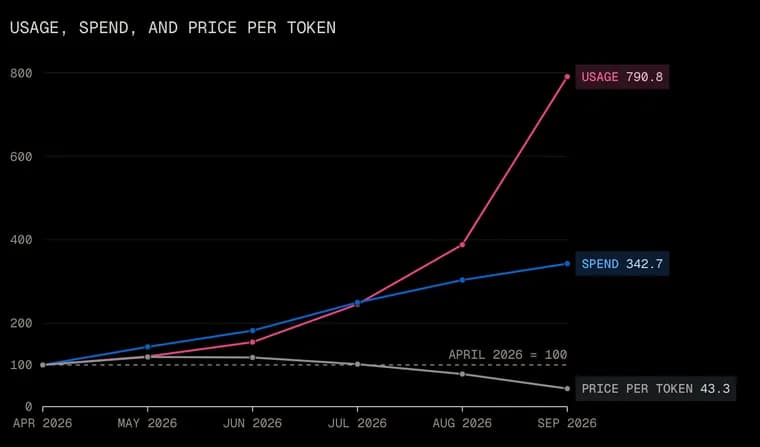
A post on minimaxir.com starts from a timeline of OpenAI and Anthropic launches and price changes between June and September 2026. All prices are given as input / output / cache read per million tokens.
On June 26, OpenAI announced GPT-5.6 Sol, priced like GPT 5.5 at $5 / $30 / $0.50, and the small GPT-5.6 Luna at $1 / $6 / $0.10, plus a middle model called Terra. On June 30, Anthropic launched Claude Sonnet 5 at $2 / $10 / $0.20, a launch price that was supposed to be temporary. On July 24 came Claude Opus 5 at $5 / $25 / $0.50. On July 30, OpenAI cut GPT-5.6 Luna by 80% to $0.20 / $1.20 / $0.02. On August 10, Anthropic made the Sonnet 5 launch price permanent. On August 21, OpenAI cut GPT-5.6 Sol by about 20% to $4 / $20 / $0.40 for three months.
On September 1, Anthropic announced Fable 5.1 at $10 / $50 / $0.25. The author says it beats Fable 5 from June (also $10 / $50 / $1) on every benchmark while cutting the cache read price by 75%. For coding agents, the author says cache reads make up 96% to 99% of token spend and the cache is hit 90 to 100% of the time, so a 75% cache cut means roughly a 70 to 75% cut in the cost of using the model. On September 3, OpenAI announced GPT-6 Astra at $10 / $50 / $1, similar in size and performance to Fable 5.1 but without the cheaper cache.
On September 22, OpenAI announced GPT-6 Sol at $2 / $10 / $0.20, half the input and output price of the temporarily discounted GPT-5.6 Sol, and GPT-6 Luna at $0.10 / $0.50 / $0.01, also half the previous version. The same day Anthropic released Claude Opus 5.5 at $4 / $20 / $0.20, saying that it requires less compute to serve than Opus 5 and its pricing reflects that. By the author's count that is a 40 to 60% total cost cut, for a model the author says is better than Fable 5.1. GPT-6 Sol turned out to be a dud on performance, so on September 29 OpenAI announced GPT-6.1 Sol at $2 / $10 / $0.10, with performance the author says is comparable to Astra after personal use. Halving the cache price to match Anthropic's cache read at 5% of input makes that model family cumulatively 75% cheaper than GPT-5.6 Sol, per the author. The cuts also apply to usage through subscription harnesses such as Codex and Claude Code, and the author says the models do not appear to have cut corners on output quality.
The author sees a tit-for-tat between the two companies but argues that nobody cuts prices by 80% without an outside force. The explanation offered is competitive pressure. Models have become close to commodities that are easy to swap in tools like OpenCode and Zed Agent or through OpenRouter. DeepSeek V4 Flash launched in April 2026 at $0.14 / $0.28 / $0.0028; its cache read is 2% of the input price, against 5% to 10% for OpenAI and Anthropic. The author suspects the July Luna cut was aimed at such small open-weight models. The updated DeepSeek Flash V4.1 1017 scores 45 on the Artificial Analysis index against 24 for the earlier Flash V4, at $0.15 / $0.60 / $0.003 from DeepSeek. The number of providers hosting it on OpenRouter is 29, up from 13 for V4 Flash in May, and many are close in effective cost. Moonshot AI's Kimi K3.1 Pro scores 55 against 58 for Opus 5.5 at half the input and output price ($2 / $10 / $0.20), and is cheaper than the original Kimi K3 at $3 / $15 / $0.30. Kimi K3 is hosted by over 20 inference providers, and once the K3.1 Pro weights drop on November 4th the author expects most to host it at a similar price.
That is the basis for the author's rebuttal of the claim, common among AI detractors, that prices are artificially low and will jump once users are hooked, as with Uber and Lyft. OpenAI and Anthropic are not a duopoly with sole power over prices, the author says, entry barriers to inference are lower, and switching costs are negligible. Providers will undercut each other as long as they price above cost, so the true cost of a token may end up being where price equals marginal cost. Both labs are building moats such as enterprise commitments and personal agent assistants (OpenAI Dots, Claude Duet).
The post then turns to IPO rumors: OpenAI in 2027, Anthropic within a couple of months. Leaked financials show both losing billions on R&D and scaling, though the author says those reports predate the recent surge in agentic use. Cutting the main revenue source by up to 80% looks bad on an S-1, yet some reports put per-token inference margins as healthy as 80%, with caveats. The author is curious to see the post-cut margins in the Anthropic prospectus.
The author's own experience: a $100/month Codex subscription (the 5x Pro plan) used to be fully exhausted on GPT-5.6 Sol. After GPT-6.1 Sol made usage effectively 75% cheaper, the author cut the quota to one fifth for 4x more efficient use of the same model, roughly neutral. When GPT-6.1 Sol launched, OpenAI also cut the usage allowance of the $200/month Codex tier by 50%, to reflect our increasingly efficient models. The author suspects subscription value would be cut before base API prices in a capital crunch. The author also wonders whether the labs hurt themselves by making their own pricier models obsolete: since Opus 5.5 shipped a month ago, nobody discusses Fable 5.1 or GPT-6 Astra. The text breaks off while predicting a Fable 5.2 or GPT-6.1 Astra release.
Key facts
- OpenAI cut GPT-5.6 Luna by 80% on July 30, 2026, from $1 / $6 / $0.10 to $0.20 / $1.20 / $0.02 (input / output / cache read per million tokens), and later halved GPT-6 Luna to $0.10 / $0.50 / $0.01.
- Anthropic's Claude Opus 5.5 (September 22) costs $4 / $20 / $0.20 against $5 / $25 / $0.50 for Opus 5, which the author puts at a 40 to 60% total cost cut; Fable 5.1 cut the cache read price by 75%.
- The author attributes the cuts mainly to competition from open-weight models: 29 providers host DeepSeek Flash V4.1 1017 on OpenRouter, and Kimi K3.1 Pro scores 55 against Opus 5.5's 58 at half the input and output price.
- The author calls the 'prices will jump later' theory a fantasy, since OpenAI and Anthropic are not a duopoly able to set prices alone.
- IPO rumors (OpenAI in 2027, Anthropic within a couple of months) and leaked losses of billions frame the cuts; the author suspects subscription allowances will be cut before base prices, noting OpenAI halved the $200/month Codex allowance.
Why it matters
Over about three months, the two leading labs cut prices on their popular models sharply while, per the author, quality did not drop. The author says the 'cheap now, expensive later' theory matters because it shapes whether people build on these models. The post gives a competing explanation: many inference providers hosting open-weight models keep pressure on both labs, and switching between models is nearly free. If that holds, the author says, the price of a token trends toward marginal cost rather than up.
Who it affects
Developers and teams that run coding agents, since the author says cache reads are 96% to 99% of token spend in that use and those prices fell the most. Subscribers to Codex and Claude Code are also affected; the author says the cuts apply to subscription harnesses, though OpenAI also halved the usage allowance of its $200/month Codex tier. Inference providers on OpenRouter and open-weight developers such as DeepSeek and Moonshot AI are the competitors the author credits for the pressure. Prospective investors in OpenAI and Anthropic are affected by the IPO rumors the post discusses.
How to use it
The post is analysis, not a product, but it lists current prices (input / output / cache read per million tokens): GPT-6.1 Sol $2 / $10 / $0.10, Claude Opus 5.5 $4 / $20 / $0.20, Fable 5.1 $10 / $50 / $0.25, DeepSeek Flash V4.1 1017 $0.15 / $0.60 / $0.003 from DeepSeek, and Kimi K3.1 Pro $2 / $10 / $0.20. The author notes that effective cost depends on the cache read share of the price and on cache hit rates, and that models are easy to swap through harnesses like OpenCode and Zed Agent or an OpenRouter endpoint. The author's own move was to cut a $100/month Codex quota to one fifth after getting 4x more efficient usage.
How solid is it
This is one blogger's secondary analysis built on public announcements, and the prices and dates in the timeline are taken from those announcements. The causes are the author's inference: the post gives no official reason from either company for the 80% Luna cut, and 'I suspect' and 'reasonable to assume' mark the claims about competitor targeting and tit-for-tat. The profit-margin figure (as healthy as 80%) and the leaked financials come with no source beyond 'some reports'. Benchmark scores for the OpenAI and Anthropic models are not given; only the Artificial Analysis scores for DeepSeek (45 vs. 24) and Kimi vs. Opus 5.5 (55 vs. 58) appear. The available text ends mid-sentence before the post's conclusion.
Risks and caveats
The author says there are no post-cut inference margins to check, so whether the cuts are sustainable is open, and both labs are still reported to lose billions. Leaked financials do not capture the recent growth in agentic use, per the author. The 75% cumulative cheapening depends on the author's own mix of cache and token costs. The Kimi K3.1 Pro hosting forecast depends on the weights being released on November 4th. The author also expects subscription value to be cut before base prices if capital tightens, and questions whether obsoleting their own pricier models is good for the labs.
“The idea that token prices will suddenly rise is more a fantasy that is not supported by both behavioral economics and the actual trends of LLM prices going down significantly over the last few months for better models, and not just from OpenAI and Anthropic.”
— Author of the minimaxir.com post