O^{2}LaF uses one pretrained video DiT to learn actions from unlabeled video
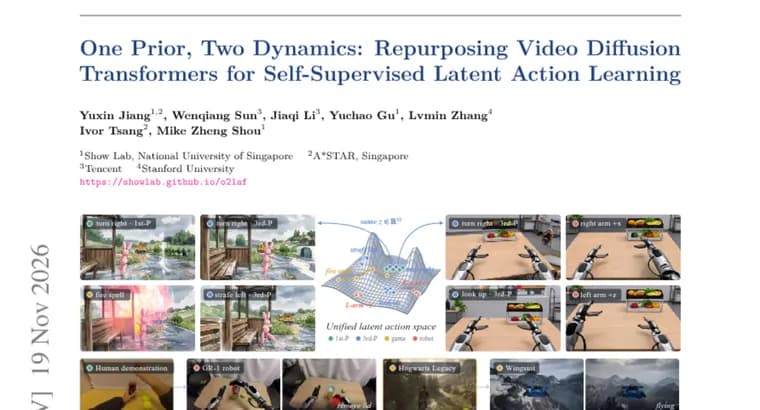
Videos show how the world changes, but rarely the actions that cause those changes. Latent action learning tries to recover that missing supervision from visual transitions. The authors of a new paper say existing methods often learn the underlying dynamics largely from scratch, and they ask whether a pretrained video generator could supply the prior instead.
Their answer is O^{2}LaF, built on a principle they state as "one prior, two dynamics". Both models in the system are initialized from the same pretrained video diffusion transformer (DiT), then adapted to different roles. The inverse dynamics model, which works out the action from a transition, is a feed-forward transition encoder with learnable action queries. The forward dynamics model, which predicts the consequence of an action, is a causal, action-conditioned video generator.
Two design choices tie the pieces together. Information access is controlled, and both dynamics are optimized end-to-end through a compact bottleneck. According to the authors, this lets O^{2}LaF learn transferable actions from unlabeled videos.
On results, the authors report that across navigation and robotic manipulation O^{2}LaF sets a new state of the art in few-shot action probing, and that it enables stronger zero-shot action transfer across visual contexts and embodiments. They also extend the framework beyond generative video priors to predictive representation priors such as V-JEPA2, where they report competitive performance.
The authors conclude that their findings suggest a broader paradigm for latent-action learning: repurposing pretrained video models to discover transferable actions and predict their consequences.
Key facts
- O^{2}LaF initializes both the inverse-dynamics and forward-dynamics models from the same pretrained video DiT, under the principle "one prior, two dynamics".
- The inverse model is a feed-forward transition encoder with learnable action queries; the forward model is a causal, action-conditioned video generator.
- Both dynamics are trained end-to-end through a compact bottleneck with controlled information access, to learn transferable actions from unlabeled videos.
- The authors report a new state of the art in few-shot action probing across navigation and robotic manipulation, plus stronger zero-shot action transfer across visual contexts and embodiments.
- The framework also extends to predictive representation priors such as V-JEPA2, with performance the authors call competitive.
Why it matters
Video is plentiful, but labeled actions are scarce, so learning what actions caused a change from unlabeled footage is a useful goal. The paper's pitch is that the dynamics need not be learned largely from scratch: a pretrained video generator can serve as the starting point for both the model that infers actions and the model that predicts their effects. The authors suggest this points to a broader paradigm of repurposing pretrained video models to discover transferable actions and predict their consequences. That is a claim of the paper, not something it proves.
Who it affects
The work is aimed at researchers in latent action learning, and at people working on navigation and robotic manipulation, the two settings where the authors report results. Anyone building on pretrained video generators or predictive representation models such as V-JEPA2 is also in scope, since the framework is extended to that kind of prior.
How to use it
This is a research preprint, so there is nothing to install or buy. The practical idea is the recipe: take one pretrained video DiT, adapt one copy as a transition encoder with learnable action queries and another as a causal, action-conditioned video generator, and train both together through a compact bottleneck. No code or model release is mentioned.
How solid is it
The claims come from the authors' own abstract, as shown on the Hugging Face paper page. They report a new state of the art in few-shot action probing and stronger zero-shot transfer across visual contexts and embodiments. No numerical results, benchmark names, baselines or margins of improvement are given, so the size of the gain cannot be judged from this text. The V-JEPA2 result is described only as competitive, with no comparison to the main variant. The specific pretrained video DiT used is not named.
Risks and caveats
Without numbers, baselines or benchmark names, the state-of-the-art claim cannot be checked here. No model size, training data or compute is stated. No author names or institutions are given. The result covers navigation and robotic manipulation, and the broader paradigm the authors describe is framed as what their findings suggest.
“We introduce O^{2}LaF, built on a simple principle: one prior, two dynamics.”
— Paper abstract