OneDayAgent sets new state of the art on long-horizon agent tasks
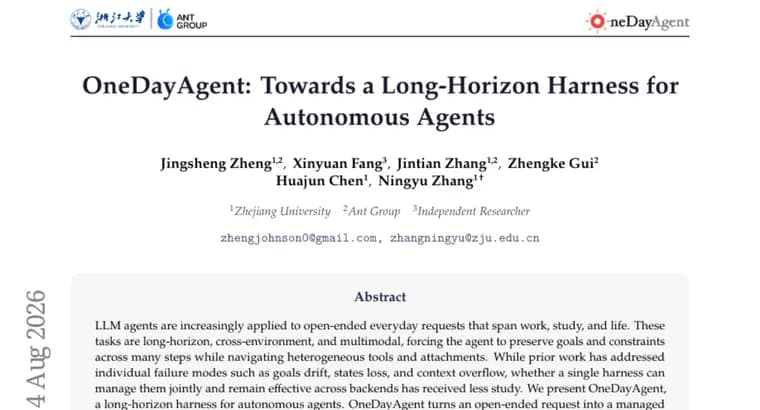
LLM-based agents are increasingly used for open-ended requests that span work, study, and everyday life. According to the researchers behind OneDayAgent, such tasks are long-horizon, cross-environment, and multimodal. That combination forces the agent to hold onto its goals and constraints over many steps while working with a mix of tools and attachments. Prior systems have addressed individual failure modes in that setting, such as goal drift, state loss, and context overflow, but whether a single harness can manage all of them together, and stay effective as the underlying model changes, has had less study, the researchers say.
The paper presents OneDayAgent, a harness that turns an open-ended request into what the researchers call a managed execution process. It decomposes the request into bounded subtasks, keeps the agent's execution memory intact under context pressure, and verifies and repairs the final deliverable before it is returned.
The researchers evaluate OneDayAgent on AgentIF-OneDay, a 104-task benchmark. Running on a GLM-5.2 backend, it reaches an overall score of 0.821, which the researchers describe as a new state of the art. The same harness, unchanged, also runs across five backend LLMs from three different model families; the researchers take this as evidence that the approach generalizes across backends without tuning, even though, in their own words, different models induce distinct execution styles under the same workflow.
Key facts
- OneDayAgent decomposes an open-ended request into bounded subtasks, keeps the agent's execution memory intact under context pressure, and verifies and repairs the final deliverable.
- On AgentIF-OneDay, a 104-task benchmark, OneDayAgent reaches an overall score of 0.821 with a GLM-5.2 backend, which the researchers call a new state of the art.
- The same harness runs unchanged across five backend LLMs from three different model families, without backend-specific tuning.
- The researchers note that different backend models produce distinct execution styles inside the same OneDayAgent workflow.
- The abstract reports only the GLM-5.2 result: no scores are given for the other four backends or for any prior state-of-the-art baseline.
Why it matters
AI agents built on top of LLMs are increasingly pointed at open-ended, everyday requests that span work, study, and life. According to the researchers, such tasks are long-horizon, cross-environment, and multimodal, and that combination forces the agent to hold onto its goals and constraints over many steps while working with a mix of tools and attachments. Earlier systems have addressed individual failure modes in that setting, such as goal drift, state loss, and context overflow, but whether one harness can manage all three together, and keep working as the underlying model changes, has had less study, the researchers say. OneDayAgent is presented as an attempt to close that gap with a single execution layer that is not tied to one specific failure mode or one specific backend model.
Who it affects
The people this affects most directly are researchers and engineers building autonomous LLM agents for multi-step, real-world tasks, the kind of open-ended work, study, and everyday requests a single prompt-and-response exchange cannot finish. It also speaks to teams evaluating or choosing backend LLMs for agentic use, since OneDayAgent is designed to sit on top of the model rather than being rebuilt for each one, and the paper reports it running across five backend LLMs from three model families. Benchmark designers and other agent-harness researchers are a third natural audience, given the direct, named evaluation on the AgentIF-OneDay benchmark.
How to use it
OneDayAgent is presented here as a research contribution rather than a released product. The abstract does not mention a code repository, a license, or any download or access link, and it does not say whether the harness or the AgentIF-OneDay benchmark itself will be made public. What is described is the design: an open-ended request is first split into bounded subtasks, the agent's execution memory is then preserved as it works through them under context pressure, and the finished deliverable is checked and repaired before being handed back. That workflow is reported to run unmodified on five different backend LLMs from three model families, which the researchers offer as evidence that it is not tied to a single vendor's model.
How solid is it
The central claim rests on one reported score: an overall 0.821 on the 104-task AgentIF-OneDay benchmark, achieved with a GLM-5.2 backend. The abstract does not give scores for the other four backend LLMs or the other two model families that were also tested, so the claim that the harness generalizes across backends is not backed by comparable numbers for every backend, only the statement that all five completed the workflow. The abstract also does not cite a prior or baseline state-of-the-art figure, so there is no way from the source alone to judge how large an improvement 0.821 represents. Nor does it say whether AgentIF-OneDay predates this paper or was introduced by the same researchers alongside their own harness, which matters for how independent the state-of-the-art claim is. The abstract text itself names no authors or institution, so there is no way to weigh the team's track record from the source.
Risks and caveats
The term long-horizon is never quantified in the abstract: no step count, time span, or token budget is given for the tasks involved, which makes it hard to judge from the source alone how long or complex these tasks really are. The researchers themselves note that different backend LLMs produce distinct execution styles under the same OneDayAgent workflow, which suggests behavior, and possibly reliability, can vary by backend even though all five completed the benchmark. The abstract also frames OneDayAgent as managing known failure modes (goal drift, state loss, and context overflow) within a bounded process rather than eliminating them outright, and it does not address how the harness performs on tasks or environments beyond the 104-task benchmark.