OneWM paper reports world modeling and action learning help each other
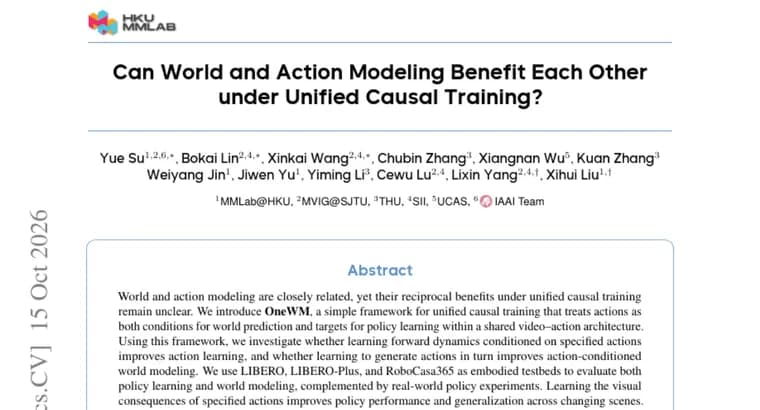
A paper on Hugging Face introduces OneWM, which its authors describe as a simple framework for unified causal training. The starting point is that world modeling (predicting what happens next) and action modeling (deciding what to do) are closely related, yet it has been unclear what each gains from the other when they are trained together under one causal setup.
OneWM treats actions in two roles at once, inside a single shared video-action architecture. Actions are conditions for world prediction, so the model learns what a specified action does to the scene. Actions are also targets for policy learning, so the same model learns to generate them.
With this framework the authors ask two questions. First, does learning forward dynamics conditioned on specified actions improve action learning? Second, does learning to generate actions in turn improve action-conditioned world modeling?
For testing, they use three embodied benchmarks, LIBERO, LIBERO-Plus and RoboCasa365, to evaluate both policy learning and world modeling. They add real-world policy experiments.
The reported answers are both yes. Learning the visual consequences of specified actions improves policy performance and generalization across changing scenes. In the other direction, action learning improves multi-view world-prediction fidelity under the same architecture. The authors conclude that these results support reciprocal benefits between world modeling and action generation under unified causal training.
The text available is the abstract only. It gives no numeric results, baselines or effect sizes, so the size of the gains is not stated.
Key facts
- OneWM is a framework for unified causal training that treats actions both as conditions for world prediction and as targets for policy learning, in one shared video-action architecture.
- The authors test two questions: whether action-conditioned forward dynamics improves action learning, and whether generating actions improves action-conditioned world modeling.
- They report that learning the visual consequences of specified actions improves policy performance and generalization across changing scenes.
- They also report that action learning improves multi-view world-prediction fidelity under the same architecture.
- Evaluation uses LIBERO, LIBERO-Plus and RoboCasa365 for both policy learning and world modeling, plus real-world policy experiments.
Why it matters
Robot learning often treats predicting the world and choosing actions as separate problems. This paper argues for training them together and reports a two-way benefit: knowing what actions do helps the policy, and learning to produce actions helps the world model. If the result holds up, it supports building one shared model for both jobs instead of two separate ones.
Who it affects
Mainly researchers working on robot policies, video-based world models and embodied benchmarks such as LIBERO, LIBERO-Plus and RoboCasa365. It is a research result and is not aimed at end users.
How to use it
There is nothing to install or run from the information available. No code or model release is mentioned. The practical takeaway for researchers is the design idea: condition world prediction on actions and also train the same architecture to generate those actions.
How solid is it
The claims come from the authors' own abstract of a preprint, and the evaluation covers three simulated benchmarks plus real-world policy experiments. The text gives no numeric results, metrics, baselines or effect sizes, and no details of the real-world robot experiments, so how large the improvements are cannot be judged from it.
Risks and caveats
The conclusion that both questions are answered positively is the authors' own. Without figures or comparison details, the strength of the benefit is unknown. The abstract names no model size, training data or compute, so it is unclear how costly the unified training is. Whether the gains carry beyond the tested benchmarks and the real-world experiments is not addressed.