OS-Omni benchmark finds Claude Opus 5.5 trails humans by 8.8 points
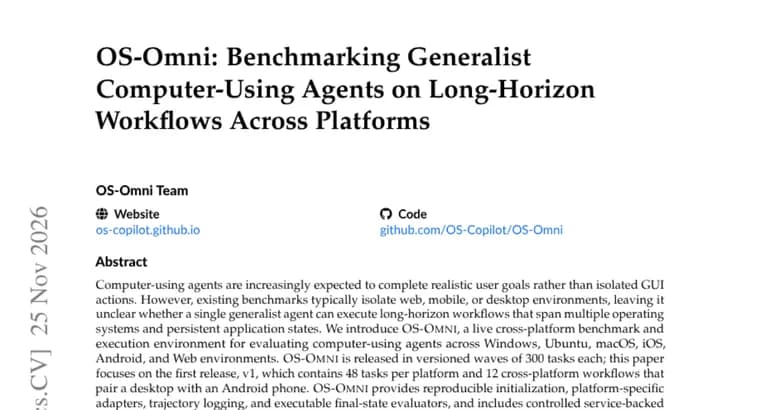
A research paper introduces OS-Omni, a live benchmark and execution environment for evaluating computer-using agents across Windows, Ubuntu, macOS, iOS, Android and the Web. The authors argue that agents are increasingly expected to complete realistic user goals rather than isolated interface actions. Existing benchmarks typically isolate web, mobile or desktop environments, which in their view leaves open whether one generalist agent can carry out long workflows that span several operating systems and keep track of persistent application state.
OS-Omni is released in versioned waves of 300 tasks each. The paper focuses on the first, v1, which contains 48 tasks per platform and 12 cross-platform workflows that pair a desktop with an Android phone. The environment provides reproducible initialization, platform-specific adapters, trajectory logging and executable evaluators that check the final state. It also includes controlled, service-backed applications for workflows involving persistent state such as accounts, carts, budgets, calendars and messages.
The tasks are long. According to the authors' human studies, OS-Omni tasks require 67.54 interaction steps, substantially more than the OSWorld reference of 15.0 steps.
On v1, the strongest evaluated agent, Claude Opus 5.5, reaches 68.5% average success. That is 8.8 percentage points below the human reference of 77.3%. The gap differs sharply by platform: frontier models exceed humans on Linux but trail them by more than 25 points on iOS and macOS.
The authors conclude that current agents remain far from long-horizon computer use that holds up across platforms, especially when success depends on sustained state tracking and durable changes to the final state.
Key facts
- OS-Omni evaluates computer-using agents across Windows, Ubuntu, macOS, iOS, Android and Web environments.
- Each versioned wave has 300 tasks; v1 contains 48 tasks per platform and 12 workflows that pair a desktop with an Android phone.
- Human studies put the tasks at 67.54 interaction steps, compared with an OSWorld reference of 15.0.
- Claude Opus 5.5, the strongest evaluated agent, averages 68.5% success on v1; the human reference is 77.3%.
- Frontier models beat humans on Linux but trail them by more than 25 points on iOS and macOS.
Why it matters
According to the authors, existing benchmarks typically test web, mobile or desktop environments in isolation. OS-Omni is meant to show whether a single generalist agent can handle long workflows across operating systems while application state persists. Its tasks are also much longer than the comparison point: 67.54 interaction steps against an OSWorld reference of 15.0.
Who it affects
The work is most relevant to teams that build or evaluate computer-using agents, particularly ones expected to operate on more than one operating system. For anyone relying on such agents on iOS or macOS, the reported deficit of more than 25 points against humans is the figure to watch. The lead over humans on Linux shows that a result on one platform may not carry over to another.
How to use it
The benchmark's design is a useful reference for agent testing: reproducible initialization, an adapter for each platform, logged trajectories and evaluators that execute checks on the final state. Service-backed applications let tests cover accounts, carts, budgets, calendars and messages, where success depends on changes that last. The abstract mentions no code, dataset link, license or availability terms.
How solid is it
These are results reported by the paper's authors, and the account here rests on the abstract. Claude Opus 5.5 is the only evaluated agent it names, and it gives no per-platform success rates. The number and background of the human study participants are not given. The abstract also does not say whether the step counts of 67.54 and 15.0 are means or medians.
Risks and caveats
The 68.5% figure is an average over v1 and hides uneven performance: ahead of humans on Linux, far behind on iOS and macOS. The 8.8-point gap therefore says little about any single platform. The scores belong to the first release, and OS-Omni is designed to ship in versioned waves, so results should be cited with the version attached.
“These results indicate that current agents remain far from platform-robust, long-horizon computer use, especially when success requires sustained state tracking and durable final-state changes.”
— OS-Omni paper abstract