Paper traces Gated DeltaNet-2 training failures to erasure
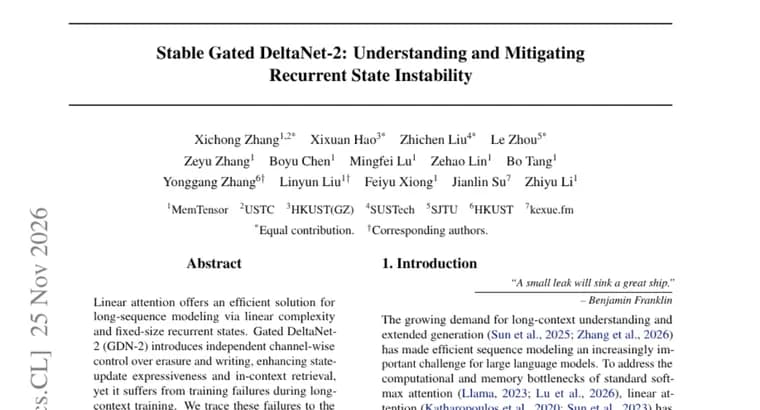
A paper titled "Stable Gated DeltaNet-2: Understanding and Mitigating Recurrent State Instability" examines why Gated DeltaNet-2 (GDN-2), a linear attention design, fails during long-context training. The authors describe linear attention as an efficient option for long-sequence modeling because it has linear complexity and fixed-size recurrent states. GDN-2 adds independent channel-wise control over erasing and writing, which they say makes state updates more expressive and improves in-context retrieval.
The authors trace the failures to the erase step. The direction used to read the state differs from the direction used to modify it, and that asymmetry produces non-normal erase operators. Their directional gains accumulate from token to token, so the recurrent state can grow exponentially even when nothing new is being written to it.
The proposed fix has two parts. Symmetric erasure keeps state propagation non-expansive, and decay-regulated residual writing preserves flexibility in what gets written. In theory, the authors establish an O(T) upper bound on recurrent state growth while keeping chunkwise parallel computation.
In experiments on models of about 1.6B parameters, the authors report that the method trains stably and retrieves better over long contexts. Against GDN-2, it raises the average RULER score at 128K context by 6.80 points in the recurrent setting. In the hybrid setting, it raises average accuracy across nine downstream tasks by 0.62 points.
Key facts
- The paper links GDN-2's long-context training failures to an asymmetry between the reading and modification directions during erasure.
- According to the authors, this can drive exponential growth of the recurrent state even without new writes.
- The fix combines symmetric erasure with decay-regulated residual writing and comes with an O(T) upper bound on state growth.
- On models of about 1.6B parameters, the 128K average RULER score rose 6.80 points over GDN-2 in the recurrent setting.
- Average accuracy across nine downstream tasks rose 0.62 points over GDN-2 in the hybrid setting.
Why it matters
Linear attention appeals for long sequences because its complexity is linear and its recurrent state stays a fixed size. The authors say GDN-2 gained expressiveness and better in-context retrieval through separate control of erasing and writing, but fails during long-context training. Their contribution is a stated mechanism for those failures, asymmetric erasure that lets the state blow up, together with a design change aimed directly at it.
Who it affects
The work is most relevant to researchers and engineers who build or train linear attention models, especially anyone using GDN-2 on long contexts. People studying how recurrent state updates behave over many tokens also get an analysis of one route to instability.
How to use it
The design idea to take away is to make erasure symmetric, so that state propagation cannot expand, and to pair it with decay-regulated residual writing so the model keeps freedom in how it writes. The authors say chunkwise parallel computation is retained. No code, model weights or repository is mentioned in the abstract.
How solid is it
The claims come from the authors and combine a theoretical bound on state growth with experiments on models of about 1.6B parameters. The reported gains are 6.80 points on the 128K average RULER score and 0.62 points in average accuracy over nine downstream tasks, both measured against GDN-2. This account rests on the paper's short abstract, which gives the differences but not the absolute scores.
Risks and caveats
The two headline gains come from different settings, recurrent for RULER and hybrid for the downstream tasks, and the abstract defines neither. It does not list the nine tasks, and it reports no comparison with models other than GDN-2. It also gives no speed, memory or compute cost measurements, and no figure for how often GDN-2 training fails. The downstream gain of 0.62 points is much smaller than the RULER gain, though the two measure different things.
“We trace these failures to the asymmetry between reading and modification directions during erasure, which yields non-normal erase operators whose directional gains accumulate across tokens, triggering exponential state growth even without new writes.”
— The paper's abstract