Paint-Anything adds exact hex-color control to image models
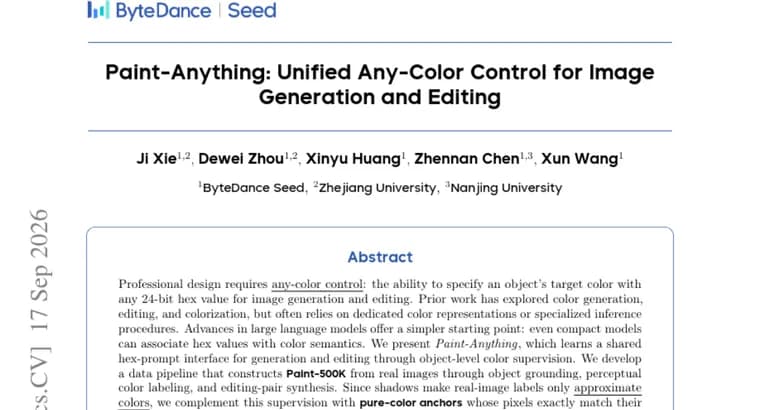
Researchers present Paint-Anything, a method that gives image generation and editing models any-color control: the ability to specify an object's target color with any 24-bit hex value, rather than a rough color name or swatch. The approach learns a shared hex-prompt interface for both generation and editing through object-level color supervision, building on the observation that even compact language models can already associate hex values with color semantics.
To train it, the team built a dataset called Paint-500K from real images through a three-step pipeline: object grounding, perceptual color labeling, and editing-pair synthesis. Because shadows and lighting make color labels on real images only approximate, the team added pure-color anchors, synthetic examples whose pixels exactly match their paired hex values. These anchors are used only at high-noise timesteps during training, while low-noise training stays on the natural, real-image data.
The team also introduces a new evaluation suite, the Any Color Benchmark (ACBench), split into ACBench-T2I for text-to-image generation and ACBench-Edit for editing, both built to measure how faithfully a model reproduces a requested hex color at the object level. Applied to the FLUX.2-4B base model, Paint-Anything improves the ACBench-T2I score by 85.3% and the ACBench-Edit score by 28.3%, both relative to the unmodified base model. Ablation experiments in the paper support the individual pieces of the training recipe. The method also reaches the highest average CompColor score among the methods it was compared against, though the paper does not name those methods or give their absolute scores.
Key facts
- Paint-Anything gives generation and editing models control over an object's color via any 24-bit hex value, through a shared hex-prompt interface.
- It is trained on Paint-500K, a dataset built from real images via object grounding, perceptual color labeling and editing-pair synthesis, supplemented with pure-color synthetic anchors used only at high-noise training steps.
- The team introduces the Any Color Benchmark (ACBench), with T2I and Edit tracks, to measure object-level hex color fidelity.
- On the FLUX.2-4B base model, it improves ACBench-T2I by 85.3% and ACBench-Edit by 28.3%, both relative to the base model, and posts the highest average CompColor score among compared methods.
- The paper gives only relative improvements, not absolute benchmark scores, and does not name the other methods it was compared against.
Why it matters
Color in generated or edited images has mostly been approximate: a prompt can ask for "red" or "a warm orange," but not for a precise, reproducible shade. Paint-Anything closes that gap by letting a prompt specify an exact 24-bit hex value per object, the same precision designers already work with in other tools, and by handling generation and editing through one shared interface rather than two separate systems.
Who it affects
The immediate audience is designers and content creators who need brand-accurate or spec-accurate colors out of a generative model rather than an approximate match, plus researchers building or evaluating color-controllable generation and editing systems. The demonstrated gains are on FLUX.2-4B specifically; the paper does not state whether the method has been applied to other base models.
How to use it
Paint-Anything is presented as a training method and dataset/benchmark contribution rather than a packaged product. The paper does not state a code release, license or dataset availability, so at this point it exists as a research description rather than something to install or call directly.
How solid is it
The gains are measured on benchmarks the same team built for this paper, ACBench-T2I and ACBench-Edit, plus a CompColor score, and are reported as relative improvements over the base model (85.3% and 28.3%) rather than absolute figures. The paper includes ablations supporting individual parts of the training recipe, and reports the highest average CompColor score among the methods it compares against, but does not name those methods or give their scores.
Risks and caveats
The evaluation runs on a benchmark introduced in the same paper, which makes it harder to judge fidelity against outside methods until absolute scores or third-party comparisons appear. The training relies partly on synthetic pure-color anchors rather than only real photographs; the paper limits their use to high-noise timesteps specifically to avoid distorting how the model learns from natural images with shadows and lighting.
“even compact models can associate hex values with color semantics”
— the researchers