Paper finds causal neuron groups are rarely all needed and transfer poorly
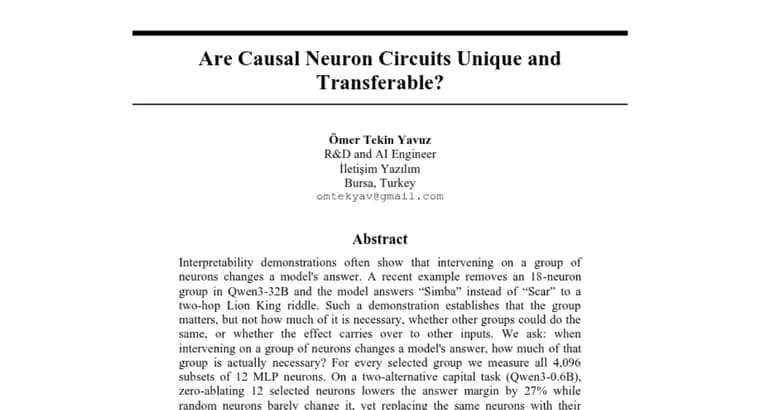
Interpretability demonstrations often show that intervening on a group of neurons changes a model's answer. The paper starts from a recent example that removes an 18-neuron group in Qwen3-32B, after which the model answers "Simba" instead of "Scar" to a two-hop Lion King riddle. The authors argue that such a demonstration shows the group matters, but not how much of it is necessary, whether other groups could do the same, or whether the effect carries over to other inputs. Their question: when intervening on a group changes the answer, how much of that group is actually necessary?
To find out, they measure all 4,096 subsets of 12 MLP neurons for every selected group. The experiments use small models: Qwen3-0.6B, Qwen3-1.7B, Llama-3.2-1B and Gemma-3-1B. No result is reported for Qwen3-32B itself.
On a two-alternative capital task in Qwen3-0.6B, zero-ablating 12 selected neurons lowers the answer margin by 27%, while random neurons barely change it. Yet replacing the same neurons with their values from other questions also barely changes the margin. Their activations are nearly constant across questions, and the authors find no evidence that they carry question-specific content.
On two-hop relation chains, the team patched 12 neurons with activations from the first-hop question. That shifts the answer to the bridge entity (from Scar to Simba in the example). The greedy answer starts with the bridge in 9 of 11 chains for Qwen3-1.7B, 9 of 11 for Llama-3.2-1B and 8 of 10 for Gemma-3-1B. Random neurons never do this.
The central finding is that the full group is rarely necessary: a few neurons often suffice. In many chains, disjoint subsets each flip the answer on their own; in an exploratory analysis, this happens most often when the model is less confident. Group effects transfer to rephrasings of the same chain but are much weaker on other tested chains.
The authors state the limit of the work: they study neuron-level causal interventions and alternative subsets, and they do not recover the full connectivity of circuits.
Key facts
- For every selected group, the authors measure all 4,096 subsets of 12 MLP neurons, in Qwen3-0.6B, Qwen3-1.7B, Llama-3.2-1B and Gemma-3-1B.
- In Qwen3-0.6B on a two-alternative capital task, zero-ablating 12 selected neurons cuts the answer margin by 27%, but swapping in their values from other questions barely changes it, since their activations are nearly constant.
- Patching 12 neurons with first-hop activations moves the greedy answer to the bridge entity in 9/11 chains (Qwen3-1.7B), 9/11 (Llama-3.2-1B) and 8/10 (Gemma-3-1B); random neurons never do.
- The full group is rarely necessary, and in many chains disjoint subsets each flip the answer alone, most often when the model is less confident.
- Effects carry over to rephrasings of the same chain but are much weaker on other tested chains.
Why it matters
Neuron-ablation demos are a common way to argue that a model's behaviour lives in a specific group of neurons. This paper says such a demo shows only that the group matters. It does not show how much of the group is needed, whether other groups could do the same job, or whether the result holds on other inputs. The reported results suggest that a group's necessity can be overstated: a few neurons often suffice, and separate subsets can each flip the same answer.
Who it affects
Mainly researchers who run causal interventions on model internals and who read or write claims about neuron groups and circuits. The experiments are on small models (Qwen3-0.6B, Qwen3-1.7B, Llama-3.2-1B, Gemma-3-1B), so the findings speak most directly to that kind of setup.
How to use it
The paper's design is a template for checking an intervention result: measure subsets of the group rather than only the whole group, compare against random neurons, test whether swapping in values from other questions changes anything, and test on rephrasings and on other chains. No code or dataset release is mentioned.
How solid is it
The source is the paper's abstract on Hugging Face. The measurements are exhaustive within each selected group (all 4,096 subsets of 12 neurons), and random neurons serve as a control. The samples are small, though: 11, 11 and 10 two-hop chains for the three models in the patching experiment. The abstract describes the subset analysis tied to model confidence as exploratory.
Risks and caveats
The authors say they study neuron-level causal interventions and alternative subsets, and do not recover the full connectivity of circuits. No result is reported for Qwen3-32B, the model in the demonstration the paper critiques. The abstract does not say how the 12 neurons were selected beyond calling them selected groups. Transfer to other chains is described only as much weaker on the tested chains, not as absent.
“The full group is rarely necessary: a few neurons often suffice”
— Paper abstract, Hugging Face