PhysOPSD trains video models on physics using simulation code
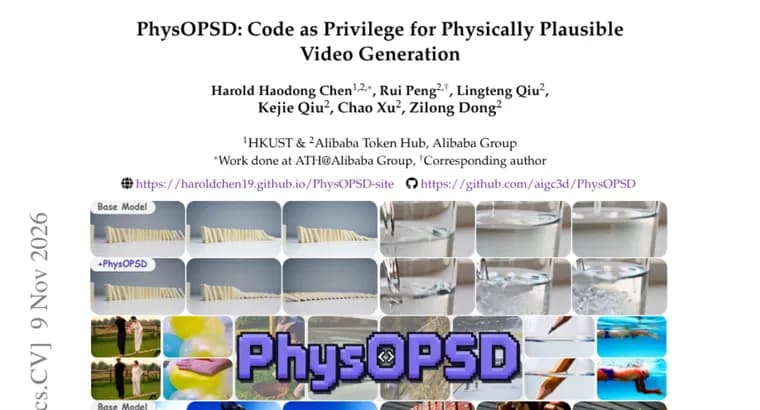
The paper starts from a familiar weakness. Modern video generative models reach remarkable visual fidelity, but they stay noticeably brittle when asked to produce physically plausible dynamics and complex interactions. Targeted post-training is crucial, the authors say, yet both standard routes have problems: supervised fine-tuning (SFT) suffers from offline state mismatch, and reinforcement learning (RL) is hindered by sparse, ill-defined physical reward functions.
The authors turn to On-Policy (Self-)Distillation (OPSD), which they say reconciles on-policy rollouts with dense corrective feedback. That shifts the core challenge to designing effective privileged context, meaning the extra information the teacher side can see. Conventional choices fall short, they argue: text prompts are inherently declarative, while real reference videos heavily entangle physical laws with visual appearance and offer no parametric control.
Their answer is PhysOPSD, which introduces executable code as the privileged physical context for video generation. The claim is that, unlike static visual observations, executable code instantiates an editable physical world with intrinsic abstraction and controllability. A component called PhysOPSD-Engine translates real-world physical scenarios into verifiable simulation programs.
PhysOPSD then adds two ingredients. The first is dual-level physical privilege, which bridges the information gap through an intermediate bottleneck. The second is controlled physical variations under shared rollout noise, intended to expose causal dynamic shifts.
On results, the authors report that extensive experiments show PhysOPSD substantially improves physical plausibility across diverse backbones. It outperforms SFT and RL baselines with only 3K samples, while preserving general video generation quality.
Key facts
- PhysOPSD is a post-training method for video generative models that uses executable code as privileged physical context in On-Policy (Self-)Distillation.
- The authors say SFT suffers from offline state mismatch and RL from sparse, ill-defined physical reward functions; text prompts and real reference videos are also poor privileged context.
- PhysOPSD-Engine translates real-world physical scenarios into verifiable simulation programs.
- The method combines dual-level physical privilege via an intermediate bottleneck with controlled physical variations under shared rollout noise.
- The authors report gains in physical plausibility across diverse backbones, beating SFT and RL baselines with only 3K samples while preserving general video quality.
Why it matters
Video generators can look convincing and still get physics wrong, and the paper treats that as a post-training problem. Its contribution is a choice of privileged context: instead of text or reference footage, the teacher side gets simulation code that describes an editable physical world. If the claim holds, a small set of 3K samples is enough to beat SFT and RL baselines, which would make physics-focused post-training cheaper than the alternatives the authors describe.
Who it affects
Researchers and teams that post-train video generative models, especially those struggling with physically plausible motion and complex interactions. It is also relevant to anyone working on on-policy distillation, since the paper argues the key design question is the privileged context. The source names no specific products or labs.
How to use it
This is a research proposal, not a product. The source describes the recipe at a high level: turn physical scenarios into simulation programs with PhysOPSD-Engine, then use them as privileged context with dual-level physical privilege and controlled physical variations under shared rollout noise. The source does not mention a release of code, models or datasets.
How solid is it
The evidence is the authors' own summary: they say extensive experiments show substantial gains across diverse backbones and an edge over SFT and RL baselines with only 3K samples. The source gives no benchmark names or metric values, and describes the improvement only as substantial, so the size of the gain over the baselines is not quantified. It is a preprint summary, not an independent evaluation.
Risks and caveats
The headline claims rest on an abstract-level description, so the strength of the results cannot be judged from it. The source does not name the backbone models, and it does not specify the simulation engine or programming language used for the simulation programs. The claim that general video quality is preserved is likewise stated without figures.
“Unlike static visual observations, executable code instantiates an editable physical world with intrinsic abstraction and controllability.”
— PhysOPSD paper abstract