Paper finds S-Space, a linear spatial workspace inside multimodal LLMs
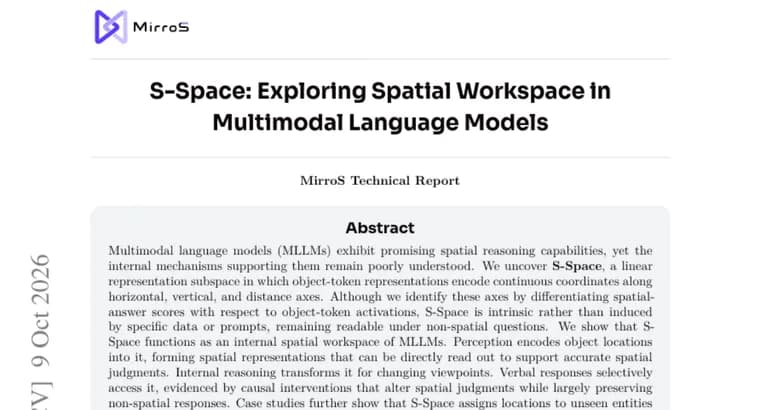
Multimodal language models (MLLMs) show promising spatial reasoning, but the internal mechanisms behind it remain poorly understood. A paper listed on Hugging Face Papers reports S-Space, a linear representation subspace in which object-token representations encode continuous coordinates along horizontal, vertical and distance axes.
The authors identify these axes by differentiating spatial-answer scores with respect to object-token activations. They say S-Space is nonetheless intrinsic rather than induced by specific data or prompts, and that it stays readable under non-spatial questions.
The central claim is that S-Space works as an internal spatial workspace of MLLMs. Perception encodes object locations into it, producing spatial representations that can be read out directly to support accurate spatial judgments. Internal reasoning transforms it when the viewpoint changes. Verbal responses selectively access it, and the evidence is causal interventions that alter spatial judgments while largely preserving non-spatial responses.
Case studies extend the picture. S-Space assigns locations to unseen entities and to the observer, and it connects physical directions with abstract linguistic meanings. The authors say this suggests both the capabilities and the limitations of large-scale language training.
Finally, the paper uses S-Space as a diagnostic tool for spatial reasoning failures. Direction-word readouts reveal systematic coupling between cardinal and image-relative reference frames. A perception-computation decomposition exposes what the authors call a key bottleneck: MLLMs can form capable spatial representations, yet fall short in the spatial transformations required to reason reliably across viewpoint changes.
Key facts
- S-Space is a linear representation subspace in which object-token representations encode continuous coordinates along horizontal, vertical and distance axes.
- The axes are found by differentiating spatial-answer scores with respect to object-token activations, yet the authors describe S-Space as intrinsic rather than induced by specific data or prompts.
- Causal interventions on S-Space alter spatial judgments while largely preserving non-spatial responses, which the authors take as evidence that verbal responses selectively access it.
- Direction-word readouts reveal systematic coupling between cardinal and image-relative reference frames.
- The diagnosed bottleneck: MLLMs form capable spatial representations but fall short in the spatial transformations needed to reason reliably across viewpoint changes.
Why it matters
Spatial reasoning is something MLLMs appear to do reasonably well, but how they do it internally has been unclear. This paper offers a concrete, linear structure that carries object positions, and ties it to the three stages of an answer: perception writes locations in, internal reasoning transforms them, and verbal responses read them out. It also localises a failure: the weak step is the spatial transformation across viewpoint changes, not the representation of space itself.
Who it affects
Mainly researchers working on interpretability and spatial reasoning in multimodal language models, who get a candidate internal workspace to probe and intervene on. It is also relevant to anyone trying to understand why such models make mistakes when the viewpoint changes.
How to use it
The paper itself uses S-Space as a diagnostic tool for spatial reasoning failures, for example through direction-word readouts and a perception-computation decomposition. No code, dataset or release is mentioned in the source, so there is nothing to download or run from the abstract alone.
How solid is it
The claims are the authors' own, drawn from the paper's abstract. They rest on causal interventions that change spatial judgments while largely leaving non-spatial responses intact. The abstract names no specific models, model sizes or benchmarks, and gives no quantitative results, so the strength of the effects cannot be judged from it.
Risks and caveats
The authors frame the findings as a diagnosis, not a fix: the abstract does not say that the viewpoint-transformation bottleneck has been resolved or how it could be. Their case-study conclusions about the capabilities and limitations of large-scale language training are described as suggestive. Details such as which models were tested are not given in the source.
“MLLMs can form capable spatial representations, yet fall short in the spatial transformations required to reason reliably across viewpoint changes.”
— Paper abstract, Hugging Face Papers 2610.13527