Philadelphia activists demand AI data center moratorium amid US pushback
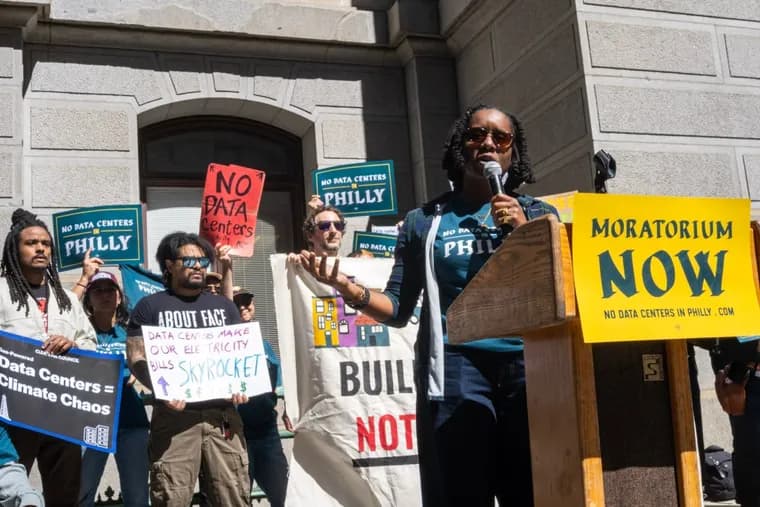
In Southwest Philadelphia's Grays Ferry neighborhood, activist Shawmar Pitts grew up next to what was then the East Coast's largest oil refinery, which closed after an explosion in 2019. Many of his friends and family had chronic health problems, and the connection did not click for him until 2018, when the environmental justice group Philly Thrive set up a table in his neighborhood about a proposed refinery expansion and laid out a list of illnesses tied to living nearby; he recognized his mother, his sister and his neighbors on that list, and the encounter pulled him into activism. Pitts is now Philly Thrive's managing co-director, and he is among those pushing Philadelphia toward a moratorium on new AI data centers. No formal data center proposal has been filed in the city, but officials have identified two potential sites: one in Northeast Philadelphia, the other in Pitts' own Grays Ferry.
Philadelphia is not alone. Across the US, residents, especially in cities and towns with limited resources, have pushed back against new data center construction, and the resistance has been strongest in places still marked by heavy industry. At a Monday rally at Philadelphia's City Hall, Philly Thrive board president Sonya Sanders, herself a Grays Ferry resident, told the crowd: 'We don't want data centers. We don't want the pollution, we don't want the noise, and we know they're not going to bring us more jobs.' Sanders said her husband, who neither smoked nor drank, died of a rare bone cancer in 2020, and she believes refinery emissions caused his illness; at the rally, she said 'the pursuit of profit' was ultimately what killed him.
The data center under discussion in Philadelphia would likely not match the environmental footprint of the now-defunct Philadelphia Energy Solutions refinery, which had processed up to 335,000 barrels of crude oil a day, but the numbers behind the broader AI buildout are large and rising fast. BloombergNEF now projects that by 2035, US data centers will consume more natural gas than Germany and Japan combined, a projection almost double what the firm had estimated only nine months earlier. Natural gas burns cleaner than oil, but burning one cubic foot of it still releases the equivalent of 60 grams of carbon dioxide, and the added data center demand is expected to generate an extra 1 million metric tons of greenhouse gas pollution a day, about 12% of all present day US emissions. Separately, a 2021 Harvard University study found that fossil fuel air pollution is responsible for one in five deaths worldwide; that figure predates the AI boom and is not specific to data centers, though the article argues it is likely to climb as AI-driven energy demand grows.
Clean Air Council attorney Annie Fox told the rally that a typical data center planned in Pennsylvania carries hundreds of diesel engines that emit air pollution. They are nominally kept for emergencies, she said, but the government has already indicated the data center should run them instead of drawing on an overstressed electrical grid during some heat waves, a pattern she expects to grow more common as fossil fuel hungry data centers worsen climate change and intensify heat waves themselves.
Officials elsewhere are already responding. New York Governor Kathy Hochul signed an executive order temporarily blocking the state from approving new permits for large projects, saying data centers should only be built in places that want them and that progress should not come with a higher utility bill, a strained water supply or noise pollution. Data center moratoriums have also been approved in Denver, Indianapolis, Asheville, Charlotte and Reno. Philadelphia is not among them: no formal data center proposal has been filed there yet, and the moratorium Pitts and Philly Thrive are seeking would still need to be adopted, not merely enforced.
More than 100 people attended the kickoff rally for the 'No Data Centers in Philly' campaign outside City Hall. Philadelphia resident Donna Greenberg, who attended, said she worries about pollution, about surveillance and data centers gaining access to information they have no business holding, and about water and electricity being diverted from neighborhoods that need them. 'I just think that our community standing up and fighting back is tremendous,' Pitts said. 'It takes a lot of effort and a lot of people.'
Key facts
- City officials have identified two potential Philadelphia data center sites, one in Northeast Philadelphia and one in Grays Ferry, where activist Shawmar Pitts grew up beside what was then the East Coast's largest oil refinery before it closed after a 2019 explosion; no formal proposal has been filed yet.
- BloombergNEF projects that by 2035, US data centers will consume more natural gas than Germany and Japan combined, a figure almost double the firm's own estimate from nine months earlier.
- The added data center demand is expected to generate about 1 million extra metric tons of greenhouse gas pollution a day, roughly 12% of all present day US emissions, and a typical Pennsylvania data center carries hundreds of diesel backup engines, per Clean Air Council attorney Annie Fox.
- New York Governor Kathy Hochul signed an executive order temporarily halting new permits for large projects, joining data center moratoriums already approved in Denver, Indianapolis, Asheville, Charlotte and Reno, though not yet in Philadelphia.
- More than 100 people attended the kickoff rally for Philadelphia's 'No Data Centers in Philly' campaign at City Hall, where Philly Thrive board president Sonya Sanders said she believes emissions from a refinery caused her husband's death from bone cancer in 2020.
Why it matters
AI's data center boom is running into neighborhoods that already absorbed the cost of heavy industry, and the mismatch looks like a national pattern rather than one local dispute. BloombergNEF now projects that by 2035, US data centers will burn more natural gas than Germany and Japan combined, a figure almost double the firm's own estimate from nine months earlier; the added demand is expected to generate about 1 million extra metric tons of greenhouse gas pollution a day, roughly 12% of current US emissions. Grays Ferry sits next to the site of what was then the East Coast's largest oil refinery, which closed after a 2019 explosion, and residents there are now being asked to accept a new industrial-scale neighbor on the promise of jobs and growth, a pitch that, per the article, has not won over a majority of Americans who oppose data center construction in their own area.
Who it affects
Residents of Philadelphia's Grays Ferry and Northeast Philadelphia, the two neighborhoods officials have flagged as potential data center sites, are the immediate stakeholders, along with the activists organizing against the plans, Shawmar Pitts and Sonya Sanders of Philly Thrive chief among them. The pattern reaches well beyond Philadelphia: New York State, now under Governor Kathy Hochul's temporary freeze on large-project permits, and residents of Denver, Indianapolis, Asheville, Charlotte and Reno, where data center moratoriums are already in place. It also touches the data center industry and its customers, who are promising jobs and economic growth, and utility ratepayers who could face a strained electrical grid during heat waves as facilities lean on backup diesel generators.
How to use it
There's no product or price to weigh here, but the piece maps out the playbook other communities are using against data center buildout: organize locally the way Philly Thrive has, push city council toward a moratorium ordinance like the ones already in Denver, Indianapolis, Asheville, Charlotte and Reno, or press a state government for a permit freeze like New York's executive order. For Philadelphia specifically, nothing is decided yet: only two sites have been flagged and no formal proposal exists, so residents and officials following the story should watch for whether the city adopts a moratorium before, rather than after, a data center proposal lands.
How solid is it
The reporting rests on TechCrunch's own interviews and on-the-record quotes from named activists, a Clean Air Council attorney and Governor Hochul, plus one attributed projection (BloombergNEF) and one attributed academic finding (a 2021 Harvard University study). Two things are worth separating from the reporting itself: the claim that a majority of Americans oppose data center construction near them is stated without a cited poll or survey, and the Harvard finding, that fossil fuel air pollution causes one in five deaths worldwide, is a general, pre-AI statistic; the article's own suggestion that the number is 'bound to increase in the age of AI' is the article's inference, not part of the Harvard research. Sonya Sanders' belief that refinery emissions caused her husband's 2020 death is presented explicitly as her belief, not as an independently confirmed medical finding.
Risks and caveats
A few things the article leaves unresolved. It never explicitly confirms that the unnamed refinery from Pitts' childhood, closed after a 2019 explosion, is the same site as the 'now-defunct Philadelphia Energy Solutions refinery' cited later for its 335,000-barrel-a-day capacity; the two appear connected but the text does not say so directly. Philadelphia itself has not adopted a moratorium and has no formal data center proposal on the table, only two flagged sites; it is not among the five cities named as already having approved one. Neither Hochul's executive order nor any of the five city moratoriums comes with a stated duration or review date in the article. And the death of Sonya Sanders' husband, who is not named in the piece, is attributed to refinery emissions only as her personal belief.
“The pollution killed him. I believe he would be here today if he wasn't silently murdered, because it was the pursuit of profit that killed him.”
— Sonya Sanders, Philly Thrive board president, at a Philadelphia rally