PhysBrain 1.5 sets new open-source state of the art on embodied AI
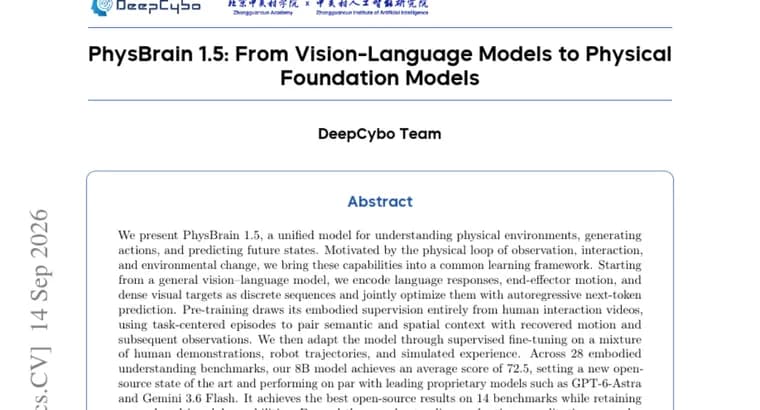
PhysBrain 1.5 is presented as a single model for three tasks that embodied-AI systems usually split across separate components: understanding a physical environment, generating the actions needed to act in it, and predicting how the scene will change next. The authors build it around what they call the physical loop of observation, interaction, and environmental change, folding all three capabilities into one learning framework. Starting from a general vision-language model, they encode language responses, end-effector motion, and dense visual targets as discrete token sequences and optimize them jointly with the same autoregressive next-token prediction used to predict text.
Training happens in two stages. Pre-training draws its embodied supervision entirely from human interaction videos, using task-centered episodes that pair a task's semantic and spatial context with the recovered motion and the observations that follow it. The model is then adapted through supervised fine-tuning on a mixture of human demonstrations, robot trajectories, and simulated experience.
On 28 embodied understanding benchmarks, the 8-billion-parameter version of PhysBrain 1.5 averages a score of 72.5, which the authors call a new open-source state of the art. It posts the best open-source result on 14 of those 28 benchmarks individually, and its average score matches leading proprietary models the authors name as GPT-6-Astra and Gemini 3.6 Flash, a comparison the text does not back with numeric scores for either of those two systems. The authors say the model keeps its general multimodal capabilities alongside these embodied-specific results.
Beyond the benchmark scores, the authors show qualitative examples of the model producing end-effector motion trajectories for a robot and predicting future scenes as spatially aligned RGB, depth, and robot-mask outputs together.
Key facts
- PhysBrain 1.5 is a single model that understands physical environments, generates robot actions, and predicts future states, trained with one autoregressive objective instead of separate systems for each task.
- Pre-training draws its embodied supervision entirely from human interaction videos; fine-tuning then mixes human demonstrations, robot trajectories, and simulated experience.
- The 8-billion-parameter model averages 72.5 across 28 embodied understanding benchmarks, the best open-source score on 14 of them, which the authors call a new open-source state of the art.
- Its average score matches proprietary models the authors name as GPT-6-Astra and Gemini 3.6 Flash, though the text gives no numeric scores for either of those two systems.
- The authors also show qualitative examples of the model generating robot end-effector trajectories and predicting future scenes as aligned RGB, depth, and robot-mask outputs.
Why it matters
PhysBrain 1.5 is framed around what the authors call the physical loop of observation, interaction, and environmental change: understanding a scene, generating the actions to act in it, and predicting how the scene will change next, folded into one model trained with a single autoregressive objective rather than three separate systems. On that basis, the 8-billion-parameter version reaches an average score of 72.5 across 28 embodied understanding benchmarks, which the authors call a new open-source state of the art, and they report its average performance matches proprietary systems they name as GPT-6-Astra and Gemini 3.6 Flash, while the model keeps its general multimodal capabilities alongside the embodied-specific results.
Who it affects
The paper speaks to robotics and embodied-AI researchers building generalist robot policies, and to anyone comparing open-source options against proprietary embodied and multimodal systems: the authors position the model's benchmark average directly against proprietary systems they name as GPT-6-Astra and Gemini 3.6 Flash. The text does not say who built PhysBrain 1.5 or name any company, lab, or institution behind it.
How to use it
The text gives no information about how to access PhysBrain 1.5: nothing is said about whether the model's weights, code, or training data are or will be released. What exists publicly for now is the paper itself, posted as a Hugging Face Papers listing; anyone wanting to run or build on the model would need to watch for a separate release announcement, since none is described here.
How solid is it
The claims come entirely from the authors' own paper: the 72.5 average, the best open-source result on 14 of 28 benchmarks, and the comparison to GPT-6-Astra and Gemini 3.6 Flash are all self-reported. No numeric scores are given for those two proprietary systems, so the on-par comparison cannot be checked against published numbers from the text alone, and the 28 benchmarks are not individually named, so the specific results are not verifiable against a public leaderboard from what is stated here. The text also does not name the individual authors, an institution, or a publication date (a crawler-sourced 'DeepCybo Team' label is not present in the article text itself), leaving little basis for judging the team's track record.
Risks and caveats
Because the benchmark numbers and the comparison to proprietary systems are self-reported and unaccompanied by third-party scores, the state-of-the-art and on-par claims rest on the authors' own framing rather than an independently reproducible comparison. The text gives no training compute, dataset size, or training duration, so there is no way to gauge how resource-intensive the result was or how it might scale. It also says nothing about releasing the model's weights, code, or training data, so outside groups cannot yet reproduce or stress-test these numbers, and the qualitative trajectory and future-scene examples are described but not quantified.
“Across 28 embodied understanding benchmarks, our 8B model achieves an average score of 72.5, setting a new open-source state of the art and performing on par with leading proprietary models such as GPT-6-Astra and Gemini 3.6 Flash.”
— the PhysBrain 1.5 paper