PixelMatte adapts pixel-space diffusion transformers for image matting
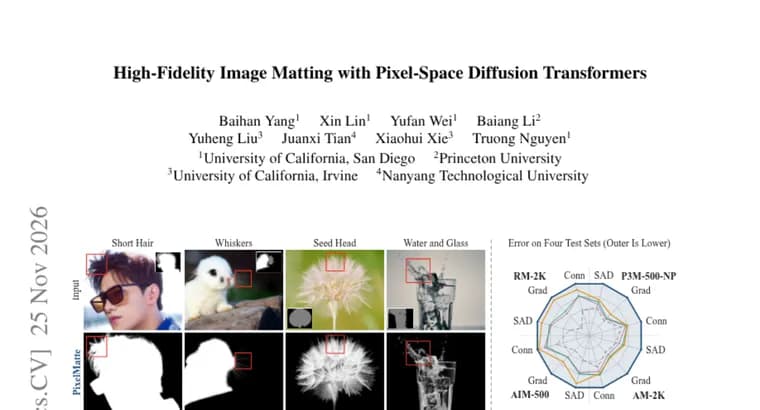
A paper listed on Hugging Face Papers presents PixelMatte, a framework that adapts pretrained pixel-space diffusion transformers for high-fidelity image matting, the task of predicting an alpha matte for an image.
The authors start from a problem with current practice. Diffusion models have shown strong potential for matting because they carry over generative priors learned in large-scale pretraining. But existing approaches largely rely on latent diffusion models, and the authors argue that their compressed representations and VAE-based reconstruction do not match the high-frequency precision that matting requires. PixelMatte instead predicts directly in pixel space.
It reuses the backbone's native patch embedding to process the input image, the trimap and the noisy alpha matte together, as spatially aligned tokens. This allows direct pixel-space prediction without additional condition encoders or adapters. Training uses pixel-accurate synthetic supervision followed by fine-tuning on real images, and the resulting model predicts alpha mattes in a single forward pass. Two lightweight calibration modules, called LayerShift and High-Pass Refiner, further improve regional opacity accuracy and boundary fidelity.
The authors also report that strong image-conditioned matting ability can be acquired even from a pure text-to-image model, without paired image-to-image pretraining.
Experiments span four benchmarks and two distinct pixel diffusion backbones. The authors report substantial improvements over existing methods: on P3M-500-NP and AM-2K, SAD and gradient errors are 24-44% lower than those of RenderMatte. On the other two benchmarks, AIM-500 and RenderMatte-2K, they describe performance as competitive. They conclude that pixel-space generative priors are effective for precision-sensitive matting. A project page is at https://white-yc.github.io/pixelmatte/.
Key facts
- PixelMatte adapts pretrained pixel-space diffusion transformers to image matting, moving away from the latent diffusion models that existing approaches largely rely on.
- The input image, trimap and noisy alpha matte pass through the backbone's native patch embedding as aligned tokens, with no extra condition encoders or adapters.
- The model predicts alpha mattes in a single forward pass after synthetic supervision and real-image fine-tuning; LayerShift and High-Pass Refiner add calibration.
- The authors report 24-44% lower SAD and gradient errors than RenderMatte on P3M-500-NP and AM-2K, and competitive results on AIM-500 and RenderMatte-2K.
- According to the authors, even a pure text-to-image model can gain strong matting ability without paired image-to-image pretraining.
Why it matters
Matting calls for high-frequency precision. The authors argue that latent diffusion models, which existing approaches largely rely on, are mismatched to that need because of compressed representations and VAE-based reconstruction. PixelMatte tests the alternative of working in pixel space. The authors' second finding is that a pure text-to-image model can acquire strong image-conditioned matting ability without paired image-to-image pretraining.
Who it affects
The work is most relevant to researchers and engineers working on image matting, especially those using diffusion priors for it. It also speaks to anyone adapting pretrained pixel-space diffusion transformers to image-conditioned tasks where fine boundaries and opacity matter, although the reported experiments concern matting.
How to use it
The recipe described has a few parts: take a pretrained pixel-space diffusion transformer, feed the image, trimap and noisy alpha matte through its native patch embedding, train with pixel-accurate synthetic supervision, then fine-tune on real images. LayerShift and High-Pass Refiner are lightweight additions for opacity accuracy and boundary quality. Note that the inputs include a trimap. The project page is at https://white-yc.github.io/pixelmatte/.
How solid is it
These are the authors' own results. They cover four benchmarks and two pixel diffusion backbones. The headline figure, a 24-44% cut in SAD and gradient errors, is relative to RenderMatte and applies to P3M-500-NP and AM-2K. For AIM-500 and RenderMatte-2K the claim is only that performance is competitive. The text summarized here does not name the two backbones, give absolute error values or break the range down by metric, benchmark or backbone.
Risks and caveats
Do not read the 24-44% range as a gain across all four benchmarks or over every existing method. The text gives no inference speed, memory use or training cost, so a single forward pass should not be taken as proof that the model is fast or cheap to run. It discusses no limitations, and it does not say whether code, model weights or data are released.
“strong image-conditioned matting capabilities can be acquired even from a pure text-to-image model without paired image-to-image pretraining”
— The authors of the PixelMatte paper