ProTEUS protein world model reports >10x activity gains in lab tests
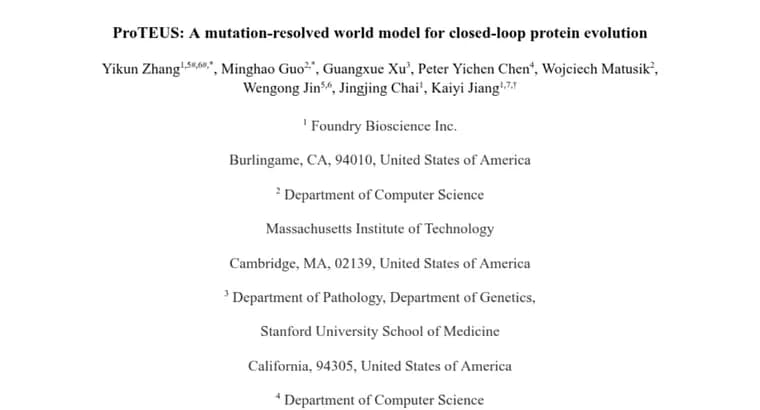
A new preprint introduces ProTEUS, which the authors call a mutation-resolved world model for closed-loop protein evolution. The starting problem is familiar to anyone in protein engineering: fitness landscapes are rugged, so a small change in sequence can cause a large change in function, while experimental screening can only sample a small fraction of sequence space. The central challenge, the authors say, is to traverse the huge combinatorial space of mutations efficiently in silico.
ProTEUS is pretrained on deep mutational scanning assays. It uses MutationFormer, a mutation-biased attention architecture, to learn a joint representation of sequence, evolutionary and structural information. In the world-model framing, a protein variant is a state in this joint latent space, and a mutation is an action whose functional consequences the model predicts.
To make it practical to explore many mutants, the authors also built a fast, physics-constrained all-atom predictor. It enforces geometric constraints explicitly, which the authors say gives guaranteed physical validity, and they report a >10 fold increase in speed compared with AlphaFold3.
The third piece is the loop itself. ProTEUS refines its prediction and understanding of protein activity through closed-loop experimental feedback, steering evolution toward a desired phenotype.
On results, the authors state that ProTEUS surpasses established models in both zero-shot and supervised fine-tuning mutation prediction tasks. They also report an experimental demonstration: two closed-loop multi-objective engineering campaigns, one on aldehyde dehydrogenase and one on levansucrase, that yielded variants with >10 fold higher activity than wild type. The authors present ProTEUS as a world-model framework that connects virtual evaluation of mutational outcomes with experimental learning for efficient protein evolution.
Key facts
- ProTEUS is a mutation-resolved world model for closed-loop protein evolution, pretrained on deep mutational scanning assays and built on the MutationFormer attention architecture.
- Variants are treated as states in a joint latent space of sequence, evolutionary and structural information; mutations are actions whose functional effects are predicted.
- The authors built a fast, physics-constrained all-atom predictor and report a >10 fold speed increase over AlphaFold3 with guaranteed physical validity.
- The authors report that ProTEUS surpasses established models in zero-shot and supervised fine-tuning mutation prediction.
- Two closed-loop multi-objective campaigns, on aldehyde dehydrogenase and levansucrase, yielded variants with >10 fold higher activity than wild type.
Why it matters
Experimental screening covers only a small fraction of possible protein sequences, so any method that picks better mutations before the lab work saves effort. ProTEUS tries to do this by combining a learned model of mutation effects with a fast structure predictor and feedback from real experiments. The reported speed-up over AlphaFold3 (>10 fold) and the >10 fold activity gains over wild type in two enzyme campaigns are the headline claims.
Who it affects
Protein engineers and groups doing directed evolution of enzymes are the obvious audience, since the paper targets the problem of searching mutation space with limited screening capacity. Researchers building protein language models and structure predictors may also care about the mutation-as-action, variant-as-state framing.
How to use it
The abstract describes a workflow rather than a product: pretrain on deep mutational scanning data, predict the effect of candidate mutations in the joint latent space, check structures with the fast all-atom predictor, test selected variants in the lab, and feed the results back to the model. The source does not mention a code, model weights or data release.
How solid is it
This is a preprint abstract, and the claims are the authors' own. The source does not say the results have been independently replicated or peer reviewed. The 'established models' in the prediction comparison are not identified, and no accuracy figures or benchmark names are given. Two points about the numbers: the >10 fold activity gain is relative to wild type, and the source does not say whether it applies to all variants or only the best one. The >10 fold speed claim is relative to AlphaFold3, and the hardware or conditions behind it are not given.
Risks and caveats
No absolute activity values, number of variants tested, or number of experimental rounds are given for the aldehyde dehydrogenase and levansucrase campaigns, so the size and breadth of the wet-lab evidence is hard to judge from the abstract. Only two enzymes were tested. The abstract also names no authors or institutions, and gives no submission or publication date.
“experimental screening can only sample a small fraction of sequence space”
— ProTEUS abstract