ProxyGenBench tests how video generators follow structural proxies
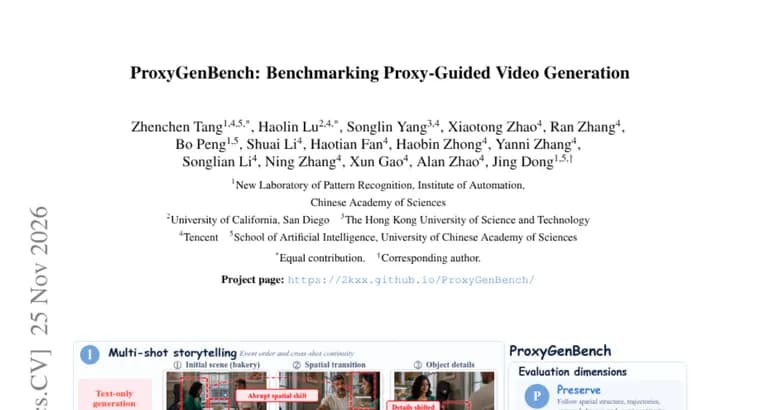
The authors of a new paper introduce ProxyGenBench, a benchmark for proxy-guided video generation. Their starting point is that recent video generators produce realistic videos, yet controlling how scenes unfold remains challenging. One way to steer them is a structural proxy, such as an animated 3D blockout, which specifies scene layout, motion, camera behavior and the order of events.
Proxies are coarse inputs. They leave details unspecified and may contain artifacts that should not be reproduced. The authors therefore set out three requirements for successful generation. A model must preserve the intended structure. It must complete missing content and correct proxy artifacts. And it must bind text, image and audio conditions to the right entities and events.
ProxyGenBench is built to study how these requirements interact. It contains 312 evaluation cases from 60 scenes across three scene tasks, with controlled variations in proxy fidelity, text detail and multimodal inputs. The authors evaluate five video generators using verified, case-specific checklists.
They report three findings. Proxies improve spatiotemporal control. Greater proxy detail, however, can coincide with poorer completion of the missing content. And strong adherence to structure does not ensure that conditions are bound correctly.
Key facts
- ProxyGenBench is a benchmark for video generation guided by structural proxies, such as animated 3D blockouts that set layout, motion, camera behavior and event order.
- It has 312 evaluation cases from 60 scenes across three scene tasks, varying proxy fidelity, text detail and multimodal inputs.
- It studies three interacting requirements: preserving structure, completing missing content while correcting proxy artifacts, and binding text, image and audio conditions correctly.
- Five video generators were evaluated with verified, case-specific checklists.
- Proxies improved spatiotemporal control, but more detailed proxies can coincide with poorer completion, and close structural adherence does not ensure correct binding.
Why it matters
Realism is only part of the job when a video has to unfold in a particular way. Structural proxies give a direct handle on layout, motion, camera and event order. The catch is that a generator has to treat the proxy selectively: keep the intended structure, fill in what is missing and leave the artifacts out. ProxyGenBench is designed to study how those demands interact with correct binding of text, image and audio conditions.
Who it affects
The work is most relevant to researchers who build or evaluate controllable video generators. It also bears on anyone who steers such models with animated 3D blockouts or similar proxies and needs the output to match both the planned structure and the other conditions supplied.
How to use it
The findings suggest checking results on each requirement separately. A clip that tracks the proxy closely may still attach a text, image or audio condition to the wrong entity or event. Adding detail to a proxy is also worth testing with care, since greater detail can coincide with poorer completion. The abstract mentions no release of the benchmark data or code, license or link.
How solid is it
These are the authors' own results, summarized in a short abstract. The setup is stated in concrete terms: 312 cases, 60 scenes, three scene tasks, five generators and verified, case-specific checklists. The abstract does not name the five generators or the three tasks, gives no scores or rankings, and does not say who or what verified the checklists or whether scoring is done by humans or automatically. The size of the reported effects therefore cannot be judged from this text.
Risks and caveats
The link between proxy detail and completion is worded cautiously: the two can coincide, which is not a claim that more detail causes worse results. Better spatiotemporal control should also not be read as better output overall, because the authors separate it from completion and binding. Proxies themselves are coarse and may carry artifacts that a generator should not copy.
“Experiments show that proxies improve spatiotemporal control, but greater proxy detail can coincide with poorer completion, while strong structural adherence does not ensure correct binding.”
— The ProxyGenBench authors, in the paper's abstract