Qwen-Image-PE teaches prompt enhancement visual design, 9B model released
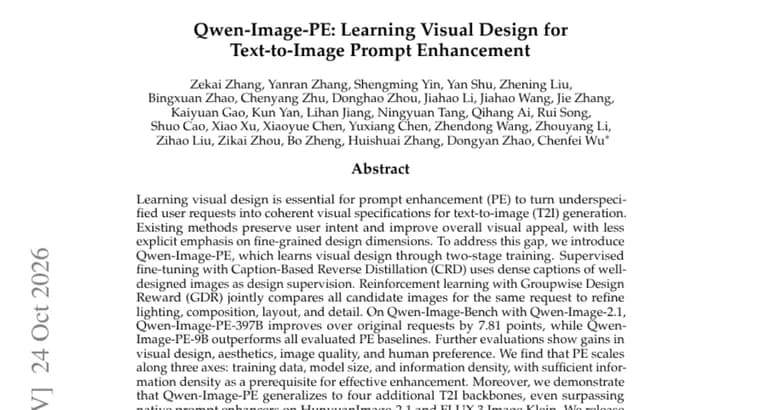
The paper introduces Qwen-Image-PE, a prompt enhancement (PE) model for text-to-image (T2I) generation. Prompt enhancement turns underspecified user requests into coherent visual specifications that an image model can render. The authors argue that existing methods preserve user intent and improve overall visual appeal, but put less explicit emphasis on fine-grained design dimensions. Qwen-Image-PE is built to close that gap by learning visual design directly.
Training has two stages. The first is supervised fine-tuning with what the authors call Caption-Based Reverse Distillation (CRD), which uses dense captions of well-designed images as design supervision. The second is reinforcement learning with a Groupwise Design Reward (GDR). Instead of scoring images one at a time, GDR jointly compares all candidate images generated for the same request, and uses that comparison to refine lighting, composition, layout and detail.
On Qwen-Image-Bench with Qwen-Image-2.1, the larger Qwen-Image-PE-397B improves over the original requests by 7.81 points. The smaller Qwen-Image-PE-9B outperforms all evaluated PE baselines. Further evaluations show gains in visual design, aesthetics, image quality and human preference.
The authors also report that PE scales along three axes: training data, model size and information density. They find that sufficient information density is a prerequisite for effective enhancement. Finally, they show that Qwen-Image-PE generalizes to four additional T2I backbones, and that it even surpasses the native prompt enhancers on HunyuanImage-2.1 and FLUX 3 Image Klein. The 9B model is released at https://huggingface.co/Qwen/Qwen-Image-2.1-PE-T2I.
Key facts
- Qwen-Image-PE is a prompt enhancer for text-to-image generation, trained to improve fine-grained design: lighting, composition, layout and detail.
- Training combines supervised fine-tuning with Caption-Based Reverse Distillation (dense captions of well-designed images) and reinforcement learning with a Groupwise Design Reward that compares all candidate images for one request.
- On Qwen-Image-Bench with Qwen-Image-2.1, Qwen-Image-PE-397B improves over original requests by 7.81 points, and Qwen-Image-PE-9B outperforms all evaluated PE baselines.
- The authors say PE scales with training data, model size and information density, and that it generalizes to four additional T2I backbones, surpassing native enhancers on HunyuanImage-2.1 and FLUX 3 Image Klein.
- Qwen-Image-PE-9B is released at huggingface.co/Qwen/Qwen-Image-2.1-PE-T2I.
Why it matters
Short, vague prompts are how most people ask for images, and prompt enhancers sit between the request and the image model. The authors' claim is that earlier enhancers keep the user's intent and make images look nicer overall, but do not push on specific design qualities. Qwen-Image-PE targets exactly those: lighting, composition, layout and detail. The training recipe is the new part: dense captions of well-designed images as supervision, then a reward that ranks a whole group of candidates for the same request at once. The finding that information density is a prerequisite for effective enhancement is also a concrete design lesson for anyone building such a system.
Who it affects
People building or running text-to-image systems are the main audience, since the paper reports that the enhancer works with four additional T2I backbones beyond Qwen-Image-2.1, including HunyuanImage-2.1 and FLUX 3 Image Klein. Researchers working on prompt enhancement and reward design for image generation get a new baseline and a training approach to compare against. Users of image generators could see more polished results from short requests if such enhancers are adopted.
How to use it
The authors release Qwen-Image-PE-9B on Hugging Face at https://huggingface.co/Qwen/Qwen-Image-2.1-PE-T2I. It is meant to sit in front of a text-to-image model and rewrite a short request into a richer visual specification. The paper reports it working with Qwen-Image-2.1 and four additional T2I backbones. Only the 9B model is stated as released; no release of the 397B model is mentioned. No license, training data size or compute is stated in the source.
How solid is it
The evidence is the authors' own evaluation, summarized in the abstract. Qwen-Image-PE-9B is said to beat all evaluated PE baselines on Qwen-Image-Bench with Qwen-Image-2.1, and the 397B model gains 7.81 points over original requests. The scale and units of that 7.81-point figure are not stated, nor the baseline score, and the baselines are not named. No improvement figure is given for the 9B model, only that it outperforms the baselines. The authors also report gains in visual design, aesthetics, image quality and human preference. Independent replication is not described.
Risks and caveats
The headline number is a single improvement of 7.81 points without a stated scale, so its practical size is hard to judge. The 9B model is the one people can use, yet the abstract gives no improvement figure for it. The names of two of the four additional backbones are not given, and the claim of surpassing native enhancers is stated only for HunyuanImage-2.1 and FLUX 3 Image Klein. The main benchmark, Qwen-Image-Bench, is paired with Qwen-Image-2.1, so results on other systems rest on the generalization claim. The abstract names no authors or institutions; Qwen is only implied by the model name and the release URL.
“Learning visual design is essential for prompt enhancement (PE) to turn underspecified user requests into coherent visual specifications for text-to-image (T2I) generation.”
— Qwen-Image-PE paper abstract