Solar now out-generates nuclear worldwide, BBC analysis of Ember data shows
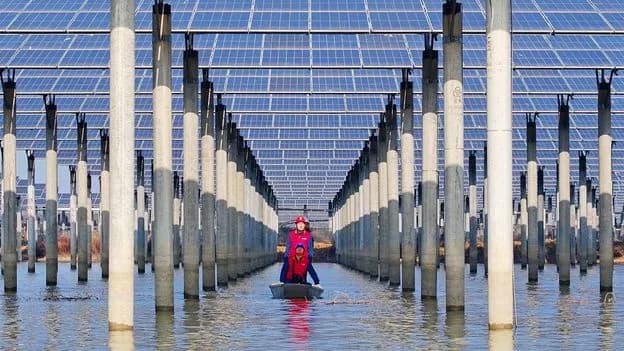
A BBC Future feature argues that solar power has crossed a threshold. A decade ago it supplied just 1% of the world's electricity. According to the UK-based energy think tank Ember, global solar generation quietly overtook nuclear (just) in 2025. BBC analysis of Ember data for the 12 months up to September 2026 shows solar clearly ahead, producing 13% more power than nuclear. The article says solar will almost certainly reach 10% of world power in 2026. Dave Jones, co-founder of Ember, calls solar out-generating all the world's nuclear plants "a pretty insane stat, for sure".
The piece gives seven reasons for the rise. First, solar was underestimated. Jan Rosenow, a professor of energy and climate policy at the University of Oxford, says mainstream projections have understated it year after year; IEA outlooks "assumed linear growth and slowly falling costs, and got both wrong". Solar is the fastest-growing source of new electricity in history and met three-quarters of the growth in world electricity demand in 2025, overtaking wind. Nuclear's output has been more or less flat since 2000, while solar's has grown some 2,700-fold.
Second, price. The article says solar became the cheapest electricity in history in 2020. Scale, higher efficiency and less silicon and silver per panel pushed prices down further, and a large fall in panel prices in 2023-24 brought what Jones calls "offensively cheap" solar. He says a single panel is "well under $100 (£75)" and keeps generating for 30 to 40 years. Researchers calculated that the US's rising wind and solar generation brought $249bn (£186bn) in climate and health benefits between 2019 and 2022.
Third, global uptake. China is by far the biggest solar power but not the only one. The US, despite tariffs, is second for installations, and has enough solar to power more than one-third of its households. Alicia Zhao of the University of Maryland says tariffs and federal policies are expected to raise costs and slow expansion, but solar is still one of the cheapest sources of new US power and "is getting built regardless of political lines". In India, new solar has met 60% of the rise in power demand over the past two years. In Australia, over four million homes, well over a third of households, have rooftop solar.
Fourth, unreliable fossil fuels. Pakistan and Lebanon are installing solar at breakneck speed, and African countries are installing some 100,000 panels per day. The article says rising diesel prices, driven by the Russia-Ukraine conflict and the US-Israel war with Iran, have swung costs further toward solar, especially where home diesel generators cover for weak grids. In Pakistan, solar's share of electricity went from less than 2% in 2019 to 24% now, mostly paid for out of people's pockets without loans, according to Jones. He also says Ethiopia has banned imports of petrol and diesel cars.
Fifth, batteries. Rosenow says solar plus storage is now routinely cheaper than new fossil plants in sunny regions and batteries have largely solved the daily problem of shifting midday sun into the evening. In California, solar and batteries met on average over a quarter of electricity demand from 19:00 to 21:00 in the first half of 2026. Rosenow and Jones both say longer-term storage across seasons, cloudy spells and monsoons remains a barrier.
Sixth, electrification. Jones expects solar to be "king of energy", not just electricity. Julia Souder, chief executive of the Long Duration Energy Storage Council, warns that uncontrolled electrification without built-in flexibility creates a fragile system. Rosenow says the limits on solar are now grids, storage and how fast demand is electrified, not panels or cost. Zhao says US data centres and electrification are pushing demand up for the first time in decades, and that renewables make up over 90% of new US capacity.
Seventh, new technology: plug-in "balcony" panels spreading in Germany and approved in several other countries and US states including California, agrivoltaics, floating and "mirror" plants, perovskite panels and solar windows.
Looking ahead, Jones says solar capacity will keep rising in 2026 but the rate of expansion may slow for the first time ever, because China changed its regime for managing and supporting new installations last summer, prompting a burst of installations in 2025 under the old price regime. Excluding China, he says more panels are being installed this year than last. The IEA expects solar generation in 2030 to be double 2025's level, with solar overtaking hydro as the world's third-largest electricity source. Rosenow's caveat: if Chinese panels become hard to import, growth will not happen at speed. The article closes by saying that, against bad climate news and a likely breach of the 1.5C limit, Jones sees the worst cases now at 2-3C of warming rather than 4C.
Key facts
- Per Ember, global solar generation overtook nuclear (just) in 2025; BBC analysis of Ember data for the 12 months to September 2026 shows solar producing 13% more power than nuclear.
- Solar met three-quarters of the growth in world electricity demand in 2025, and its output has grown some 2,700-fold since 2000 while nuclear's stayed roughly flat.
- Drivers named: record-low panel prices (a single panel "well under $100", per Jones), cheaper batteries, costly diesel and unreliable grids, and rapid uptake in Pakistan (24% of electricity), India, Africa and Australia.
- Jones says expansion may slow in 2026 for the first time ever because of China's changed support regime; the IEA expects 2030 solar generation to be double 2025's.
- Rosenow says the limits are now grids, storage and the pace of electrification, not panels or cost.
Why it matters
Solar going from 1% of world power a decade ago to more generation than all nuclear plants is a shift in the energy system that, the article says, defied every mainstream projection. Rosenow says IEA-type outlooks assumed linear growth and slowly falling costs and got both wrong. The article adds that the growth in clean electricity has directly meant fewer coal plants being built, and Jones puts the worst cases of warming at 2-3C rather than 4C. Rosenow calls solar "the engine of the power transition". The article also notes that data centres and electrification are pushing US power demand up for the first time in decades, which Zhao says could create an opening for renewables.
Who it affects
Households and grid users in places with costly or unreliable power are the clearest winners: Pakistani households, African homes replacing diesel generators with imported rooftop panels, and the four million-plus Australian homes with rooftop solar. US consumers and utilities are affected too, since the US has enough solar for more than one-third of its households and over 90% of its new capacity is renewable, per Zhao. Grid operators and storage providers face the next constraint. Panel exporters, mainly in China, and countries that depend on their imports are also part of the story.
How to use it
This is a reference piece rather than a product. A reader can take from it the headline comparison (13% more than nuclear over the 12 months to September 2026, per BBC analysis of Ember data) and the seven drivers as a checklist for assessing solar in a given market. On the consumer side, the article notes that plug-in "balcony" panels feed a standard socket and have been approved in several countries and US states including California. Jones's rough price for a single panel is under $100, with a 30 to 40 year life, though that is his spoken estimate, not a market statistic.
How solid is it
It is a BBC Future feature whose central numbers come from Ember, a UK-based energy think tank, and from BBC's own analysis of Ember data; the article does not name an author. The 2025 crossover is described only as "just", and the source gives no absolute generation figures for either solar or nuclear. The 13% lead is relative to nuclear's output, not a share of world power. The 10% share for 2026 is a forecast ("will almost certainly"), not a measurement. Many other points are expert statements (Jones, Rosenow, Zhao), and the $249bn US benefit figure is attributed only to unnamed researchers.
Risks and caveats
The article lists several. Jones says solar expansion may slow in 2026 for the first time ever after China changed its support regime and a burst of 2025 installations preceded it. Rosenow says growth will not happen at speed if Chinese panels become hard to import. Zhao says US tariffs and federal policy are expected to raise costs and slow expansion. Storage across seasons, cloudy periods and monsoons remains a barrier, per Rosenow and Jones. Souder warns that uncontrolled electrification without built-in flexibility creates a fragile system: "Electrification is not automatically resilient." Rosenow says the open question is whether power systems and institutions can keep up.
“[Solar] generating more electricity than all the world's nuclear power plants is a pretty insane stat, for sure”
— Dave Jones, co-founder of Ember