Radev model targets calibrated clinical decisions from CT scans
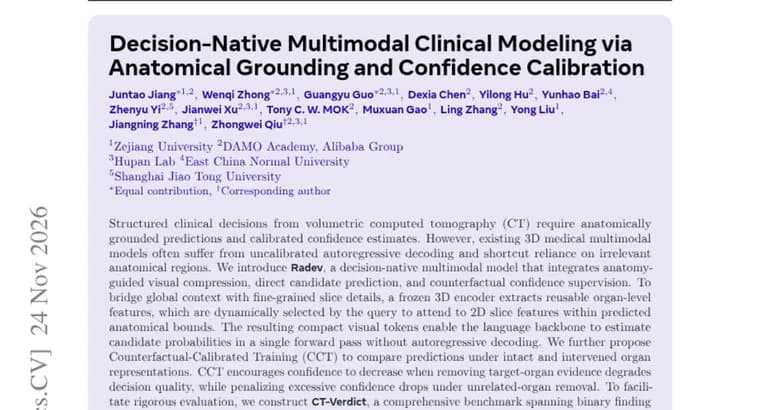
A paper abstract introduces Radev, which its authors call a decision-native multimodal model for structured clinical decisions from volumetric computed tomography (CT), meaning 3D scans. The authors argue that such decisions need predictions grounded in anatomy and confidence estimates that are well calibrated. In their account, existing 3D medical multimodal models often fall short on both counts: their autoregressive decoding is uncalibrated, and they take shortcuts by relying on anatomical regions that are irrelevant to the question.
Radev combines three components: anatomy-guided visual compression, direct prediction of candidate answers, and counterfactual supervision of confidence. To connect the global picture with fine detail in individual slices, a frozen 3D encoder extracts reusable organ-level features. The query dynamically selects among them, and the selected features attend to 2D slice features within predicted anatomical bounds. This yields a compact set of visual tokens, which lets the language backbone estimate the probability of each candidate answer in a single forward pass, with no autoregressive decoding.
The authors also propose Counterfactual-Calibrated Training (CCT), which compares the model's predictions when organ representations are intact and when they have been intervened on. If removing evidence from the target organ makes the decision worse, CCT encourages confidence to fall. If an unrelated organ is removed, it penalizes excessive drops in confidence.
For evaluation, the authors built a benchmark called CT-Verdict. It covers three task types (whether a finding is present, multiple-choice questions and ordinal severity assessment) across both in-distribution and external cohorts. They report that in extensive experiments Radev significantly outperforms state-of-the-art methods in both decision accuracy and confidence calibration, and generalizes robustly under distribution shifts. The abstract gives no metric values to size that improvement. A project page is available at https://juntaojianggavin.github.io/projects/Radev/.
Key facts
- Radev is a multimodal model for structured clinical decisions from 3D CT, combining anatomy-guided visual compression, direct candidate prediction and counterfactual confidence supervision.
- A frozen 3D encoder extracts organ-level features; the query selects them to attend to 2D slice features within predicted anatomical bounds.
- The language backbone estimates candidate probabilities in a single forward pass without autoregressive decoding.
- Counterfactual-Calibrated Training links confidence to organ evidence by comparing predictions with intact and intervened organ representations.
- The authors built the CT-Verdict benchmark and report significant gains over state-of-the-art methods in accuracy and calibration; the abstract gives no figures.
Why it matters
A clinical answer is more useful when its stated confidence can be trusted and when it rests on the right part of the body. The authors say existing 3D medical multimodal models often struggle here, with uncalibrated autoregressive decoding and shortcuts through irrelevant anatomy.
Their response works on both problems. Radev scores candidate answers directly, and CCT tests how confidence reacts when evidence from the target organ or an unrelated one is taken away.
Who it affects
The work is most relevant to researchers who build or evaluate multimodal models for 3D medical imaging, especially those working on CT, confidence calibration or performance under distribution shift. CT-Verdict is aimed at evaluation, with binary, multiple-choice and severity tasks on in-distribution and external cohorts.
No clinical deployment, clinical trial, comparison with radiologists or regulatory approval is mentioned in the abstract.
How to use it
The starting point is the project page: https://juntaojianggavin.github.io/projects/Radev/. The abstract does not say whether code, weights or the benchmark are released.
The design ideas can be read on their own: select organ-level features according to the query, limit slice attention to predicted anatomical bounds, score candidates in one pass, and train confidence against organ removal.
How solid is it
This account rests on the paper's abstract. The performance claims are the authors' own: significantly better decision accuracy and calibration than state-of-the-art methods, plus robust generalization under distribution shifts.
The abstract gives no accuracy or calibration values and does not name the compared methods. It also gives no size for CT-Verdict, such as the number of scans, questions, patients or cohorts. The description of the benchmark as comprehensive is the authors' wording.
Risks and caveats
Without figures, readers cannot judge from the abstract how large the gains are or how well the model holds up on external cohorts, whose origins are not named. No speed, compute cost or token compression ratio is reported either, and the language backbone and 3D encoder are not named.
The results should be read as research claims about benchmark performance. They do not establish that the model is ready for use with patients.
“CCT encourages confidence to decrease when removing target-organ evidence degrades decision quality, while penalizing excessive confidence drops under unrelated-organ removal.”
— The paper's abstract