RevFlow generates images by reversing a frozen encoder's path
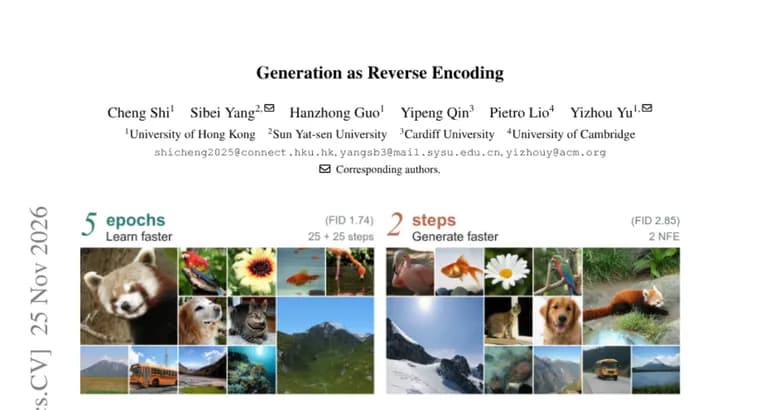
A paper titled "Generation as Reverse Encoding" introduces RevFlow, an image generation method built on a frozen encoder, meaning one whose representations are reused as they are.
The authors start from a trade-off. Pretrained visual representations speed up generative learning because they abstract away appearance and spatial detail. That same abstraction makes the way back to pixels much harder and shifts much of the burden onto a larger decoder. The encoder already provides a learned path from pixels to semantics, so the authors ask why the path from representation back to pixels should be learned independently.
RevFlow treats the encoder's intermediate representations as successive generation targets. It first generates deep semantic representations, then shallow ones that keep appearance and spatial detail, and only then decodes to pixels. To avoid training a separate generator for each stage, the authors built HyC-DiT, a single generative model with a standard DiT backbone shared across stages and condition injection specific to each stage. They also report that native matching in semantic representation space enables few-step generation.
The headline claim is that RevFlow accelerates both learning and sampling. On ImageNet 256x256 it reaches 1.96 FID at 690M and 1.74 FID at 1.55B after only 5 training epochs. It also achieves 30.25 dB reconstruction PSNR with an 89M decoder. After a short native-matching adaptation phase, the RevFlow-XL variant reaches 2.85 FID using a single sampling step in each stage. The authors give a code repository at https://github.com/ChengShiest/RevFlow.
Key facts
- RevFlow generates a frozen encoder's deep semantic representations first, then shallow ones with appearance and spatial detail, then decodes to pixels.
- HyC-DiT, a unified model, shares a standard DiT backbone across stages and injects conditions specific to each stage.
- Reported ImageNet 256x256 results after only 5 training epochs: 1.96 FID at 690M and 1.74 FID at 1.55B.
- An 89M decoder achieves 30.25 dB reconstruction PSNR.
- After a short adaptation phase, RevFlow-XL reaches 2.85 FID with one sampling step in each stage.
Why it matters
The paper targets a specific tension in generators that lean on pretrained visual representations. Abstraction helps the model learn faster, but it leaves much of the work of recovering pixels to a larger decoder. RevFlow's answer is to retrace the encoder's own route in the opposite direction, moving from deep semantic layers to shallower, more detailed ones before decoding. In the authors' account, this speeds up both learning and sampling.
Who it affects
The work is most relevant to researchers and engineers who build image generators on top of pretrained encoders, especially those working with DiT backbones, decoder design or few-step sampling. The reported results are for image generation on ImageNet at 256x256.
How to use it
The authors point to a code repository at https://github.com/ChengShiest/RevFlow. The design to study has three parts: a frozen encoder whose intermediate representations serve as targets, the shared HyC-DiT backbone with stage-specific condition injection, and native matching in semantic representation space for few-step generation. The source gives the link but says nothing about a license or released weights.
How solid is it
These are the authors' own reported results, with concrete figures: 1.96 and 1.74 FID on ImageNet 256x256, 30.25 dB reconstruction PSNR, and 2.85 FID for single-step stages. The source text gives no baseline methods or comparison figures. The speed-up in learning and sampling is also not quantified as a factor, training time or compute cost.
Risks and caveats
The 2.85 FID result applies to RevFlow-XL, comes after a short native-matching adaptation phase, and uses one sampling step in each stage, which is not the same as one step for the whole image. The number of stages is not stated, nor is the size of RevFlow-XL. The source does not say what the 690M, 1.55B and 89M figures count, and it does not name the frozen encoder. Results are reported only for ImageNet 256x256, so they should not be read as evidence about other datasets, resolutions or text-to-image generation.
“Yet the same abstraction makes the return to pixels far harder, shifting much of the burden onto a larger decoder.”
— The authors of "Generation as Reverse Encoding"