RLVB reward curbs premature answers from lazy AI agents
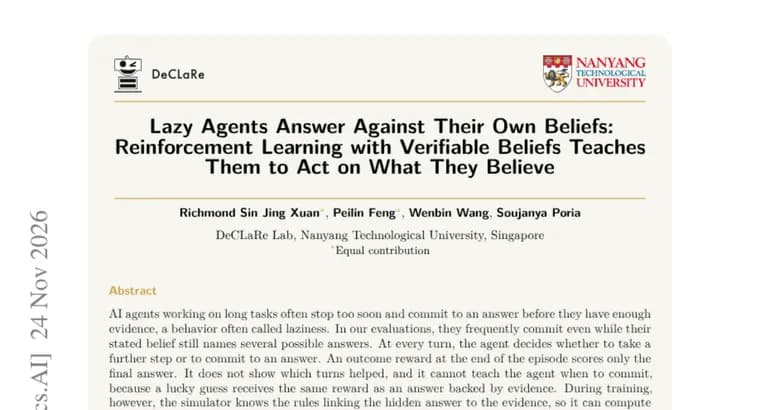
AI agents working on long tasks often commit to an answer before they have enough evidence, a behavior the paper's authors call laziness. In their evaluations, agents frequently commit even while their own stated belief still names several possible answers.
The authors trace the training problem to the outcome reward given at the end of an episode. It scores only the final answer, so a lucky guess earns the same reward as an answer backed by evidence, and the agent cannot learn when to commit. During training, however, the simulator can compute the exact posterior over the answer at every step and tell whether the evidence is already enough.
Their method, Reinforcement Learning with Verifiable Beliefs (RLVB), uses that signal. It rewards the agent for taking further steps while the posterior still allows several answers, and for committing once the evidence is sufficient. The reward needs no judge, critic or reward model. It also never reads the belief line that the agent writes before each action.
The authors also introduce Pro Worlds, a benchmark of visual puzzles in which the agent views a large world through a small window. They evaluate three vision-language models on three benchmarks, two of which are never seen in training. RLVB improves the base model in all nine settings, by 17.1% on average. Under the outcome reward, two reinforcement learning methods, GRPO and PPO, fall below the base model on average. RLVB also beats PPO with a process reward from an LLM judge by 9.3% on average while using 1.6 times fewer GPU-hours.
The trained agent answers with sufficient evidence in 51%, 12% and 74% of episodes on the three benchmarks, against 8%, 0.4% and 36% for the base model. The authors conclude that its accuracy gain therefore comes from answering more often at high levels of evidence. They also report that it acts on its own belief: among turns where the evidence is insufficient and its belief line still names several answers, it commits at only 0.1 to 2.2%, against 3 to 68% for the base model.
Key facts
- RLVB rewards an agent for taking more steps while the simulator's exact posterior allows several answers, and for committing once evidence is sufficient. It needs no judge, critic or reward model.
- Across three vision-language models and three benchmarks, RLVB improves the base model in all nine settings, by 17.1% on average.
- It beats PPO with an LLM-judge process reward by 9.3% on average using 1.6 times fewer GPU-hours, while GRPO and PPO under an outcome reward fall below the base model on average.
- Episodes answered with sufficient evidence reach 51%, 12% and 74% on the three benchmarks, against 8%, 0.4% and 36% for the base model.
- On turns with insufficient evidence and several answers still named, the trained agent commits at 0.1 to 2.2%, against 3 to 68% for the base model.
Why it matters
The paper targets a specific failure in long-running agents: answering too early, sometimes against what the agent itself has just written that it believes. The authors argue that scoring only the final answer cannot fix this, because it treats a lucky guess and a well-supported answer alike. RLVB moves the reward to the question of timing, judged against an exact posterior that the simulator computes. The reported contrast is sharp: GRPO and PPO under the outcome reward end up below the base model on average, while RLVB improves on it in every tested setting.
Who it affects
The work is most relevant to researchers and engineers who train agents with reinforcement learning, especially vision-language agents that must gather information over several steps before answering. Teams that pay for an LLM judge to score intermediate steps have a direct comparison to look at. Pro Worlds, the new benchmark of visual puzzles seen through a small window, may also interest people who evaluate how agents explore before they decide.
How to use it
The key requirement is a training environment where a simulator can compute the exact posterior over the answer at every step and tell whether the evidence is enough. Given that, the reward keeps the agent exploring while several answers remain possible and credits it for committing once the evidence suffices. No judge, critic or reward model is needed, and the authors report 1.6 times fewer GPU-hours than PPO with an LLM-judge process reward. No code, model or benchmark release is mentioned in the abstract.
How solid is it
These are the authors' own results, and this account rests on the paper's abstract. The test covers three vision-language models on three benchmarks, two of them never seen in training, with gains over the base model in all nine settings. The abstract does not state whether the 17.1% and 9.3% figures are relative gains or percentage points. The three models are not named, and Pro Worlds is the only benchmark identified by name.
Risks and caveats
The reward depends on a posterior that the simulator provides during training, and nothing in the abstract says the method works in real-world tasks without a simulator. Early answering is also far from solved on every test: the trained agent answers with sufficient evidence in 74% of episodes on one benchmark but only 12% on another. That 12% is still well above the base model's 0.4%. Average gains can also hide differences between individual models and benchmarks.
“An outcome reward at the end of the episode scores only the final answer, so it cannot teach the agent when to commit, because a lucky guess receives the same reward as an answer backed by evidence.”
— The paper's abstract