RoboDojo-Mirror finds mirrors cut robot policy success rates
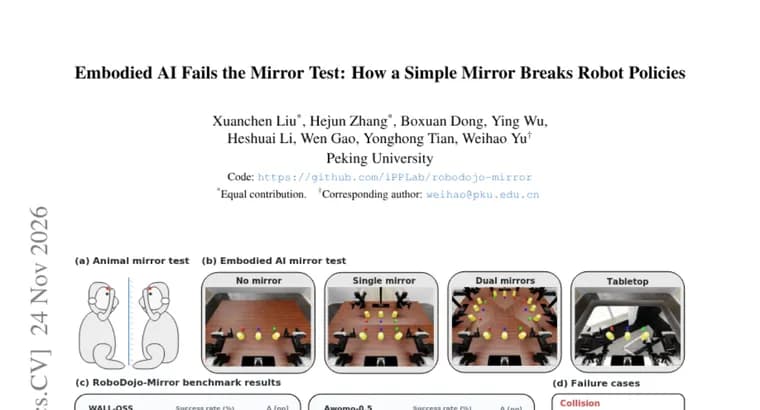
Can a simple mirror expose the limits of today's robot manipulation policies? A research paper takes up that question, drawing inspiration from the mirror self-recognition test used in animal cognition. The authors ask whether robot policies can reliably manipulate physical objects in scenes that also contain their reflections.
Their benchmark, RoboDojo-Mirror, is built on RoboDojo. It keeps the task objectives, success criteria and policy checkpoints the same, and compares a mirror-free baseline with three conditions: a single mirror, dual mirrors and a mirrored tabletop.
The evaluation covers five policies spanning Vision-Language-Action (VLA) models, World Action Models and agentic policies. Every mirror condition reduced aggregate success rates. Averaged over the three conditions, the drop ranged from 10.8 to 56.7 percentage points depending on the policy. On the mirrored tabletop it reached 62.5 points.
A mirror is also a physical obstacle, so the authors compared it against non-reflective panels with matching geometry. Between 50% and 88% of mirror-specific failures occurred without any recorded contact between robot and panel, which means direct collisions alone do not explain the degradation. Analyses of trajectories and contacts instead showed recurring behaviors consistent with robots targeting phantom, reflected objects and mislocating real ones.
Further targeted diagnostics examine grasping near reflections, pushing progress (which depended on the policy) and interaction with the physical target when the main camera's view is occluded. In real-robot experiments, π0.5 and FastWAM also had lower overall success rates with an upright mirror and with a mirrored tabletop.
The authors conclude that diverse robot policies share a vulnerability to reflective environments, and that evaluation of embodied intelligence should account for reflections. Their code is on GitHub.
Key facts
- RoboDojo-Mirror, built on RoboDojo, compares a mirror-free baseline with single-mirror, dual-mirror and mirrored-tabletop conditions using the same tasks, success criteria and checkpoints.
- All mirror conditions lowered aggregate success across five policies; average drops ranged from 10.8 to 56.7 percentage points across policies, and the mirrored-tabletop drop reached 62.5 points.
- In comparisons with matched non-reflective panels, 50% to 88% of mirror-specific failures happened without recorded robot-panel contact.
- Observed behaviors were consistent with targeting reflected phantom objects and mislocating real ones.
- Real-robot tests of π0.5 and FastWAM also showed lower overall success with an upright mirror and a mirrored tabletop.
Why it matters
The benchmark isolates one ordinary feature of a scene, a reflective surface, while holding tasks, success criteria and policy checkpoints fixed. The result cut across different kinds of systems: VLA models, World Action Models and agentic policies were all in the group of five, and aggregate success fell under every mirror condition. The authors argue this points to a shared weakness and makes a case for reflection-aware evaluation.
Who it affects
The work is most relevant to researchers and engineers who build or evaluate robot manipulation policies, particularly VLA models, World Action Models and agentic approaches. Teams that expect robots to handle objects near mirrors or on reflective tabletops have a direct reason to test those settings. The size of the effect differed widely between policies, from 10.8 to 56.7 percentage points on average.
How to use it
The authors have released code at https://github.com/iPPLab/robodojo-mirror. The benchmark's design also offers a template for testing: run the same task and checkpoint without a mirror and then with one, two or a mirrored tabletop. Comparing against a non-reflective panel of matching geometry helps separate the effect of the reflection from the effect of an extra obstacle.
How solid is it
The findings come from the authors' own paper. Several elements support them: a mirror-free baseline, matched non-reflective panels as a control for physical obstruction, trajectory and contact analyses, and real-robot experiments with π0.5 and FastWAM that moved in the same direction on overall success.
Risks and caveats
The headline figures need careful reading. The 10.8 to 56.7 range runs across policies, with each policy's drop in percentage points averaged over three conditions, while 62.5 points is the maximum drop in success rate, reached on the mirrored tabletop. The 50% to 88% figure is a share of mirror-specific failures without recorded robot-panel contact; it shows collisions alone do not account for the damage, without ruling out that they play a part. Phantom targeting and mislocalization are described as behaviors consistent with those patterns, not as a proven mechanism. The real-robot result is reported for the upright-mirror and mirrored-tabletop conditions.
“These findings reveal a shared vulnerability to reflective environments across diverse robot policies and motivate reflection-aware evaluation of embodied intelligence.”
— The paper's authors