Route Anything paper tests AI model routing on 374,401 runs
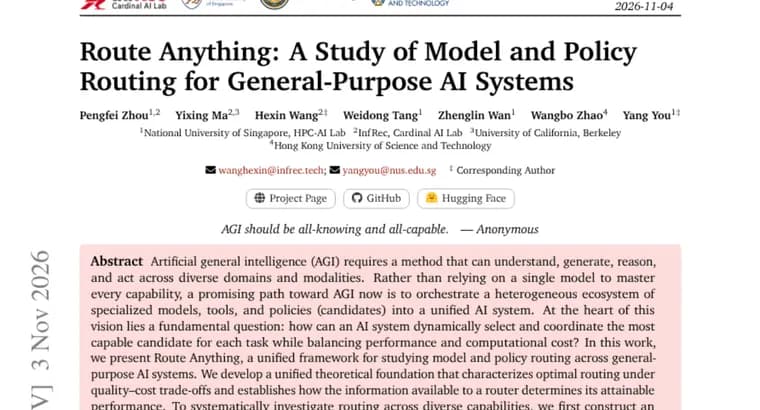
Route Anything is a paper that studies how a general-purpose AI system can choose, for each task, the most capable component from a mixed pool of specialized models, tools and policies (the paper calls them candidates), while balancing performance against computational cost. Its starting premise is that a promising path toward AGI is to orchestrate such a heterogeneous ecosystem into one unified system rather than rely on a single model to master every capability.
The work has two main parts. The first is theory: the authors develop a unified foundation that characterizes optimal routing under quality-cost trade-offs and establishes how the information available to a router determines how well it can perform.
The second is empirical. To test routing across very different capabilities, the authors first build an omni-modal trajectory matrix. It spans 25 benchmarks covering language understanding, image, video and speech generation, coding and workplace agents, and robotic manipulation. The matrix holds 374,401 scored runs from 452 candidate configurations. On top of it they train and test different routers to examine three things: the potential of omni-modal model routing, what learned routers can do, and the conditions under which routing improves efficiency.
The headline results, as the abstract states them: per-input oracle routing outperforms the best fixed candidate by 5.4 points. Learned routers outperform that best fixed candidate by 0.3 points across 16 benchmarks, by 2.1 points on video generation, and by 1.1 points on robot manipulation, where they also use 24% less policy time. Routing also raises efficiency by 8.82x on average compared with the reference model. The authors conclude that the results reveal substantial opportunities for capability orchestration.
Key facts
- Route Anything is a framework for studying model and policy routing, with a theory of optimal quality-cost routing and of how a router's available information limits its performance.
- The omni-modal trajectory matrix covers 25 benchmarks (language, image, video, speech generation, coding and workplace agents, robotic manipulation) and holds 374,401 scored runs from 452 candidate configurations.
- Per-input oracle routing beats the best fixed candidate by 5.4 points; learned routers beat it by 0.3 points across 16 benchmarks.
- Learned routers gain 2.1 points on video generation and 1.1 points on robot manipulation, the latter with 24% less policy time.
- Routing raises efficiency by 8.82x on average compared with the reference model.
Why it matters
Most AI progress is told as one model getting better. This paper argues for a different route to general capability: keep many specialized models, tools and policies, and decide per task which one to use. That makes the router a central piece, and the question becomes how much quality you keep while spending less compute. The paper's contribution is a shared theory plus a large matrix of scored runs, 374,401 across 452 configurations, so that routers can be trained and compared on the same ground across text, images, video, speech, agents and robots.
Who it affects
Researchers building routers or multi-model systems get a benchmark matrix spanning 25 benchmarks and a theoretical framing of quality-cost routing. Teams that run several models or policies side by side, including coding and workplace agents and robot control, are the natural audience for the question of when switching candidates pays off.
How to use it
The abstract describes a research framework rather than a product. Its practical lesson is the setup: collect scored runs of many candidates on many tasks, then train a router to pick among them and compare it with the best single candidate. The abstract does not mention released code, a dataset release or the model names of the 452 candidates.
How solid is it
The evidence base is large: 374,401 scored runs over 25 benchmarks. The figures below come from the abstract alone. Learned routers' gains are small in aggregate (0.3 points across 16 benchmarks) and larger on particular tasks (2.1 points on video generation, 1.1 points on robot manipulation). The 5.4-point oracle figure is a per-input oracle result, not something learned routers are said to reach. The abstract does not say which model is the reference model behind the 8.82x efficiency figure, nor what efficiency is measured in.
Risks and caveats
Read the numbers by their scope. The 0.3-point learned-router gain is far below the 5.4-point oracle gain, so most of the headroom the oracle shows is not captured by the learned routers reported here. The 24% policy-time saving is stated only for robot manipulation. The 8.82x efficiency figure is relative to an unnamed reference model, so it cannot be compared with other efficiency claims. The 5.4-point oracle gain is not tied to a stated benchmark set or metric scale in the abstract.
“Rather than relying on a single model to master every capability, a promising path toward AGI now is to orchestrate a heterogeneous ecosystem of specialized models, tools, and policies (candidates) into a unified AI system.”
— Route Anything abstract