Safin-1 builds AI safety into the model's own memory routing
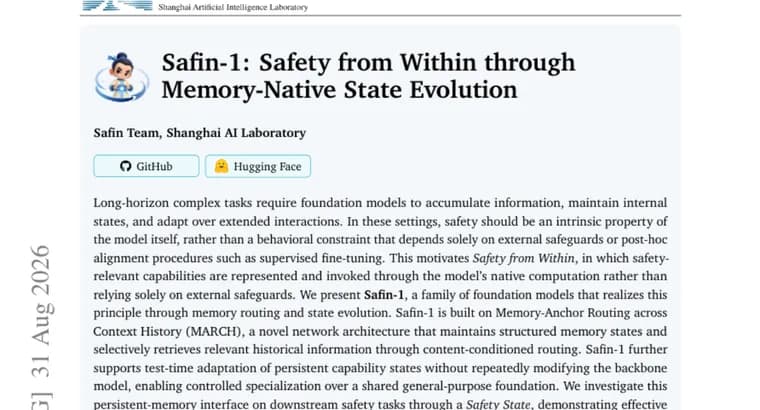
A new paper introduces Safin-1, a family of foundation models built around a principle the authors call Safety from Within. Instead of treating safety as a behavioral constraint enforced through external safeguards or post-hoc alignment methods such as supervised fine-tuning, the work represents and invokes safety-relevant capabilities through the model's own native computation. The motivation is long-horizon, complex tasks, where a model has to accumulate information, maintain internal state, and adapt over extended interactions; the authors argue safety should be an intrinsic property of the model itself in that setting, not something added afterward.
Safin-1 is built on an architecture the authors call MARCH, Memory-Anchor Routing across Context History. MARCH maintains structured memory states and selectively retrieves relevant historical information through content-conditioned routing. It also supports test-time adaptation of persistent capability states without repeatedly modifying the model's backbone, which the authors say enables controlled specialization over a shared foundation model.
The authors test this routed-state interface on downstream safety tasks through what they call a Safety State, and report effective state-based adaptation with substantial safety improvements; the paper does not give specific benchmark numbers for this claim. They also evaluate Safin-1 across general capabilities, long-context understanding, retrieval, and efficiency, saying these further validate the approach, again without stating figures. The broader argument is that this routed-state interface unifies contextual memory and persistent capability adaptation within the model's native computation, reframing memory from a passive record of prior context into an active substrate for maintaining and evolving model behavior.
The authors are explicit that this is only an initial architectural exploration of Safety from Within, not a finished system, and that substantial further work is needed to realize the broader vision. The abstract names no individual authors or institutions, and gives no model size, training data, release timeline, code availability, or comparison to other models.
Key facts
- Safin-1 is a family of foundation models designed around Safety from Within: safety-relevant capabilities are represented and invoked through the model's own native computation rather than through external safeguards or post-hoc alignment such as supervised fine-tuning.
- Its architecture, MARCH (Memory-Anchor Routing across Context History), maintains structured memory states and retrieves relevant historical information through content-conditioned routing.
- MARCH supports test-time adaptation of persistent capability states without repeatedly modifying the model's backbone, enabling controlled specialization over a shared foundation model.
- Using a dedicated Safety State built on this interface, the authors report effective state-based adaptation with substantial safety improvements, though the abstract gives no benchmark figures.
- The authors describe the work as only an initial architectural exploration, with substantial further work needed to realize the broader vision.
Why it matters
Most current approaches treat AI safety as something applied on top of an already-trained model, through external guardrails or post-hoc alignment steps like supervised fine-tuning. Safin-1 proposes representing safety as a capability the model invokes through its own native computation instead, built on memory and state rather than an added layer. The authors tie this specifically to long-horizon tasks, where a model must accumulate information and adapt its behavior over an extended interaction rather than a single turn.
Who it affects
The paper targets builders and researchers working on foundation models for long-horizon, agentic use, where accumulating context and maintaining state over many steps raises different safety questions than single-turn interactions. It is a research contribution rather than a shipped product, so the immediate audience is other alignment and architecture researchers rather than end users of a deployed model.
How to use it
The practical mechanism is MARCH's support for test-time adaptation of persistent capability states without repeatedly modifying the model's backbone. The authors present this as letting a shared foundation model take on controlled specialization, including a dedicated Safety State, without retraining the whole model each time. No pricing, release, or code availability is stated, so there is nothing to deploy from this paper alone.
How solid is it
The authors report effective state-based adaptation with substantial safety improvements from the Safety State, and say further evaluations across general capabilities, long-context understanding, retrieval, and efficiency validate Safin-1. The abstract gives no benchmark scores, no comparison to specific baselines or competing models, and no model size or training details to weigh those claims against. The authors themselves frame the work as only an initial architectural exploration.
Risks and caveats
By the authors' own account, this is an early exploration, and substantial further work is needed before the broader vision is realized. Readers cannot independently check the substantial safety improvements claim from the abstract alone, since no figures, baselines, or benchmark details are given, and no release timeline or code availability is mentioned.
“Safety should be an intrinsic property of the model itself, rather than a behavioral constraint relying solely on external safeguards or post-hoc alignment such as supervised fine-tuning.”
— Safin-1 paper