Scene-Designer trains an AI agent to design and critique 3D indoor scenes
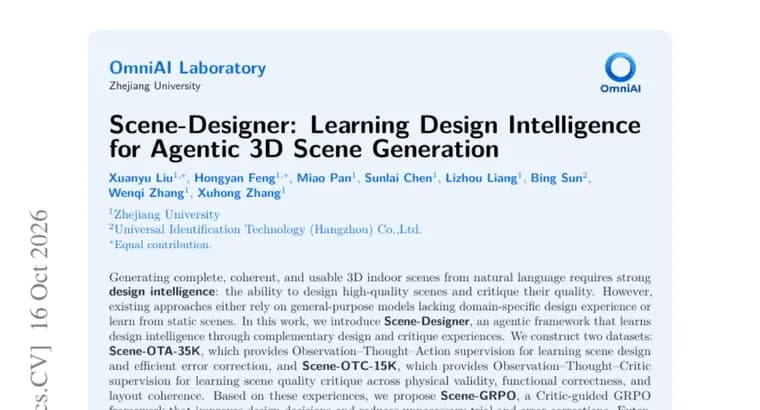
The paper introduces Scene-Designer, an agentic framework for generating 3D indoor scenes from natural language. The authors start from a diagnosis: producing complete, coherent and usable scenes requires strong design intelligence, which they define as the ability to design high-quality scenes and also to critique their quality. In their view, existing approaches either rely on general-purpose models that lack domain-specific design experience, or learn from static scenes. Scene-Designer is meant to learn design intelligence from two complementary kinds of experience, design and critique.
To supply that experience, the authors construct two datasets. Scene-OTA-35K provides Observation-Thought-Action supervision for learning scene design and efficient error correction. Scene-OTC-15K provides Observation-Thought-Critic supervision for learning to critique scene quality across three dimensions: physical validity, functional correctness and layout coherence.
On top of these, the authors propose Scene-GRPO, a Critic-guided GRPO training framework. According to the authors, it improves design decisions and reduces unnecessary trial-and-error corrections.
The reported results are qualitative in the abstract. The authors say extensive experiments show Scene-Designer achieves superior performance in physical validity, functional correctness and layout coherence, and that the learned Scene-Critic significantly outperforms general-purpose models in scene critique. They also report that using the Critic at test time further improves scene generation, which they take as showing the Critic can give useful guidance beyond training. Finally, additional analysis suggests a trend of mutual enhancement between scene design and critique abilities: getting better at one appears to go with getting better at the other.
Key facts
- Scene-Designer is an agentic framework that generates 3D indoor scenes from natural language and learns from both design and critique experience.
- Two datasets back it: Scene-OTA-35K (Observation-Thought-Action, for design and error correction) and Scene-OTC-15K (Observation-Thought-Critic, for quality critique).
- Scene-OTC-15K critique covers three dimensions: physical validity, functional correctness and layout coherence.
- Scene-GRPO, a Critic-guided GRPO framework, is meant to improve design decisions and cut unnecessary trial-and-error corrections.
- The authors report superior results on all three dimensions and say the learned Scene-Critic significantly outperforms general-purpose models at critique.
Why it matters
The paper targets a specific weakness the authors identify in text-to-3D-scene work: general-purpose models lack domain-specific design experience, and methods trained on static scenes do not learn from the process of designing and fixing a scene. Scene-Designer's answer is to train on both design steps and critique steps, and to use the learned critic to guide reinforcement-style training with GRPO. The suggested link between design and critique ability is the most interesting idea here, though the authors only call it a trend.
Who it affects
Mainly researchers working on agentic 3D scene generation and on critic or reward models for generation tasks. The framing around indoor scenes that are physically valid, functionally correct and coherent in layout also points at anyone who needs usable generated environments rather than loose visual mock-ups.
How to use it
The abstract does not describe a release, so there is nothing to run yet. For now the practical value is the recipe: pair action-style supervision (Observation-Thought-Action) with critique-style supervision (Observation-Thought-Critic), then train with a Critic-guided GRPO step and, optionally, use the Critic again at test time. The datasets are named Scene-OTA-35K and Scene-OTC-15K.
How solid is it
This is a preprint abstract, and the claims are the authors' own. They state superior performance and a significant edge for Scene-Critic over general-purpose models, but the abstract gives no scores, percentages or margins, and does not name baselines or benchmarks. The mutual-enhancement finding is described only as a suggested trend. The claims cannot be checked or sized from the abstract alone.
Risks and caveats
Without numbers, baselines or benchmarks, how large the gains are and how fair the comparison is remains unknown. The abstract does not explain how the datasets were built or what they contain beyond the 35K and 15K in their names. The test-time Critic result is presented by the authors as evidence that the Critic helps beyond training, and the mutual-enhancement point is a trend rather than an established effect.
“Additional analysis suggests a trend of mutual enhancement between scene design and critique abilities.”
— Scene-Designer paper abstract