Self-HPO alternates harness and RL tuning for coding agents
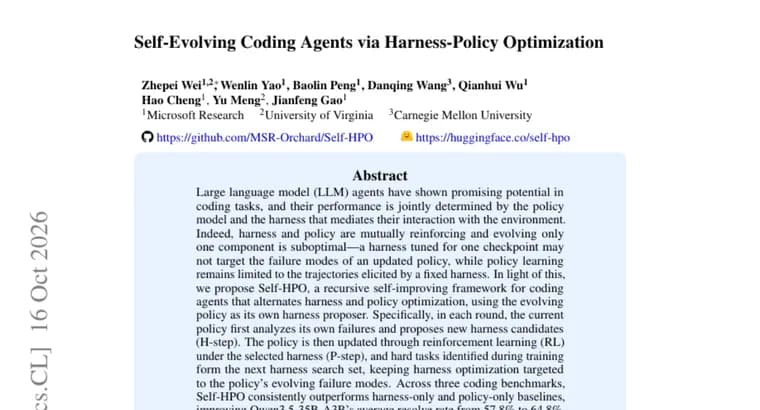
A coding agent's performance depends on two things together: the policy model, and the harness that mediates its interaction with the environment. The paper behind Self-HPO argues that the two reinforce each other, so evolving only one is suboptimal. A harness tuned for one checkpoint may not target the failure modes of an updated policy, while policy learning stays limited to the trajectories that a fixed harness elicits.
Self-HPO is the proposed answer: a recursive self-improving framework for coding agents that alternates harness and policy optimization, and uses the evolving policy as its own harness proposer. Each round has two steps. In the H-step, the current policy analyzes its own failures and proposes new harness candidates. In the P-step, the policy is updated through reinforcement learning (RL) under the selected harness. Hard tasks identified during training then form the next harness search set, which keeps harness optimization aimed at the policy's changing failure modes.
The headline result: across three coding benchmarks, Self-HPO consistently outperforms harness-only and policy-only baselines, improving Qwen3.5-35B-A3B's average resolve rate from 57.8% to 64.8%. That is a gain of 7.0 percentage points. The authors say the gains generalize to out-of-distribution settings.
Further analysis reports that both optimized components retain gains even when paired with their base counterparts, while their joint gain exceeds the sum of their individual gains. Self-HPO also improves reliability (Pass@1) and expands the capability frontier (Pass@k) over the base agent. In an additional experiment, using a stronger external model (Opus 4.8 is given as an example) as the harness proposer yields a further performance boost from the same framework.
Key facts
- Self-HPO alternates a harness step (H-step), where the policy analyzes its own failures and proposes harness candidates, with an RL policy step (P-step) under the selected harness.
- Hard tasks found during training become the next harness search set, so harness search follows the policy's changing failure modes.
- Across three coding benchmarks, Qwen3.5-35B-A3B's average resolve rate goes from 57.8% to 64.8%, and Self-HPO beats harness-only and policy-only baselines.
- The joint gain of the optimized harness and policy exceeds the sum of their individual gains; Pass@1 and Pass@k both improve over the base agent.
- A stronger external model (e.g., Opus 4.8) as harness proposer gives a further boost.
Why it matters
Most work on coding agents improves either the model or the scaffolding around it. This paper's claim is that the two should be improved together, because each shapes the failures the other has to fix. The mechanism is a loop: the policy finds its own weak spots, the harness is adapted to them, and RL then trains the policy under that harness. The reported result is an average resolve rate for Qwen3.5-35B-A3B that moves from 57.8% to 64.8% across three coding benchmarks.
Who it affects
Researchers and teams building coding agents on top of open-weight models are the audience, particularly anyone who tunes a harness by hand or runs RL on a fixed one. The paper's example model is Qwen3.5-35B-A3B.
How to use it
The abstract describes the recipe at a high level. Each round, have the current policy analyze its failures and propose harness candidates, pick a harness, run RL on the policy under it, and carry the hard tasks found in training into the next harness search. A stronger external model such as Opus 4.8 can serve as the harness proposer instead of the policy itself. No code, model release or licence is mentioned.
How solid is it
This retelling rests on the paper's abstract alone, and the numbers are the authors' own claims. The three coding benchmarks are not named. No per-benchmark scores are given, only the average resolve rate. The abstract does not say whether the 57.8% baseline is the base agent or the best harness-only/policy-only baseline; it says only 'from 57.8% to 64.8%' for Qwen3.5-35B-A3B. It also does not say whether the 64.8% result uses Opus 4.8 or the model's own harness proposer.
Risks and caveats
The size of the further boost with Opus 4.8 as harness proposer is not given, and neither are the sizes of the harness-only and policy-only gains. The number of rounds, training compute and cost are not stated, so the price of the 7.0-point gain is unknown. The claim that the joint gain exceeds the sum of the individual gains is the authors' reading of their own analysis, and the abstract gives no figures for it.
“harness and policy are mutually reinforcing and evolving only one component is suboptimal”
— Self-HPO paper abstract