ScienceBuddy debuts recursive-in-recursive self-improvement for scientific agents
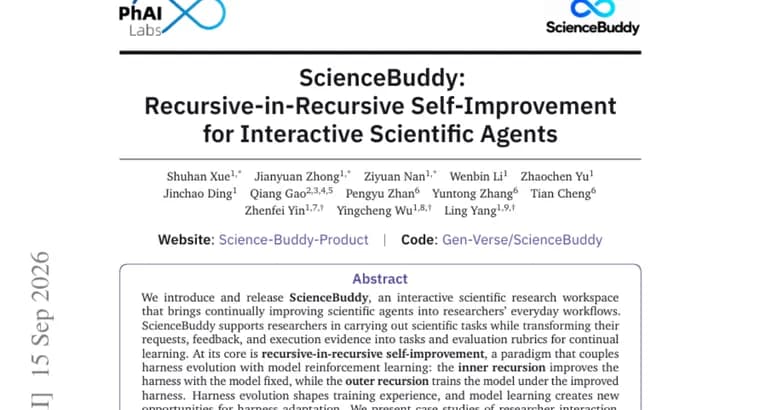
ScienceBuddy is an interactive scientific research workspace designed to bring continually improving scientific agents into researchers' everyday workflows. It supports researchers carrying out scientific tasks while turning their requests, feedback and execution evidence into tasks and evaluation rubrics that feed continual learning.
At the core of the system is what its creators call recursive-in-recursive self-improvement, a paradigm that couples harness evolution with model reinforcement learning. The design nests two loops: an inner recursion that improves the execution harness while the model itself stays fixed, and an outer recursion that then trains the model under that improved harness. The two loops feed each other: harness evolution shapes what the model trains on, and what the model learns in turn opens new opportunities for adapting the harness.
The release includes case studies covering researcher interaction, harness refinement and model learning, with benchmark cases spanning four scientific task families that the text does not name. The authors present ScienceBuddy as a research product, making the paradigm available to the scientific community, and frame it as a step toward what they call discovery intelligence: scientific AI that advances through sustained collaboration with researchers and evolves alongside the research it supports. The project is hosted at science-buddy.io.
Key facts
- ScienceBuddy is an interactive scientific research workspace that folds continually improving scientific agents into researchers' everyday workflows, turning their requests, feedback and execution evidence into tasks and evaluation rubrics for continual learning.
- Its core method, recursive-in-recursive self-improvement, nests two loops: an inner recursion that improves the execution harness while the model stays fixed, and an outer recursion that trains the model under that improved harness.
- The two loops reinforce each other: harness evolution shapes the model's training experience, and model learning opens new opportunities for adapting the harness.
- The release includes case studies of researcher interaction, harness refinement and model learning, with benchmark cases spanning four scientific task families that the text does not name.
- ScienceBuddy ships as a research product, framed as a step toward what its creators call discovery intelligence, and is hosted at science-buddy.io.
Why it matters
ScienceBuddy's central idea is to keep two things moving instead of just one: the execution harness (the tools, tasks and evaluation rubrics surrounding the model) and the model itself. Recursive-in-recursive self-improvement nests an inner recursion that improves the harness while the model stays fixed, inside an outer recursion that trains the model under that improved harness. The authors say the two reinforce each other, with harness evolution shaping the model's training experience and model learning opening new opportunities for harness adaptation. The stated premise is that researchers' own requests, feedback and execution evidence become the raw material feeding both loops, so the training material comes directly from researchers' own use of the workspace.
Who it affects
The immediate subjects are the researchers who use ScienceBuddy to carry out scientific tasks: their requests, feedback and execution evidence are what the continual-learning loop turns into new tasks and evaluation rubrics, so their day-to-day use is what the system keeps learning from. The authors also address the wider scientific community, presenting the release as a step toward what they call discovery intelligence: scientific AI that advances through sustained collaboration with researchers and evolves alongside the research it supports.
How to use it
ScienceBuddy is released as a research product with a public site at science-buddy.io. The text describes researchers using the workspace to carry out scientific tasks, with their requests, feedback and execution evidence feeding the continual-learning loop, but it does not say whether ScienceBuddy or its code is open source, or what is actually available at the site beyond naming it. No price or access process is given.
How solid is it
The description is the authors' own account of their method and release. The text gives no benchmark results, accuracy figures or performance comparisons to support the design, and the four scientific task families used in the case studies are not named or described, so their difficulty and relevance cannot be judged from the text alone. At the time of writing, the piece had drawn 16 points and one comment on Hugging Face's papers board, suggesting it has attracted little outside scrutiny so far.
Risks and caveats
The text does not name any individual author, institution or company behind ScienceBuddy, and it gives no date for the paper's submission or for the system's release. It also does not identify an underlying model or base LLM. Readers are left with the authors' own description of the paradigm and no independent detail on who built it, when, or on top of what model.
“The inner recursion improves the harness with the model fixed, while the outer recursion trains the model under the improved harness.”
— the ScienceBuddy paper