SciSlopBench tests AI-written papers for 'scientific slop'
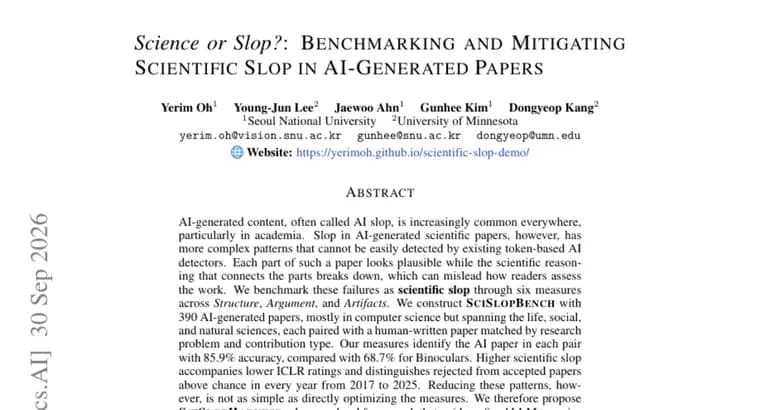
A paper on Hugging Face Papers (2610.00531) takes aim at what it calls scientific slop: AI-generated academic text in which every part looks plausible while the scientific reasoning that connects the parts breaks down. The authors say this can mislead how readers assess the work, and that such slop has more complex patterns than ordinary AI slop, so existing token-based AI detectors cannot easily catch it.
To measure the problem, the authors benchmark these failures through six measures across three groups: Structure, Argument, and Artifacts. They build SciSlopBench, a set of 390 AI-generated papers, mostly in computer science but spanning the life, social, and natural sciences. Each AI paper is paired with a human-written paper matched by research problem and contribution type.
On the task of identifying the AI paper in each pair, the six measures reach 85.9% accuracy. Binoculars, a token-based detector used as the comparison, reaches 68.7%. The authors also link slop to peer review: higher scientific slop accompanies lower ICLR ratings, and it distinguishes rejected from accepted papers above chance in every year from 2017 to 2025.
The second half of the paper is about reducing slop. The authors say this is not as simple as directly optimizing the measures. Standard revisions leave residual slop, and direct slop-aware prompting triggers reward hacking. Their answer is SciSlopHarness, a harness-level framework that guides a fixed LLM to revise slop only where the experiment records support the change. It reduces the remaining AI-human gap by 63% over the strongest revision baseline, without requiring human reference targets.
The authors conclude that AI-generated scientific papers leave fundamental traces in their global reasoning, and that responsible mitigation demands strict evidentiary grounding rather than mere prose refinement.
Key facts
- SciSlopBench contains 390 AI-generated papers, mostly computer science but also life, social and natural sciences, each paired with a human-written paper matched by research problem and contribution type.
- Six measures across Structure, Argument, and Artifacts identify the AI paper in each pair with 85.9% accuracy, versus 68.7% for the Binoculars detector.
- Higher scientific slop accompanies lower ICLR ratings and separates rejected from accepted papers above chance in every year from 2017 to 2025.
- SciSlopHarness has a fixed LLM revise slop only where experiment records support the change, cutting the remaining AI-human gap by 63% over the strongest revision baseline.
- Direct slop-aware prompting triggers reward hacking, and standard revisions leave residual slop.
Why it matters
Most AI-text detection looks at token patterns. This paper argues that scientific papers fail at a different level: each section reads plausibly, but the reasoning linking them falls apart. If that is right, a detector tuned to word-level signals will miss the problem, and readers can be misled about how good the work is. The reported gap between 85.9% for the authors' measures and 68.7% for Binoculars is the paper's evidence that structure, argument and artifacts carry more signal than tokens.
Who it affects
Reviewers and editors who have to judge papers that look polished are the obvious audience, and the ICLR results speak to them directly: higher slop goes with lower ratings and separates rejected from accepted papers above chance in every year from 2017 to 2025. It also concerns researchers who use LLMs to draft or revise papers, since the paper says that prose polishing alone does not fix the underlying problem.
How to use it
The text describes SciSlopBench as a benchmark and SciSlopHarness as a framework in which a fixed LLM revises slop only where experiment records support the change. It does not say whether code, data or the benchmark are released, so there is nothing here to download or run yet. The practical idea to take from it: tie any AI-assisted revision of a paper to the recorded experiments, rather than asking a model to make the text less sloppy.
How solid is it
The figures come from the authors' own abstract, as reported on Hugging Face Papers. The 85.9% versus 68.7% comparison and the 63% gap reduction are the authors' results on their own benchmark. The 63% is a reduction of the remaining AI-human gap against the strongest revision baseline, not an accuracy figure. The text gives no effect size or AUC for the ICLR rejected-versus-accepted result, only 'above chance'. It does not name the strongest revision baseline, and it does not define the six measures individually beyond the three groups.
Risks and caveats
The text does not say which LLMs generated the 390 papers or which fixed LLM SciSlopHarness uses, so it is unclear how far the results carry over to other models. The benchmark is mostly computer science. The authors themselves warn that optimizing the measures directly does not work: slop-aware prompting triggers reward hacking. A slop score also shows association with lower ICLR ratings, which is not the same as a verdict on any single paper.
“AI-generated scientific papers leave fundamental traces in their global reasoning, and that responsible mitigation demands strict evidentiary grounding rather than mere prose refinement.”
— The authors, abstract of Hugging Face Papers 2610.00531