SciUtopia simulates academic research with LLM agents across 61 worlds
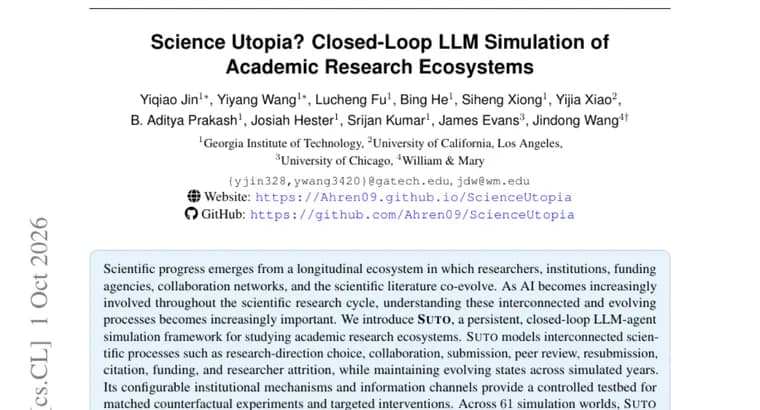
A paper titled "Science Utopia? Closed-Loop LLM Simulation of Academic Research Ecosystems" introduces SciUtopia, a persistent, closed-loop simulation framework in which LLM agents play the parts of researchers and other actors in academic science. The starting premise is that scientific progress emerges from a longitudinal ecosystem where researchers, institutions, funding agencies, collaboration networks and the scientific literature co-evolve. As AI becomes more involved across the research cycle, the authors say, understanding these interconnected, evolving processes matters more.\n\nSciUtopia models research-direction choice, collaboration, submission, peer review, resubmission, citation, funding and researcher attrition, and it keeps evolving states across simulated years. Its institutional mechanisms and information channels are configurable, which the authors describe as a controlled testbed for matched counterfactual experiments and targeted interventions.\n\nThe scale is substantial. Across 61 simulation worlds, SciUtopia simulates over 40,000 researchers from 8,000 institutions. These runs produced around 400,000 publication decisions and 1.2 million LLM-generated peer reviews.\n\nUsing these longitudinal simulations, the authors report three findings. First, rejection-driven resubmission substantially amplifies reviewer burden beyond population growth alone. Second, cautious exploration balances citation impact with career success and long-term topic diversity. Third, resource inequality can emerge even without detectable cumulative advantage from narrowly winning early funding. Code is available on GitHub at github.com/Ahren09/ScienceUtopia.
Key facts
- SciUtopia is a persistent, closed-loop LLM-agent simulation of academic research ecosystems, with evolving states kept across simulated years.
- It models research-direction choice, collaboration, submission, peer review, resubmission, citation, funding and researcher attrition.
- Across 61 simulation worlds it simulates over 40,000 researchers from 8,000 institutions, producing around 400,000 publication decisions and 1.2 million LLM-generated peer reviews.
- Reported findings: rejection-driven resubmission amplifies reviewer burden beyond population growth alone, and cautious exploration balances citation impact, career success and topic diversity.
- Resource inequality can emerge even without detectable cumulative advantage from narrowly winning early funding. Code is on GitHub.
Why it matters
Science policy questions such as how to fund, review and organise research are hard to test on real institutions. SciUtopia offers a configurable simulated testbed where mechanisms and information channels can be changed and compared in matched counterfactual experiments. The authors frame it against a backdrop of AI becoming more involved throughout the research cycle. The scale, 61 worlds and about 1.2 million simulated reviews, is large for this kind of study.
Who it affects
The most direct audience is researchers who study the science of science, peer review and research funding, along with anyone designing institutional mechanisms. The three findings touch reviewers (resubmission load), early-career researchers (exploration strategy and career success) and funders (how inequality emerges). The paper is a framework for studying these groups, not a description of any real institution.
How to use it
The authors say code is available at https://github.com/Ahren09/ScienceUtopia. The framework is built for matched counterfactual experiments and targeted interventions, so a researcher could change institutional mechanisms or information channels and compare outcomes across worlds.
How solid is it
The material here is the paper's abstract, and the numbers are the authors' own: 61 worlds, over 40,000 researchers, 8,000 institutions, around 400,000 publication decisions and 1.2 million LLM-generated peer reviews. The findings come from simulation. The abstract does not say they were validated against real-world academic data. It also gives no effect sizes or numeric magnitudes for the three findings, and it does not say which LLMs power the agents or how many simulated years each world covers.
Risks and caveats
All three findings are outputs of LLM agents in a simulated world, so they show what the model produces, not necessarily how real science behaves. Peer reviews here are LLM-generated, and the abstract does not say whether they were checked against real reviewing. The inequality result is stated narrowly: inequality can emerge without detectable cumulative advantage from narrowly winning early funding. That is not a claim that funding advantage never matters. Treat the conclusions as hypotheses until the full paper's methods and magnitudes are examined.