Semi-OPD beats on-policy distillation in 14 of 17 model pairs
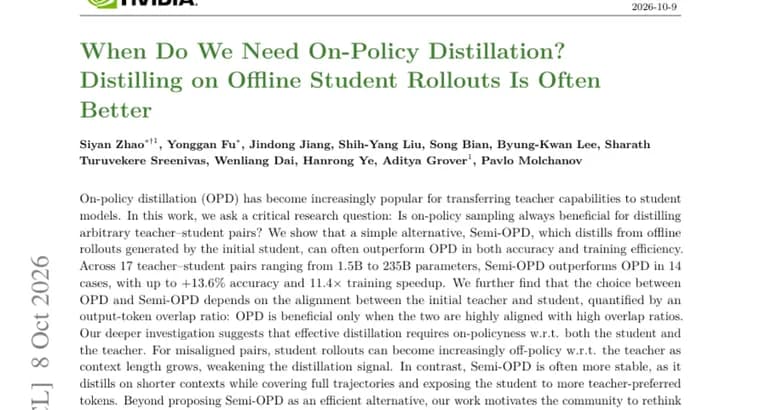
On-policy distillation (OPD) has become increasingly popular as a way to transfer a teacher model's capabilities to a student model. A research paper, whose abstract is posted on Hugging Face Papers, asks whether on-policy sampling is always beneficial when distilling arbitrary teacher-student pairs.
The authors propose a simple alternative called Semi-OPD. Instead of sampling fresh rollouts from the student as training proceeds, it distills from offline rollouts generated by the initial student. They report that this can often outperform OPD in both accuracy and training efficiency.
The evidence is a sweep of 17 teacher-student pairs ranging from 1.5B to 235B parameters. Semi-OPD outperforms OPD in 14 of the 17 cases, with gains of up to +13.6% accuracy and up to 11.4x training speedup. Both figures are maxima, not typical results.
The paper also says when each method fits. The choice between OPD and Semi-OPD depends on the alignment between the initial teacher and student, which the authors quantify with an output-token overlap ratio. OPD is beneficial only when the two are highly aligned, with high overlap ratios.
The authors' deeper investigation suggests that effective distillation requires on-policyness with respect to both the student and the teacher. For misaligned pairs, student rollouts can become increasingly off-policy with respect to the teacher as context length grows, which weakens the distillation signal. Semi-OPD is often more stable because it distills on shorter contexts while still covering full trajectories, and it exposes the student to more teacher-preferred tokens.
Beyond offering Semi-OPD as an efficient alternative, the authors say their work should push the community to rethink when to use OPD and to study stronger OPD variants with meaningful teacher-student pairs.
Key facts
- Semi-OPD distills a teacher into a student using offline rollouts generated by the initial student, rather than on-policy sampling.
- Across 17 teacher-student pairs from 1.5B to 235B parameters, Semi-OPD outperforms OPD in 14 cases.
- The best reported results are up to +13.6% accuracy and up to 11.4x training speedup over OPD.
- OPD is beneficial only when teacher and student are highly aligned, measured by an output-token overlap ratio.
- For misaligned pairs, student rollouts drift off-policy with respect to the teacher as context length grows, weakening the distillation signal.
Why it matters
OPD has become a popular way to transfer teacher capabilities to students, and this paper questions the assumption that sampling on-policy is always the better choice. Its claim is narrower and more useful than a blanket verdict: OPD pays off only when teacher and student are already closely aligned, and otherwise a simpler offline approach can win on both accuracy and training cost. The authors say the result should make the community rethink when OPD is used and study stronger OPD variants with meaningful teacher-student pairs.
Who it affects
Anyone distilling a larger teacher model into a smaller student, particularly where the two models differ a lot in how they generate text. The tested pairs span 1.5B to 235B parameters, so the claim is not limited to one scale. Researchers working on OPD variants are also addressed directly: the authors call for stronger variants evaluated on meaningful teacher-student pairs.
How to use it
The practical takeaway is to check alignment before choosing a method. The authors measure it with an output-token overlap ratio between the initial teacher and student. When overlap is high, OPD is beneficial; when the pair is misaligned, Semi-OPD, which distills from offline rollouts generated by the initial student, is often the better and cheaper option. No numeric threshold for the overlap ratio is given. No code or model release, publication venue or date is mentioned.
How solid is it
This account rests on the paper's abstract alone, so the details of the experiments are not visible. The headline numbers are specific: 14 of 17 pairs favour Semi-OPD, with maxima of +13.6% accuracy and 11.4x training speedup. But the abstract names no specific teacher or student models, no benchmarks or tasks, and does not say whether +13.6% is percentage points or a relative gain. The mechanism explanation is phrased by the authors as a suggestion from their investigation, not a proof. The abstract names no authors or institutions.
Risks and caveats
The 13.6% and 11.4x figures are best cases, and no typical or average gain or speedup is stated. Semi-OPD does not win everywhere: in 3 of the 17 pairs it does not outperform OPD, and those cases are not described. The authors also say OPD remains beneficial for highly aligned pairs, so the result is a rule for choosing between methods, not a case for dropping OPD. Because the benchmarks and models are not named, how far the numbers transfer to a given setup is unclear.
“Is on-policy sampling always beneficial for distilling arbitrary teacher-student pairs?”
— Paper abstract, Hugging Face Papers