Skaling law cuts scaling-law prediction error by up to 3x
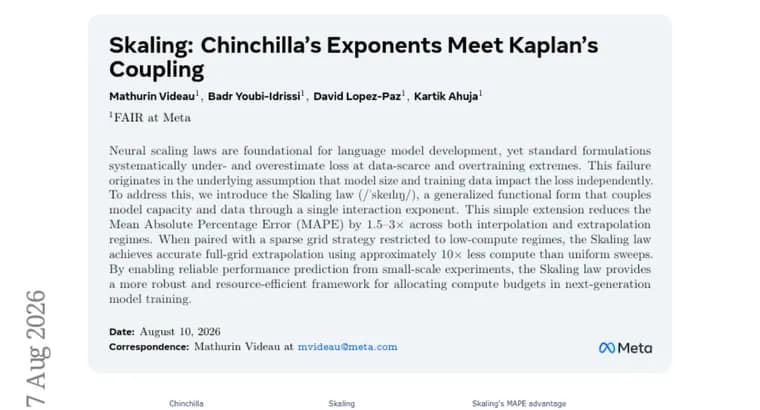
Standard neural scaling laws, the formulas labs use to predict how loss will fall as models and datasets grow, assume model size and training data affect loss independently. A new paper argues that assumption is wrong, and that it is exactly why standard formulations systematically underestimate or overestimate loss at the two extremes practitioners care most about: data-scarce training and overtraining. The paper, titled 'Skaling: Chinchilla's Exponents Meet Kaplan's Coupling,' introduces the Skaling law, a generalized functional form that couples model capacity and data through a single added interaction exponent rather than treating the two as separate terms. Across both interpolation (predicting within the range of data already seen) and extrapolation (predicting beyond it), this change reduces the Mean Absolute Percentage Error (MAPE) of loss predictions by 1.5 to 3x compared with standard formulations. The paper also pairs the Skaling law with a sparse grid strategy, a training schedule restricted to low-compute regimes, and reports that the combination achieves accurate full-grid extrapolation using about 10x less compute than sweeping the full grid of model and data sizes uniformly. The stated aim is to let teams predict large-scale model performance reliably from small-scale experiments, making compute-budget allocation for future model training more robust and resource-efficient.
Key facts
- Standard scaling laws assume model size and training data affect loss independently, which the paper identifies as the cause of systematic under- and overestimation of loss at data-scarce and overtraining extremes.
- The Skaling law adds a single interaction exponent that couples model capacity and data instead of treating them separately.
- Mean Absolute Percentage Error (MAPE) of loss predictions drops 1.5 to 3x across both interpolation and extrapolation regimes versus standard formulations.
- Paired with a sparse grid strategy restricted to low-compute regimes, the method reaches accurate full-grid extrapolation using about 10x less compute than uniform sweeps.
- The goal stated is more reliable performance prediction from small-scale experiments, to make compute-budget allocation for large training runs more efficient.
Why it matters
Scaling laws are how labs decide, before spending the compute, roughly how a model's loss will fall as they add parameters or training tokens. The paper argues the standard formulations get this wrong at exactly the two extremes that matter most in practice: when data is scarce and when a model is trained well past the compute-optimal point. It traces the error to a specific modeling choice, treating model size and data as independent contributors to loss, and fixes it by coupling them through one added exponent. The 1.5 to 3x cut in prediction error, and the roughly 10x compute reduction for full-grid extrapolation when paired with a sparse grid strategy, are direct consequences of that single change.
Who it affects
Anyone running scaling-law experiments to plan large training runs: teams that extrapolate from small-scale pilot runs to decide how big a model or dataset to commit compute to, and researchers working on scaling-law theory itself, since the paper's title frames it as reconciling two established scaling-law traditions (Chinchilla-style exponents and Kaplan-style coupling).
How to use it
The paper describes pairing the Skaling law with a sparse grid strategy, a set of training runs restricted to low-compute regimes, to extrapolate accurately across the full grid of model and data sizes. It reports this combination needs about 10x less compute than sweeping the full grid uniformly, which would let a team run far fewer pilot configurations and still get a reliable full-grid prediction. The source gives no detail on how the sparse grid is constructed beyond naming the approach.
How solid is it
The claims come from a paper abstract with no author names, institutional affiliations, specific model sizes, datasets, or benchmark suites named in the available text, and no absolute MAPE values, only the 1.5 to 3x and roughly 10x reduction factors relative to standard methods. That is consistent with an early paper posting rather than a fully detailed writeup, but it means the improvement figures cannot yet be checked against a specific experimental setup from the text alone.
Risks and caveats
No timeline is given for whether or when this framework would see practical adoption, and the sparse grid strategy is named without a description of how it is built or how sensitive the 10x compute figure is to that construction. The reported gains are relative improvement factors rather than absolute error rates, so the practical size of the remaining prediction error is not stated.