SLA adds 3D spatial alignment to pi05 robot policy during continual pre-training
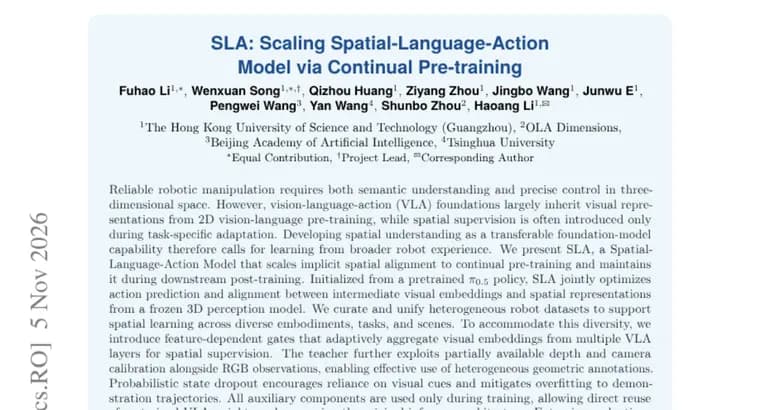
A paper listed on Hugging Face presents SLA, a Spatial-Language-Action Model for robot manipulation. The authors start from a problem: reliable manipulation needs both semantic understanding and precise control in three-dimensional space, yet vision-language-action (VLA) foundations largely inherit their visual representations from 2D vision-language pre-training. Spatial supervision, they say, is often introduced only during task-specific adaptation. Developing spatial understanding as a transferable foundation-model capability therefore calls for learning from broader robot experience.
SLA scales implicit spatial alignment to continual pre-training and maintains it during downstream post-training. The model is initialized from a pretrained pi05 policy. It jointly optimizes action prediction and the alignment between its intermediate visual embeddings and spatial representations from a frozen 3D perception model, which acts as a teacher.
The paper lists several design pieces. The authors curate and unify heterogeneous robot datasets to support spatial learning across diverse embodiments, tasks and scenes. To cope with that diversity, they introduce feature-dependent gates that adaptively aggregate visual embeddings from multiple VLA layers for spatial supervision. The teacher also uses partially available depth and camera calibration alongside RGB observations, which lets the method make use of heterogeneous geometric annotations. Probabilistic state dropout encourages the model to rely on visual cues and mitigates overfitting to demonstration trajectories.
All of these auxiliary components are used only during training. That allows direct reuse of pretrained VLA weights and preserves the original inference architecture. The text available here is the paper's abstract and gives no benchmark results or other figures.
Key facts
- SLA is a Spatial-Language-Action Model initialized from a pretrained pi05 policy.
- It jointly optimizes action prediction and alignment between intermediate visual embeddings and spatial representations from a frozen 3D perception model.
- Feature-dependent gates aggregate visual embeddings from multiple VLA layers, and the teacher can use partial depth and camera calibration alongside RGB.
- Probabilistic state dropout is meant to reduce overfitting to demonstration trajectories.
- Auxiliary components are training-only, so pretrained VLA weights can be reused and the inference architecture stays unchanged.
Why it matters
The authors argue that VLA models mostly inherit 2D visual representations, with spatial supervision added only when a model is adapted to a specific task. SLA moves spatial alignment into continual pre-training and keeps it through post-training, so that spatial understanding becomes a transferable capability of the foundation model rather than a per-task add-on.
Who it affects
Robotics and machine learning researchers building VLA policies, especially those working from pi05-style pretrained checkpoints or training on mixed robot datasets with different embodiments, tasks and scenes.
How to use it
The abstract describes a training recipe: start from a pretrained pi05 policy, add alignment to a frozen 3D perception model, use feature-dependent gates over several VLA layers, and apply probabilistic state dropout. Because the auxiliary parts are used only in training, the pretrained weights can be reused directly and inference runs on the original architecture.
How solid is it
This is a paper abstract, and the authors' claims are stated without supporting numbers in the text. No benchmark results, success rates or comparison with the original pi05 are reported there. Treat the approach as a proposal until the full results are read.
Risks and caveats
The abstract does not name the frozen 3D perception model, the datasets or the number of embodiments, and does not describe real-robot or simulation evaluation. Whether the claimed benefits hold up can't be judged from this text alone.