Tau Robotics sends remotely piloted humanoid robots to clean San Francisco homes
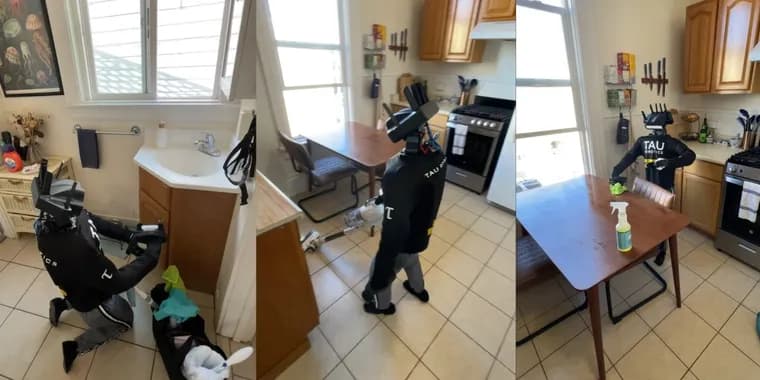
The startup Tau Robotics is sending humanoid robots to clean homes in San Francisco, and a writer at MIT Technology Review booked one without telling the company about being a journalist (the real name was used, so Tau could have looked it up). The writer had seen an X post about the service, joined the waitlist, and wanted the apartment to feel like The Jetsons for an hour.
The robots are not autonomous. For now they are piloted remotely by humans, who watch through cameras mounted in the robots' heads and wrists. While the robots clean, they collect data that Tau will use to train more independent models. Because that data is so valuable to Tau, it charges less than one might expect. When the writer booked, an hourlong cleaning with a single robot cost $30; the current price is $60 per weekly cleaning with two robots, or $100 for a one-time visit. Even at $30 an hour the writer says the robots are not a great bargain: they are thorough but slow, and anyone tempted to stand and watch the whole visit would be better off cleaning the place themselves.
Each robot stands four and a half feet tall. It has a 3D-printed head with antennae for communicating with Tau's headquarters and two 3D-printed claw hands; the more humanlike alternatives apparently are not durable enough, and claws do surprisingly well for most cleaning tasks. The writer's robot wore a Tau Robotics shirt and grippy socks to protect the hardwood floors. The writer likens the setup to a radio-controlled car more than a Waymo. Tasks such as making the bed and folding laundry need kinematic guidance: the human pilot performs the motions, sensors transmit them, and the robot copies them. Those guided tasks produce especially valuable training data. According to cofounder Cornelia Weinzierl, the robot can already do some other tasks, such as vacuuming and mopping, with no human help.
The first visit went badly. The robot arrived in a blue minivan and was helped out by Weinzierl and another Tau employee. It then struggled up the eight stairs to the building's front door, stumbling as if drunk, though it never entirely lost its footing. The carpeted staircase inside beat it completely, and Weinzierl had to carry it up the last few steps. During cleaning it kept stalling. Weinzierl blamed overheating in unseasonably hot weather, until a colleague said the heat had shut down not the robot but the equipment its human controller was using to watch it. Without remote assistance the robot could not work, so it left before the booked hour was up. Weinzierl explained that the odd walking comes from remote operation from headquarters: a short signal delay can affect coordination. "The amount of work and time that we spend just optimizing, for example, timings and connectivity is crazy," she said. Back in September a Tau representative stayed with the robot throughout visits; she says that is no longer necessary.
Tau apologized by email, comped the visit and offered another, and that was before the writer revealed being a journalist. The second cleaning, about a month later, went more smoothly. The robot got up the stairs with little help, though still with the stagger. It did a creditable job on the kitchen (without braving the stove) and cleaned the toilet, which the writer calls its most impressive performance: three times the head fell off its toilet cleaning wand, and three times it reattached it by poking around with the handle until it connected at the right angle. It also repeatedly left taps dripping, knocked over a closed bottle of olive oil, and could not right an air purifier it had toppled. The writer forgave all of it for the charm, comparing the feeling to being delivered home safely by a Waymo.
The writer also flags the downside: if Tau or its competitors manage to train robots to clean autonomously and cheaply, people could lose their livelihoods, and the United States is a long way from policies to support those unemployed by AI. Weinzierl argues that handing cleaning to robots could make sense someday: cleaning is not a job many people actively want, with high turnover and a high risk of injury. She said the company is starting to consider someday using the robots for other dangerous or physically demanding work, such as mold remediation and home health care. The writer's verdict: Tau has a long way to go, since the data needed for varied apartment cleaning is probably enormous and the company has completed only a couple hundred cleanings, but it is remarkable that humanoid robots can now clean toilets and mop floors, even with a lot of human help.
Key facts
- Tau Robotics sends four-and-a-half-foot humanoid robots to clean San Francisco homes; for now humans pilot them remotely through cameras in the robots' heads and wrists.
- Cleanings double as training data: the writer booked at $30 for an hour with one robot, and the current price is $60 per weekly cleaning with two robots or $100 for a one-time visit.
- The first visit ended early after equipment used by the human controller shut down in the heat; the second, about a month later, went much better, including a toilet cleaned after the wand head fell off three times.
- The writer calls the robots thorough but slow and not a great bargain, and notes the company has completed only a couple hundred cleanings.
- Cofounder Cornelia Weinzierl says the robot can already vacuum and mop without human help; the writer warns that cheap autonomous cleaners could cost people their livelihoods.
Why it matters
This is a rare first-hand look at a humanoid robot doing paid household work in a real home. The writer's comparison is telling: with so much human support, the robots are closer to radio-controlled cars than Waymos. Tau's model is to trade a cheap service for data, since every wiped counter and folded T-shirt helps train the models that will power more independent versions. The piece shows both how far such robots have come (they can clean a toilet and mop a floor) and how much human labor still sits behind them.
Who it affects
Today it affects San Francisco households that can book Tau's service, and the humans who pilot the robots remotely from the company's headquarters. Further out, the writer says cleaners could lose their livelihoods if Tau or competitors train robots to clean autonomously and cheaply. Weinzierl frames the work as one with high turnover and a high risk of injury, and says Tau is starting to consider other dangerous or physically demanding jobs such as mold remediation and home health care.
How to use it
The service is in San Francisco; the writer found it through an X post and a waitlist. Current prices are $60 per weekly cleaning with two robots and $100 for a one-time visit; the writer booked at an earlier $30 for an hourlong visit with one robot. The writer's practical advice: the robots are thorough but slow, so if you would stand and watch the whole visit, you would probably do better to clean yourself. Expect the robot to arrive by minivan with Tau staff, and expect that stairs may give it trouble.
How solid is it
This is one writer's first-hand experience of two visits, one cut short, so it is anecdote rather than a systematic test. The writer did not reveal being a journalist until a few weeks after the first cleaning, which supports an authentic experience, though the real name was used and Tau might have looked it up. Claims about autonomy (vacuuming and mopping without human help) come from Weinzierl, not from independent verification. Tau has completed only a couple hundred cleanings so far.
Risks and caveats
The robots depend on remote human operators and stable connections: the first visit failed when the controller's equipment shut down in the heat, and a short signal delay can affect the robot's coordination. Observed mishaps included dripping taps, a knocked-over closed bottle of olive oil, and an air purifier the robot could not right. The service is a beta product with a long way to go; the data needed to train robots for varied apartment cleaning is probably enormous. The writer also notes that customers give up some data privacy, and that the United States is a long way from policies to care for people unemployed by AI.
“We need people, and we don’t have them, and no one wants to do it.”
— Cornelia Weinzierl, Tau cofounder