SMELT loops MoE transformer layers, cuts training FLOPs by up to 18%
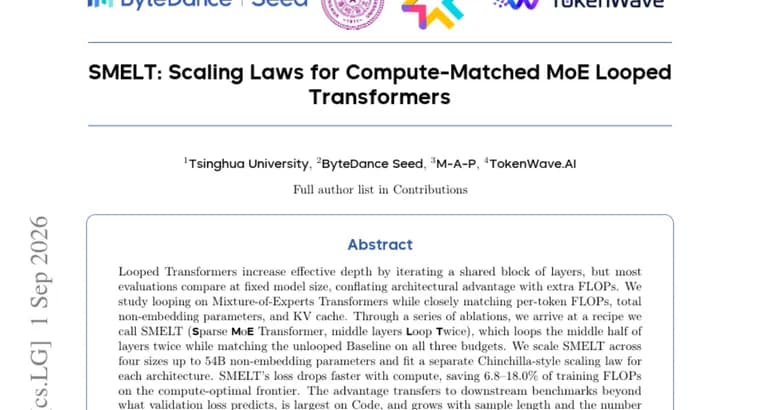
Looped transformers, which reuse a shared block of layers to add effective depth, are usually tested at a fixed model size, a setup that mixes up the benefit of the looping architecture itself with the extra compute it happens to use. Researchers instead tested looping on Mixture-of-Experts (MoE) transformers while holding three budgets equal to an unlooped baseline: per-token FLOPs, total non-embedding parameters, and KV cache size. Through a series of ablations they settled on a recipe named SMELT, for Sparse MoE Transformer, middle layers Loop Twice, which runs the middle half of a model's layers through twice while everything else stays matched to the baseline.
The team scaled SMELT across four model sizes, up to 54 billion non-embedding parameters, and fit a separate Chinchilla-style scaling law for each architecture to compare them on equal footing. SMELT's training loss falls faster with compute than the baseline's, saving 6.8 to 18.0 percent of training FLOPs on the compute-optimal frontier. That advantage carries over to downstream benchmarks by more than validation loss alone would predict, is largest on coding tasks, and grows as sample length and the number of in-context examples increase.
A mechanistic analysis of why the recipe works found that a token's second pass through the looped layers reduces the attention sink, the tendency of attention to pile onto a few fixed tokens rather than the content that matters, and redirects that attention mass toward content-relevant tokens instead. The authors describe this shift as an inductive bias that may underlie the performance gains, and conclude that looping can improve transformers even when compute, parameters and memory are held constant against a non-looped baseline of the same size.
Key facts
- SMELT (Sparse MoE Transformer, middle layers Loop Twice) loops the middle half of an MoE transformer's layers twice while matching an unlooped baseline on per-token FLOPs, total non-embedding parameters, and KV cache.
- Scaled across four model sizes up to 54 billion non-embedding parameters, with a separate Chinchilla-style scaling law fit for each architecture.
- SMELT saves 6.8 to 18.0 percent of training FLOPs on the compute-optimal frontier compared with the matched baseline.
- The gain on downstream benchmarks exceeds what validation loss predicts, is largest on Code, and grows with longer samples and more in-context examples.
- Mechanistic analysis shows the second pass through the looped layers reduces the attention sink and redirects attention toward content-relevant tokens.
Why it matters
Most looped-transformer results to date compared a looped model against a same-size baseline, which lets a looped model quietly use more compute per token and makes it impossible to tell how much of the gain is the architecture and how much is extra FLOPs. SMELT is built specifically to close that gap: it matches an MoE baseline on FLOPs, parameters and KV cache, and still comes out ahead on the compute-optimal frontier. That is evidence that depth reuse through looping is a real architectural advantage for MoE transformers, not an artifact of an uneven comparison.
Who it affects
The result speaks to teams designing and training large MoE transformers, since it offers a way to improve the compute-loss tradeoff without changing the FLOP, parameter or memory budget already committed to a model. It also matters to researchers studying scaling laws and transformer interpretability, given the paper fits a separate Chinchilla-style scaling law per architecture and backs its result with a mechanistic explanation rather than benchmark numbers alone.
How to use it
SMELT is described as a recipe rather than a released model or product: loop the middle half of a Mixture-of-Experts transformer's layers twice while holding per-token FLOPs, non-embedding parameter count and KV cache equal to a non-looped baseline of the intended size. The source gives no code release, licence or pricing, so applying it means implementing the described recipe rather than adopting a shipped tool.
How solid is it
The claim rests on scaling experiments across four model sizes up to 54 billion non-embedding parameters, with a dedicated scaling law fit per architecture rather than a single-size comparison, plus a mechanistic analysis of attention patterns that offers a causal explanation rather than only a correlation. The source names no institution, author or publication venue in the text itself, and gives no absolute FLOP or loss values, only the 6.8 to 18.0 percent savings range and the parameter ceiling, so independent replication or peer review status cannot be assessed from the abstract alone.
Risks and caveats
The paper compares SMELT only against an unlooped baseline matched on the same three budgets; it does not report how SMELT stacks up against other looping recipes, so its advantage over the broader field of depth-reuse methods is untested here. The attention sink explanation is offered as a plausible mechanism the authors say 'may underlie' the gains, not a proven cause, and all figures come from the paper's own scaling-law fits rather than independently verified benchmarks.