Startups pay you to rent out spare compute for AI inference
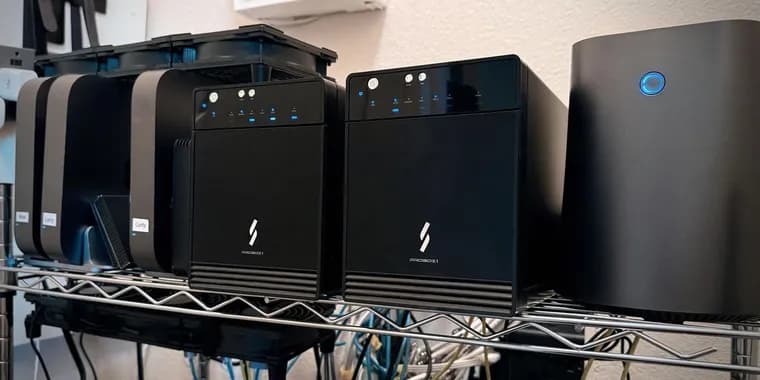
A cluster of startups is trying to turn the world's idle laptops, gaming rigs and home servers into a paid market for AI inference, the step where a pretrained model actually answers a query. Ilman Shazhaev, founder and CEO of Abu Dhabi-based Far Labs, describes the pitch as "Uber or Airbnb, but for AI-inference computing tasks." His platform, Far AI, is launching in the coming weeks. John Federico, founder and CEO of Austin-based Evolving Edge, is already running an open beta with the same premise, and the article names Bless Network, Salad and Gradient as other companies that have launched similar platforms over the past year.
The pitch is explicitly about avoiding new data centers, which the article says have raised local electricity prices and strained water resources and communities. Federico frames the opportunity around ordinary bandwidth: "92 percent of the country has broadband, and you have people like me who have mini data centers in a closet." Hosts sign up, install an application, and the platform runs inference jobs on their machine only on a schedule the host sets; usage is monitored but access is otherwise limited. Federico's team open-sourced its node software so hosts can inspect what runs on their machines. Far Labs designs around "least privilege": inference runs as an isolated, authenticated, encrypted workload with explicit caps on GPU, CPU, memory, storage and network use, and hosts can inspect usage, pause a node, revoke access or remove the software at any time; work is also segmented so an individual node sees only the minimum data it needs to process its piece.
Both companies are explicit that this targets smaller, mostly open-source models rather than frontier ones. Federico argues that once a company reaches a certain scale, paying for tokens on a state-of-the-art frontier model stops making sense, so they fine-tune smaller open-source models for specific tasks instead, and those models fit more easily on consumer hardware. When a model is too large for a single device, Evolving Edge splits the job across multiple GPUs or CPUs using the open-source tool Ray, while Far Labs uses its own proprietary system: it cuts a model into pieces distributed across devices, with an orchestrator and load balancer managing the task flow and combining the results.
Both founders argue the approach beats a single data center on cost, reliability and latency. Shazhaev says the model is cheaper because "we don't have capital expenditure," and more reliable because it spreads the workload across many devices instead of one that can go down entirely, comparing the resilience to Bitcoin's decentralization: "Today, to shut down Bitcoin, you need to nuke the whole planet. Here, we have the same concept." Federico makes the reliability case concrete: "We could lose 100 nodes in a network of 250,000 and it wouldn't matter." He also points to a 2026 Amazon Web Services outage during which internet-connected smart beds got stuck upright and their owners could not adjust them, arguing that a distributed model would blunt the impact of such single-point failures for smart cities, environmental sensors and autonomous vehicles as well as AI. On latency, Far Labs claims 100 milliseconds or less by routing jobs to nearby devices, which the article says could unlock use cases like in-game AI video generation that are currently too slow and expensive to run centrally.
Shazhaev also uses OpenAI's finances to argue that inference cost is the industry's real bottleneck: "OpenAI last year had US $30 billion in revenue, but they closed the financial year at an $8 billion loss. Why? The official reason is due to the high cost of inference." He notes that OpenAI's models are mostly text, whereas gameplay applications involve audio, video and animation, heavier data that demands real-time responses, which is the problem his company is trying to solve. The article positions the whole approach as a modern, commercial descendant of SETI@Home, the volunteer project that used spare home computers to scan radio-telescope data for signs of extraterrestrial life from 1999 to 2020, except that today's version pays its participants.
Key facts
- Far Labs (Abu Dhabi, launching Far AI in the coming weeks) and Evolving Edge (Austin, in open beta) pay owners of home servers, gaming PCs and laptops to run AI inference jobs on idle hardware; Bless Network, Salad and Gradient have launched similar platforms over the past year.
- The model targets smaller, mostly open-source models rather than frontier ones; oversized models get split across multiple devices, using the open-source tool Ray at Evolving Edge or Far Labs' own orchestrator-and-load-balancer system.
- Security is built around isolated, encrypted, permission-limited workloads: hosts can inspect, pause, revoke or remove the software at any time, and Evolving Edge's node software is open source.
- Far Labs claims inference latency of 100 milliseconds or less by routing jobs to nearby devices, and both founders argue distributed compute is cheaper (no capital expenditure) and more resilient to outages than a single data center.
- Shazhaev cites OpenAI's $30 billion revenue against an $8 billion loss last year as evidence that inference cost, not training cost, is the industry's real financial pressure point.
Why it matters
AI inference is treated in this piece as the industry's real cost problem, not just training: Shazhaev points to OpenAI posting $30 billion in revenue against an $8 billion loss last year and attributes it to inference costs. Distributed inference is pitched as a structural answer, cheaper because it carries no capital expenditure on data centers, and it reframes AI infrastructure as something that can be built from existing consumer hardware rather than new construction that the article says has driven up local electricity prices and strained water resources near data centers.
Who it affects
Directly: owners of home servers, gaming PCs and underused laptops, who become paid hosts on these networks. Also AI companies serving smaller, mostly open-source or fine-tuned models, who get a cheaper, lower-latency alternative to renting frontier-model tokens or building their own data centers. Federico argues the resiliency case extends beyond AI inference to smart cities, environmental sensors and autonomous vehicles, any application currently routed through a single centralized point of failure.
How to use it
Far Labs' platform, Far AI, is launching in the coming weeks; Evolving Edge is already in open beta. Becoming a host means signing up and installing an application; jobs run on the device only per a schedule the host sets, and the host can monitor usage. Far Labs layers on "least privilege" controls: encrypted, authenticated, resource-capped workloads, with the ability to inspect, pause, revoke or remove access at any time. The source gives no figures on what a host could actually earn or on pricing and revenue-share terms.
How solid is it
The claims in the article come almost entirely from the two companies' own founders, Shazhaev and Federico, describing their own products; there is no independent measurement of the claimed 100-millisecond latency, the cost savings, or the reliability comparisons to data centers. The article itself is more skeptical about scope: it states that training frontier models and running the leading companies' own models will likely remain the purview of large data centers, so this approach is explicitly aimed at smaller, mostly open-source workloads rather than the state of the art. In-game AI video generation is floated only as a hypothetical use case this approach might enable, not something any of these companies has shipped.
Risks and caveats
The article does not disclose how much a host could actually earn, nor any pricing, payout schedule or revenue-share terms, so the economics of participating are unclear. Consumer devices are also, by the article's own account, less powerful, more varied and less reliably connected than data-center hardware, which is why large or state-of-the-art models still need splitting across many devices or simply do not fit. Security depends on trusting each platform's isolation and permissioning claims; the article reports these as design principles from the companies themselves rather than as externally audited guarantees.
“Imagine Uber or Airbnb, but for AI-inference computing tasks”
— Ilman Shazhaev, founder and CEO of Far Labs