Speculative Forcing cuts denoising steps in autoregressive video generation
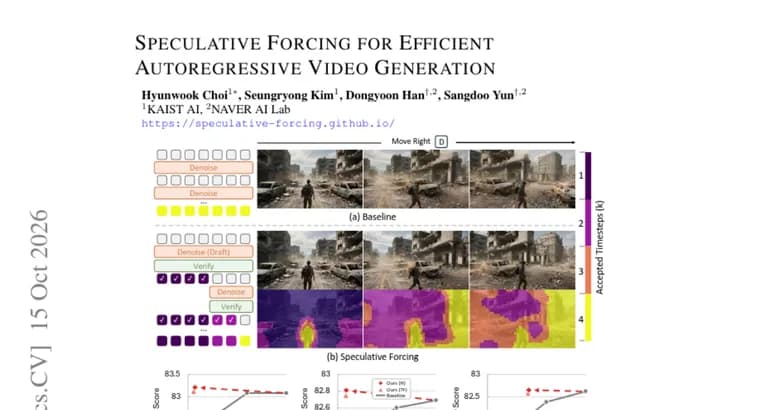
Few-step autoregressive video generators make streaming generation possible, but the authors point out a waste: every token goes through the final denoising step, however much refinement it actually needs. Their observation is that this uniform computation is often unnecessary. Many tokens already closely match their eventual full-step outputs in the initial steps, while others need refinement right to the end.
The paper introduces Speculative Forcing, a framework built on that observation. It treats the intermediate clean estimates as drafts and predicts when individual tokens can be safely accepted early. Once a token is accepted, it is frozen as its final output and gets no further denoising. Its cached keys and values stay available as context for the tokens that are still being refined.
The decision to accept a token is made by a verifier, and the authors explore two designs. One is training-free and relies on similarity to clean content and stability across steps. The other is learned: it reads the frozen generator's intermediate features to estimate each token's remaining gap to its full-step output.
The authors say that across short-video, long-video and world generation, Speculative Forcing preserves the quality of full-step sampling while substantially reducing computation. On LongLive, it matches the four-step generator with about 1.7 denoising steps per token, running over 1.5x faster at 41.7 and 37.8 fps. On Lingbot-World 2.0, where camera motion continually changes the visible content, it maintains quality with about 2.5 denoising steps per token and runs 1.35x faster at 24.5 fps.
Key facts
- Speculative Forcing treats intermediate clean estimates in few-step autoregressive video generators as drafts and predicts when each token can be accepted early.
- An accepted token is frozen as its final output and is not denoised further, while its cached keys and values still serve as context for the remaining tokens.
- Two verifier designs are explored: a training-free one (similarity to clean content, stability across steps) and a learned one that reads the frozen generator's intermediate features.
- On LongLive it matches the four-step generator with about 1.7 denoising steps per token, running over 1.5x faster at 41.7 and 37.8 fps.
- On Lingbot-World 2.0 it maintains quality with about 2.5 denoising steps per token and runs 1.35x faster at 24.5 fps.
Why it matters
Streaming video and interactive world generation depend on speed, and few-step autoregressive generators already cut the cost of each token. This work goes after what remains: the final denoising step is applied to every token, including those that settled early. Letting settled tokens stop saves compute without changing the generator itself, since the verifier works on the frozen model's own intermediate outputs. The reported gains are moderate, not dramatic: more than 1.5x on LongLive and 1.35x on Lingbot-World 2.0.
Who it affects
Researchers and engineers building streaming or real-time video generators and interactive world models, especially those already using few-step autoregressive designs such as LongLive or Lingbot-World 2.0. The paper covers short-video, long-video and world generation.
How to use it
The abstract describes the method but gives no usage steps. The source is an abstract only: it names no authors, institutions or code/model release. The idea itself is to run the generator as usual, check at intermediate steps whether a token's clean estimate is good enough, and freeze it if so. The training-free verifier needs no extra training; the learned verifier reads the frozen generator's intermediate features.
How solid is it
These are the authors' own claims, from an abstract on a preprint page. They state that quality is preserved relative to full-step sampling across short-video, long-video and world generation. The source gives no quality metric names or scores, so quality preservation is asserted, not quantified. The speed figures are concrete: about 1.7 steps per token and over 1.5x on LongLive, about 2.5 steps per token and 1.35x on Lingbot-World 2.0. Hardware used for the fps measurements is not stated.
Risks and caveats
The source does not say which verifier (training-free or learned) produced the reported speed and step numbers. It does not say which of 41.7 and 37.8 fps matches which LongLive configuration, nor the baseline fps. The LongLive speedup is given only as 'over 1.5x', and the baseline for the Lingbot-World 2.0 figure of 1.35x is not explicitly named. The gain is smaller on Lingbot-World 2.0, where camera motion continually changes the visible content and more steps per token are needed.
“many tokens already closely match their eventual full-step outputs in the initial steps, while others require refinement until the end”
— Speculative Forcing paper abstract