Sponsored white paper: humanoid robots learn pro tennis style with split planner and tracker
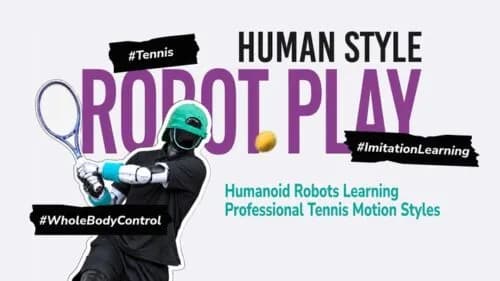
IEEE Spectrum and Wiley are distributing a complimentary white paper, sponsored by Noitom Robotics, about how to give humanoid robots the motion style of a professional athlete without losing reliable task performance. The topic is tennis. The paper's starting point is that humanoid robots have begun to show real capability in ball sports, but keeping a professional's style while still performing the task reliably is, in its words, an unresolved problem.
The white paper examines an adaptive motion planning and tracking framework that learns tennis serving and rally styles directly from broadcast video and motion-capture data. Its design is hierarchical. A planner generates stylistic kinematic motion, and a separate tracker executes that motion with minimal interference. Splitting the two is the paper's answer to the trade-off between style and performance.
The description lists what readers will learn. First, how motion data taken from broadcast video and motion-capture recordings can be reconstructed, retargeted and physically corrected into reference motions that a humanoid can safely track. Second, why moving from simulation to physical hardware introduces compounding tracking errors. The paper states that tracking performance inevitably degrades when a policy trained in simulation moves to real hardware. To reduce this, the framework trains its tracker on randomized execution speeds and conditions its planner on a learned motion-speed representation (described elsewhere on the page as a motion-speed adapter). That is meant to cut the compounding errors introduced by autoregressive planning and noisy perception.
Third, the paper documents real-world validation across two humanoid platforms: a research humanoid platform, plus transfer to a full-size humanoid robot. This includes serving in an uncontrolled, in-the-wild environment performed without any motion-capture system. The paper closes with practical, transferable lessons for engineers building future humanoid ball-sports systems.
The page is a download landing page: a 'LOOK INSIDE' button leads to the document itself, and the text describes the paper rather than reporting its measurements.
Key facts
- IEEE Spectrum and Wiley offer a free white paper, sponsored by Noitom Robotics, on teaching humanoid robots professional tennis serving and rally styles.
- The framework learns styles directly from broadcast video and motion-capture data, and uses a hierarchical design: a planner generates stylistic kinematic motion, a tracker executes it.
- To handle the sim-to-real gap, the tracker is trained on randomized execution speeds and the planner is conditioned on a learned motion-speed representation.
- The paper documents validation on a research humanoid platform and transfer to a full-size humanoid robot, including serving in an uncontrolled environment without motion capture.
- The audience is roboticists and control engineers; the paper closes with practical lessons for future humanoid ball-sports systems.
Why it matters
Humanoid ball sports are a hard test for robots: the motion must look like a skilled athlete's and still hit the task reliably. The white paper frames that combination as an open problem and proposes decoupling the two jobs, a planner for style and a tracker for execution. It also targets the sim-to-real gap, which it says inevitably degrades tracking when a simulated policy meets physical hardware, by making the system speed-aware.
Who it affects
The paper is aimed at roboticists and control engineers, especially those building humanoid systems for ball sports or other tasks where motion style and reliable execution both matter. Sponsor Noitom Robotics and publishers IEEE Spectrum and Wiley are the named organisations behind the document.
How to use it
The white paper is complimentary. The page offers it through a 'LOOK INSIDE' button to download. Engineers can expect a walkthrough of reconstructing, retargeting and physically correcting video and motion-capture data into trackable reference motions, the speed-randomized training of the tracker, and the closing practical lessons.
How solid is it
This is a sponsored, promotional landing page, so what it offers is a description of the paper rather than the evidence itself. No quantitative results are given: no success rates, tracking error values, speeds, or comparison against baselines. No authors or institutions behind the research are named, and the two humanoid platforms are not identified. The text does not report independent evaluation or peer review. The claim of validation across two platforms, including serving without motion capture, comes from the paper's own description.
Risks and caveats
Treat the claims as the sponsor-backed paper's own. The page does not say Noitom Robotics developed the framework, only that it sponsors the white paper. The text does not name a professional player as the source of the style, so how closely the robot matches any real athlete cannot be judged from this page. Whether the approach transfers beyond tennis is not addressed in the description; the stated closing lessons concern humanoid ball-sports systems generally.
“Humanoid robots have begun to show real capability in ball sports, but preserving a professional athlete’s motion style while maintaining reliable task performance is still an unresolved problem.”
— White paper description, IEEE Spectrum and Wiley, sponsored by Noitom Robotics