Study finds visual understanding and generation can help or fight each other in unified AI models
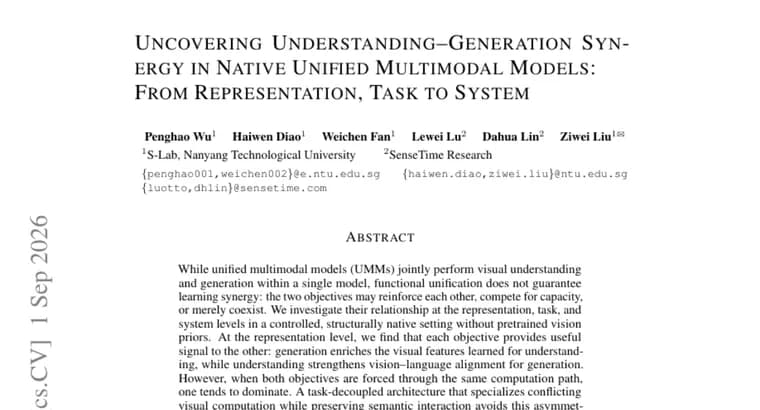
Unified multimodal models (UMMs) are built to handle visual understanding and visual generation inside one model, but the researchers behind this paper argue that putting both jobs in the same network does not automatically mean they help each other: the two objectives could reinforce one another, compete for the model's capacity, or simply sit side by side without interacting. To test which happens, they studied the relationship at three levels (representation, task, and system) using a controlled setup built natively for the comparison rather than one that starts from a model already pretrained with vision priors. At the representation level, they found real mutual benefit in principle: generation enriches the visual features the model learns for understanding, and understanding in turn strengthens the alignment between vision and language that generation relies on. The catch is architectural. When both objectives are forced to run through the same shared computation path, one objective tends to dominate and the other degrades. The researchers show that a task-decoupled architecture, one that gives conflicting visual computations their own specialized paths while still letting the two tasks interact at the semantic level, avoids this asymmetric degradation. At the task level, they ran three case studies and found positive bidirectional transfer: when an understanding task and a generation task draw on the same underlying knowledge, progress on one carries over to the other. At the system level, they compared an end-to-end UMM against a matched pipeline that instead splits the job into a separate planner and executor, and found the end-to-end model wins on complex tasks that explicitly require both understanding and generation together. The overall conclusion is that a unified model's value is not just having one interface for two jobs; specializing the right parts of the architecture, sharing task-relevant knowledge, and training end-to-end are what actually convert coexistence into synergy.
Key facts
- The study examines whether visual understanding and generation in unified multimodal models (UMMs) actually reinforce each other, compete for capacity, or merely coexist, testing this at the representation, task, and system levels in a controlled, structurally native setting without pretrained vision priors.
- At the representation level, generation enriches the visual features learned for understanding and understanding strengthens vision-language alignment for generation, but when both objectives share the same computation path, one tends to dominate the other.
- A task-decoupled architecture that specializes conflicting visual computation while preserving semantic interaction avoids this asymmetric degradation.
- Across three case studies, the researchers found positive bidirectional transfer between understanding and generation tasks when the tasks rely on shared knowledge.
- At the system level, an end-to-end UMM outperforms a matched planner-executor pipeline on complex tasks that explicitly require both image understanding and generation.
Why it matters
Unified multimodal models are usually sold on the idea of one model doing both visual understanding and visual generation, but this paper's starting point is that combining the two jobs functionally does not guarantee they actually help each other inside the network. The paper's contribution is showing that synergy is not automatic, it depends on how the architecture routes the two objectives, whether the tasks share exploitable knowledge, and whether the system is trained end-to-end rather than split into separate stages. That reframes UMM design: the goal is not just a single interface, but building the specific conditions (specialization, shared knowledge, end-to-end optimization) under which coexistence turns into synergy.
Who it affects
The direct audience is researchers and engineers designing unified multimodal model architectures, since the findings speak to concrete design choices, how to route visual computation, when to decouple tasks, and whether to train end-to-end or as a planner-executor pipeline. It also matters to teams evaluating whether to adopt a unified architecture at all versus keeping understanding and generation as separate systems.
How to use it
This is a research paper, not a released tool or product, so there is nothing to install or license. Its practical takeaway for architecture design is that visual computation which conflicts between understanding and generation should be given specialized, decoupled paths rather than forced through a single shared pathway, while semantic interaction between the two tasks should still be preserved, and that end-to-end training of a unified model can outperform a pipeline that splits planning from execution.
How solid is it
The paper reports its findings from a controlled, structurally native experimental setup built specifically to isolate representation-level, task-level, and system-level effects, including three case studies for the task-level claims and a direct comparison against a matched planner-executor pipeline for the system-level claim. The available text does not include benchmark names, datasets, model names or sizes, or numeric performance scores, so the magnitude of the reported effects cannot be independently checked from what is stated here.
Risks and caveats
No authors or institutions are named in the text, and no model names, sizes, benchmarks, or numeric results are given for the unified model, the task-decoupled architecture, or the planner-executor baseline it is compared against. No publication venue or date is stated either. Without those specifics, it is not possible to judge how the findings would generalize beyond the paper's own controlled setup.
“appropriate specialization, shared task knowledge, and end-to-end optimization can turn coexistence into synergy”
— the paper's abstract