StateWeaver targets consistency in long AI-generated video
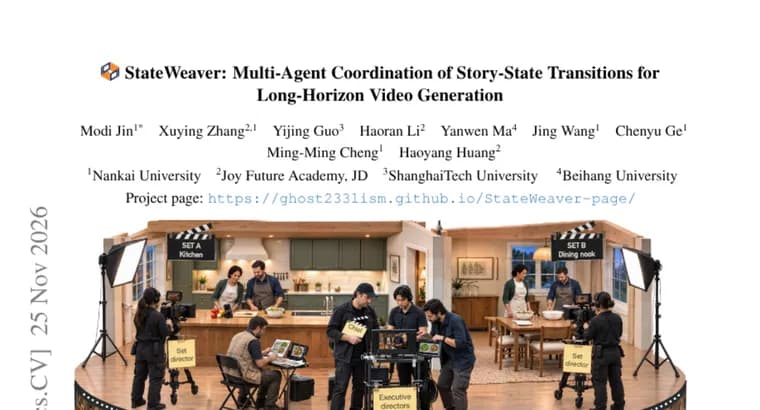
A paper introducing StateWeaver takes on a weakness of current video generation. According to the authors, modern video foundation models produce high-quality short clips, but keeping a long video consistent and correctly showing state changes caused by events remain challenging. They argue that existing agentic workflows struggle here because continual planning and repair pile up context, while updates to visual references stay limited.
StateWeaver combines two components, Active States and Hierarchical Collaboration. Together they are meant to connect visual reference updates, driven by review, with the inheritance of state from one shot to the next.
Active States turn the state mismatches found during review into concrete requirements for visual assets. Those requirements guide how references are built, validated and regenerated. The goal is to repair the target attributes while preserving identity and the content that was already correct. Once a generation result is confirmed, it is linked to the corresponding asset states, the story time and the reference versions, so that later shots can verify and reuse it.
Hierarchical Collaboration addresses the context problem. It isolates execution contexts by task, clip and repair round, and uses hierarchical memory to organize the process across multiple sets.
The authors report that across multiple benchmarks StateWeaver beats existing methods and produces long videos with sustained cross-shot consistency, both when the storyboard is predefined and when it is planned autonomously.
Key facts
- The problem: video foundation models make good short clips, but long-video consistency and event-driven state changes remain hard, the authors say.
- Active States convert mismatches found in review into visual asset requirements, repairing target attributes while keeping identity and correct content.
- Confirmed results are tied to asset states, story time and reference versions so later shots can check and reuse them.
- Hierarchical Collaboration separates execution contexts by task, clip and repair round, backed by hierarchical memory.
- The authors report better results than existing methods on multiple benchmarks, with both predefined and autonomously planned storyboards.
Why it matters
A long video has to remember what has happened. If an event changes something in the story, later shots need to show the new state while everything else stays recognizable. The authors identify two reasons existing agentic workflows fall short: context accumulates through repeated planning and repair, and visual references get only limited updates. StateWeaver is aimed at both, with Active States handling reference updates and Hierarchical Collaboration keeping execution contexts apart.
Who it affects
The work is most relevant to researchers and developers building long-video generation systems, especially agentic pipelines that plan, review and repair output shot by shot. Anyone who needs consistency across shots, whether working from a fixed storyboard or letting the system plan one, is looking at the problem the paper sets out to solve.
How to use it
No code, model or demo release is mentioned. What a builder can take from the description is a set of design ideas: translate review findings into specific asset requirements; validate and regenerate references while protecting what is already right; record each confirmed result with its asset state, story time and reference version; and give each task, clip and repair round its own isolated context.
How solid is it
The performance claim is the authors' own: StateWeaver outperforms existing methods across multiple benchmarks and sustains consistency between shots. The text behind this account gives no metric values or margins of improvement, and it names neither the benchmarks nor the methods used for comparison. The size of the advantage cannot be judged from it.
Risks and caveats
Treat the results as reported claims until you have checked the numbers and the test setup. The underlying video generation and language models are not named, and there are no figures for video length, cost or runtime, all of which matter when deciding whether a pipeline with review and repair rounds is practical. No limitations of the method are mentioned.
“Existing agentic workflows face these challenges because continual planning and repair accumulate context, while reference updates remain limited.”
— The StateWeaver authors