Survey argues continual learning is shifting from weight tweaks to system-level adaptation
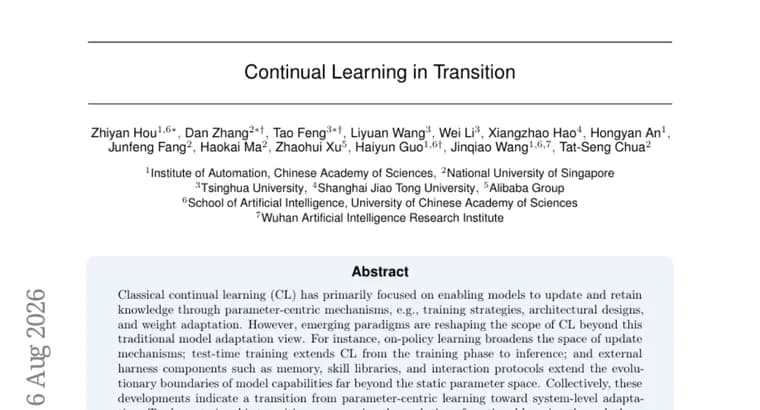
A survey paper titled "Continual Learning in Transition" argues that continual learning, the study of how AI models keep updating and retaining knowledge over time, is undergoing a structural shift. Classical continual learning has focused on parameter-centric mechanisms: training strategies, architectural designs, and weight adaptation aimed at updating a model's internal weights without losing what it already knows.
The paper describes several emerging paradigms pushing the field beyond that model-adaptation view. On-policy learning broadens the space of update mechanisms available. Test-time training extends continual learning from the training phase into inference, meaning a model can keep adapting after it has already been deployed. External harness components, such as memory systems, skill libraries, and interaction protocols, extend what a model's capabilities can reach far beyond its static, fixed parameters.
Taken together, the paper argues these developments mark a transition from parameter-centric learning toward system-level adaptation, where the surrounding system, not only the model's weights, does much of the adapting.
To characterize this transition, the paper proposes a tri-axial framework built around three questions: When learning happens, How it happens, and Where it happens. The How axis spans off-policy, on-policy, and beyond-gradient optimization mechanics. The When axis covers pre-training, post-training, and inference-time stages. The Where axis distinguishes updates made within a model's internal parameters from updates made through external structural constraints outside the model.
Anchored by this framework, the paper surveys representative methods in the field, traces the transition it describes, and discusses key challenges, broader implications, and future directions that follow from the shift toward system-level adaptation. The available text lays out the framework and the argument for the transition; it does not name specific methods, papers, or benchmarks, and it does not report new experimental results.
Key facts
- The survey, titled "Continual Learning in Transition," proposes a tri-axial framework organized around When, How, and Where learning occurs.
- Classical continual learning has focused on parameter-centric mechanisms: training strategies, architectural designs, and weight adaptation.
- Test-time training extends continual learning from the training phase into inference, letting models keep adapting after deployment.
- External harness components, memory, skill libraries, and interaction protocols, extend model capabilities far beyond the static parameter space.
- The How axis covers off-policy, on-policy, and beyond-gradient optimization; the When axis covers pre-training, post-training, and inference-time stages; the Where axis separates internal parameter updates from external structural constraints.
Why it matters
The paper reframes what counts as learning for a deployed AI system. Instead of treating continual learning as purely a matter of retraining or fine-tuning weights, it argues the field now has to account for systems that keep adapting through test-time training and through external scaffolding like memory and skill libraries. That reframing changes what researchers measure and compare when they claim a system continues to learn after release.
Who it affects
Primarily AI researchers working on continual learning and the engineers building systems that must keep adapting after deployment, such as agents that rely on memory, skill libraries, or test-time training. As a framework and survey paper rather than a product, its direct effect is on how the research community organizes and compares existing methods, not on any specific commercial system.
How to use it
The paper offers a classification framework rather than a tool, model, or product. Researchers can use the tri-axial When, How, Where structure to place a given continual learning method: whether it updates parameters or external structures (Where), whether it operates off-policy, on-policy, or beyond gradients (How), and whether it happens during pre-training, post-training, or inference (When). No pricing, license, or code release is described in the available text.
How solid is it
This is a survey and framework paper, which by nature organizes and argues rather than reports new experiments. The available text is the paper's framing and argument; it does not name the specific representative methods, papers, or benchmarks the survey covers, and it does not disclose author names, institutional affiliations, or a publication venue. On Hugging Face's papers page, the entry had drawn 14 points and 2 comments, modest engagement rather than a widely discussed release.
Risks and caveats
The claims here are about framing and organization, not new empirical results: the text gives no accuracy numbers, benchmark comparisons, or case studies backing the tri-axial framework itself. It is best read as a proposed lens for organizing a fast-moving field rather than a validated methodology. Because the available text does not name the authors or their affiliations, readers cannot independently check the survey's coverage or provenance from this excerpt alone.