Survey maps robot-learning research along a weights-versus-skills axis
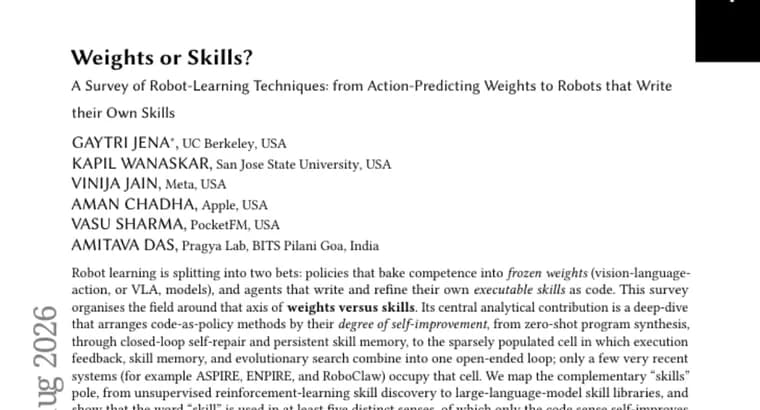
A survey paper frames robot learning as a split between two approaches: policies that bake competence into frozen weights, the vision-language-action (VLA) model approach, and agents that write and refine their own executable skills as code. The survey organizes the field around this weights-versus-skills axis.
Its central contribution is a taxonomy that arranges code-as-policy methods by their degree of self-improvement. The scale runs from zero-shot program synthesis, through closed-loop self-repair and persistent skill memory, to a cell where execution feedback, skill memory, and evolutionary search combine into one open-ended loop. Only a few very recent systems, for example ASPIRE, ENPIRE, and RoboClaw, occupy that top cell.
The survey also maps the complementary "skills" pole, covering approaches that range from unsupervised reinforcement-learning skill discovery to large-language-model skill libraries. It finds that the word "skill" is used in at least five distinct senses across the field, and that only the code sense self-improves without gradient updates.
The survey connects this taxonomy to what it calls the emerging skill economy: commercial robot-skill marketplaces already distribute one-tap skills across robots, but currently ship only static playback. That gap surfaces a set of open problems: adaptation, cross-embodiment portability, provenance, safety verification, composition, and standardization.
The survey is deliberately focused rather than exhaustive: it examines 77 representative systems across six technique families through one taxonomy and a set of contrast tables, and it supplies operational definitions of the self-improvement mechanisms along with a statement of what each family cannot do.
Key facts
- The survey examines 77 representative systems across six technique families.
- It organizes the field along a weights axis (frozen-weight VLA policies) versus a skills axis (agents that write and refine executable code skills).
- It ranks code-as-policy methods by degree of self-improvement, from zero-shot program synthesis to a top cell combining execution feedback, skill memory, and evolutionary search, occupied so far only by systems like ASPIRE, ENPIRE, and RoboClaw.
- The word "skill" is used in at least five distinct senses across the field, and only the code sense self-improves without gradient updates.
- Commercial robot-skill marketplaces already distribute one-tap skills but ship only static playback, leaving adaptation, cross-embodiment portability, provenance, safety verification, composition, and standardization unresolved.
Why it matters
Robot learning has been splitting into two competing bets without a shared map between them: frozen-weight VLA policies on one side, and agents that write their own executable skills as code on the other. This survey gives the field a single taxonomy that places both approaches, and every point in between, on one axis, and adds a second axis ranking how much a code-writing system can improve itself without retraining.
Who it affects
Robotics researchers building or evaluating VLA models and code-as-policy agents get a shared vocabulary and contrast tables to place their own system. Builders of commercial robot-skill marketplaces, which already sell one-tap skills across robots, are directly named as the group facing the open problems the survey lists.
How to use it
The survey supplies operational definitions for the self-improvement mechanisms it identifies (zero-shot program synthesis, closed-loop self-repair, persistent skill memory, and the combined open-ended loop) and states what each of the six technique families cannot do, which can serve as a checklist for placing a new system or spotting an unaddressed gap.
How solid is it
The survey is deliberately focused rather than exhaustive: 77 representative systems across six technique families, organized through one taxonomy and a set of contrast tables. No author names, institutional affiliations, publication venue, or date are given in the available text.
Risks and caveats
The survey itself flags open problems in the commercial skill economy: marketplaces distribute one-tap skills across robots but ship only static playback, leaving adaptation, cross-embodiment portability, provenance, safety verification, composition, and standardization unresolved. Only a handful of very recent systems reach the fully combined self-improvement loop, so most of the field remains short of it.
“commercial robot-skill marketplaces now distribute one-tap skills across robots but ship only static playback”
— the survey