Synthesia builds a TechCrunch reporter her own AI avatar
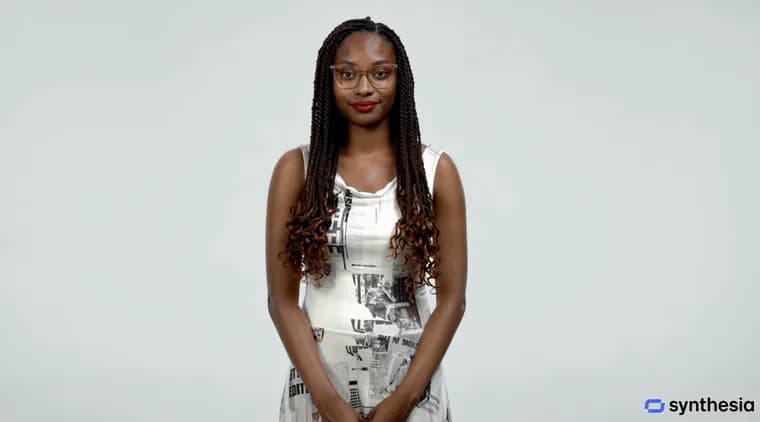
A TechCrunch journalist visited Synthesia's new New York office in September and had the company build a digital avatar of them, something Synthesia says it had previously done only for its own head of corporate affairs, Alexandru Voica, whose interactive avatar answers press questions about the company. Synthesia, a video-generation startup originally based in the U.K. and valued at $4 billion earlier this year after crossing $100 million in annual recurring revenue the year before, makes avatars for enterprise training videos and a roleplay product where employees practice tasks like sales pitches with an AI that responds and scores them. To build the journalist's avatar, Synthesia photographed them in a studio and recorded a two-minute voice sample. The team produced two personal avatars, which simply read back a script, and two interactive avatars, which can listen and respond, each made with and without glasses. The interactive avatar was trained on one specific article, about why venture-backed startups commit more fraud than non-VC-backed ones, and is deterministic: it will only discuss that story and redirects any other question back to it, including questions the journalist's own parents asked hoping the avatar would reveal something 'only they would know.' The avatar's stack combines voice-to-text, an agentic language model, text-to-voice and a Synthesia-built video model; Synthesia uses its own voice and video models by default but lets customers swap in alternatives from Cartesia, ElevenLabs, Google or OpenAI, and enterprises can host their avatars on their own cloud or pay Synthesia to host them. It took the Synthesia team a couple of days to build the avatars. The journalist's mother called the result 'amazing' and joked, 'I don't remember giving birth to two of you,' after testing it, while friends found the likeness in the interactive avatar less convincing than in the personal one but still 'somewhat creepy.' The piece closes on the implications for journalism: one investor told the journalist immediately that they would not accept news presented by an avatar, and the journalist argues that trust, the core of journalism, cannot be outsourced to AI, though they see clearer appeal in using a deterministic clone of oneself for repetitive tasks outside reporting.
Key facts
- Synthesia, valued at $4 billion earlier this year after crossing $100 million in ARR, built a TechCrunch journalist a personal avatar (reads a script) and an interactive avatar (listens and responds), each with and without glasses.
- The interactive avatar is deterministic and trained on a single story, about venture-backed startup fraud, and redirects any other question back to that article.
- The build took a couple of days and combined voice-to-text, an agentic language model, text-to-voice and Synthesia's own video model; customers can substitute voice or language models from Cartesia, ElevenLabs, Google or OpenAI.
- Enterprises can host their avatars on a cloud of their choice or pay Synthesia to host them.
- One investor told the journalist they would not accept news presented by an avatar, and the journalist concludes that journalism's trust cannot be outsourced to AI.
Why it matters
Interactive, deterministic avatars are moving from novelty into corporate use, first as a PR tool for Synthesia's own staff and now as a demonstration built for outside press. It puts a concrete example in front of readers of what an AI clone that can converse, rather than just recite a script, actually looks and sounds like, and surfaces the question of whether such avatars could ever front news or PR communication in place of a person.
Who it affects
Journalists and PR professionals who may increasingly encounter or be asked to use AI avatars in press interactions; enterprises already using Synthesia for training videos and roleplay practice; and Synthesia itself, which is testing how far its avatar technology can extend beyond its original corporate-training use case.
How to use it
Synthesia offers three product lines: a video-creation platform where a script is typed and an avatar reads it back, an agentic 'Sessions' platform for interactive roleplay and surveys, and an API platform for combining Synthesia's voice and video models with other services to build custom interactive avatars. Customers can swap in voice or language models from Cartesia, ElevenLabs, Google or OpenAI instead of Synthesia's own, and can host the resulting avatars on their own cloud infrastructure or have Synthesia host them.
How solid is it
This is a first-person account by the TechCrunch journalist who went through the process, describing Synthesia's office, staff and build steps directly, and including reactions from the journalist's own friends and parents after testing the avatar. It is a company-hosted demo rather than independent testing, so the account reflects one guided experience rather than a broad evaluation of the technology.
Risks and caveats
The journalist notes the avatar is deterministic, meaning it can only repeat what it was trained to say, and contrasts that with the risk of a nondeterministic, freely pontificating chatbot avatar contributing to what they call a 'tinge of AI psychosis.' An investor's immediate rejection of avatars presenting news, and existing backlash against AI slop on social platforms, are cited as signs that trust in journalism is not something the piece expects to be replaced by an avatar.
“I don't remember giving birth to two of you”
— the journalist's mother, after testing the avatar