TacForcing generates robot actions from execution-time tactile feedback
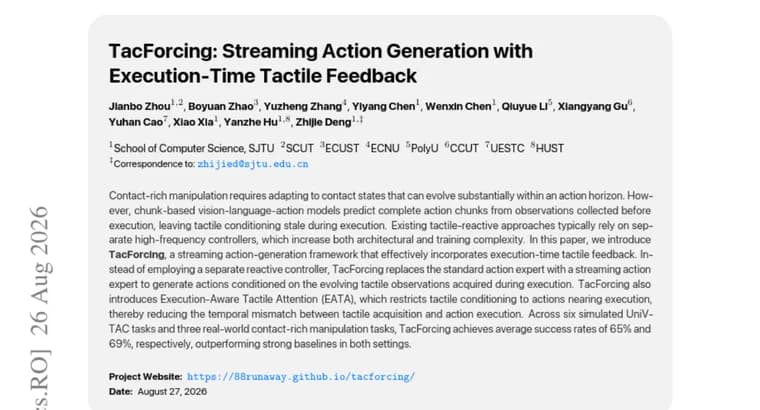
Contact-rich manipulation, tasks where a robot's contact with an object can shift substantially while a single motion unfolds, needs sensing that keeps pace with how that contact evolves. Chunk-based vision-language-action (VLA) models fall short here: they predict a whole block of future actions from observations gathered before the robot starts moving, so by the time later actions in that chunk execute, the tactile information behind them is already stale. Existing fixes usually bolt on a separate, high-frequency tactile controller alongside the base model, which adds both architectural and training complexity.
A new paper introduces TacForcing, a streaming action-generation framework that folds execution-time tactile feedback directly into action generation instead of adding a second controller. It replaces the model's standard action expert with a streaming action expert, one that keeps producing actions conditioned on tactile observations as they evolve during execution rather than freezing on what was sensed beforehand. The paper also introduces Execution-Aware Tactile Attention (EATA), which restricts tactile conditioning to only the actions nearing execution, cutting the mismatch between when a touch is sensed and when the corresponding action runs.
TacForcing was tested across six simulated UniVTAC contact-rich manipulation tasks and three real-world contact-rich manipulation tasks, reaching average success rates of 65% and 69% respectively, and outperforming strong baselines in both settings. The abstract does not name those baselines, describe the robot hardware or sensors used, or specify the real-world tasks themselves. It also says nothing about releasing code or a dataset, and gives no training data size, compute cost, or model size.
Key facts
- TacForcing swaps a VLA model's standard action expert for a streaming action expert that keeps generating actions conditioned on tactile readings gathered while the motion is already executing.
- Execution-Aware Tactile Attention (EATA) limits tactile conditioning to only the actions about to run, narrowing the gap between when a touch is sensed and when it can affect the robot's next move.
- Across six simulated UniVTAC contact-rich manipulation tasks, TacForcing reaches an average success rate of 65%.
- Across three real-world contact-rich manipulation tasks, TacForcing reaches an average success rate of 69%, outperforming strong baselines in both settings.
- Prior tactile-reactive approaches typically require a separate high-frequency controller bolted onto the base model, adding architectural and training complexity that TacForcing avoids.
Why it matters
Chunk-based vision-language-action models plan a whole block of future actions from what they observed before the robot started moving, which works until contact conditions shift mid-motion, at which point the tactile picture behind later parts of that action chunk is already stale. Bolting on a separate high-frequency tactile controller to react in real time is the usual fix, but it means training and maintaining a second system alongside the main model. TacForcing instead builds execution-time tactile feedback into the action-generation step itself, through a streaming action expert that keeps updating what it predicts as new touch data arrives.
Who it affects
The result is aimed at robotics researchers and teams building vision-language-action systems for contact-rich work such as insertion, assembly, or handling objects whose grip or resistance changes as a task proceeds. It is a research contribution rather than a released product: the abstract names no authors, institution, or affiliation behind TacForcing, so who built it and whether it will be maintained or extended is not stated.
How to use it
TacForcing's core change is architectural: a streaming action expert replaces the standard action-generation module, continuously conditioning on tactile observations as they evolve during execution instead of only on what was sensed before the motion began. Execution-Aware Tactile Attention narrows that conditioning further, restricting it to the actions nearing execution so the touch data used is always close in time to the action it affects. The abstract does not mention releasing code or a dataset, so there is currently no way to run TacForcing outside the paper's own experiments.
How solid is it
TacForcing was evaluated on six simulated UniVTAC contact-rich manipulation tasks and three real-world contact-rich manipulation tasks, reaching average success rates of 65% and 69% respectively and outperforming strong baselines in both settings. Those baselines are not named in the abstract, and the robot hardware, sensors, and specific real-world tasks used are not described either, so the size of the improvement cannot be independently checked from the text alone.
Risks and caveats
A 65% and 69% average success rate still means TacForcing fails on roughly a third of trials in both settings, an improvement over baselines rather than a solved problem. The abstract gives no training data size, compute cost, or model size, and does not mention releasing code or a dataset, so neither the method's cost nor its reproducibility can be assessed from the source alone.