TerminalHorizon engine synthesizes long-horizon terminal tasks, tunes Qwen3.5-27B
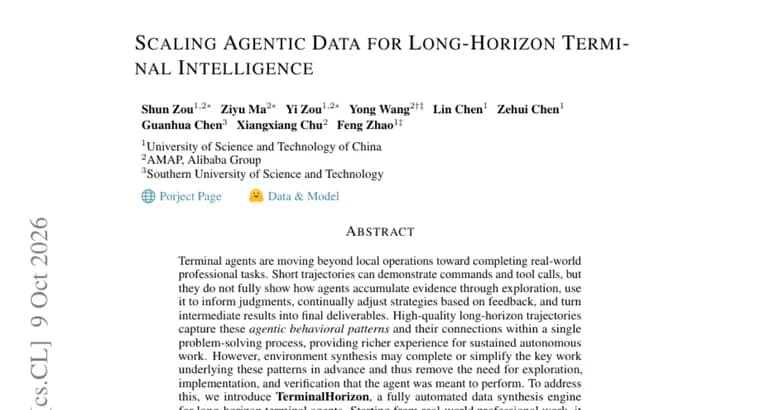
A new paper introduces TerminalHorizon, a fully automated data synthesis engine for long-horizon terminal agents. The starting point is a problem the authors describe: terminal agents are moving beyond local operations toward real-world professional tasks, and short trajectories show commands and tool calls but not how an agent gathers evidence through exploration, uses it to inform judgments, adjusts strategy based on feedback, and turns intermediate results into final deliverables. Long, high-quality trajectories capture those behavioral patterns within a single problem-solving process.
The obstacle, according to the authors, is that environment synthesis may complete or simplify the key work behind these patterns in advance. That removes the exploration, implementation and verification the agent was supposed to perform, so the resulting data teaches less than it appears to.
TerminalHorizon addresses this in two ways. First, it starts from real-world professional work and uses independent execution to identify key work that was omitted during construction, then uses that evidence to guide reconstruction of the environment. Second, to extend the patterns across stages, it progressively expands tasks under the same goal, adding new requirements that build on prior results and call for further exploration and improvement.
Using the engine, the authors construct 1.5K task environments and run supervised fine-tuning of Qwen3.5-27B on the resulting dataset, producing TerminalHorizon-27B. They report substantial performance gains on all 12 benchmarks, which span coding-agent tasks, agentic tasks in real-world production settings, and general reasoning.
The paper also describes multiple RSI case studies, each with a 12-hour research budget. According to the authors, these show the model continuing to experiment beyond an initial solution, improving its methods based on feedback, and retaining effective improvements in its final deliverables.
Key facts
- TerminalHorizon is a fully automated data synthesis engine for long-horizon terminal agents, introduced by the paper's authors.
- It starts from real-world professional work, uses independent execution to find key work omitted during construction, and rebuilds the environment from that evidence.
- Tasks are progressively expanded under the same goal with new requirements that build on prior results.
- The authors built 1.5K task environments and fine-tuned Qwen3.5-27B on them to get TerminalHorizon-27B.
- They report substantial gains on all 12 benchmarks covering coding-agent tasks, agentic production tasks and general reasoning, plus RSI case studies with a 12-hour research budget each.
Why it matters
Training data for agents that work in a terminal is often too short to show the full arc of real work: exploring, judging, adjusting and delivering. The paper's point is that synthesized environments can quietly do the hard part for the agent, which defeats the purpose. TerminalHorizon is an attempt to build long tasks where that work is still left to the agent, and to do it without human curation.
Who it affects
Teams building or training terminal and coding agents are the direct audience, particularly those who generate synthetic environments and trajectories for supervised fine-tuning. Researchers working on agent benchmarks and long-horizon evaluation may also care, since the paper covers coding-agent tasks, production-style agentic tasks and general reasoning.
How to use it
As a practitioner, the transferable idea is the construction recipe: begin from real professional work, run the task independently to see which key steps the environment accidentally supplied, rebuild the environment to restore them, then extend the task in stages with requirements that depend on earlier results. No release of code, data or model weights is mentioned.
How solid is it
The claims come from the authors' own abstract. No benchmark names and no per-benchmark scores are given; 'substantial performance gains' is not quantified. No baseline numbers or comparison to the unmodified Qwen3.5-27B or to other models are stated. The abstract does not expand the abbreviation 'RSI' nor say how many case studies were run. Treat the headline result as a reported claim until the full paper's tables are checked.
Risks and caveats
The size of the training dataset in trajectories or tokens is not given; only 1.5K task environments. The abstract names no authors or institutions. The reported gains are the authors' own and cannot be judged without the benchmark list and baselines. The case studies are described qualitatively, as demonstrations of behavior rather than measured results.