Test-Time Memory Evolution beats test-time training on five math tasks, cutting FLOPs 82.8-84.6%
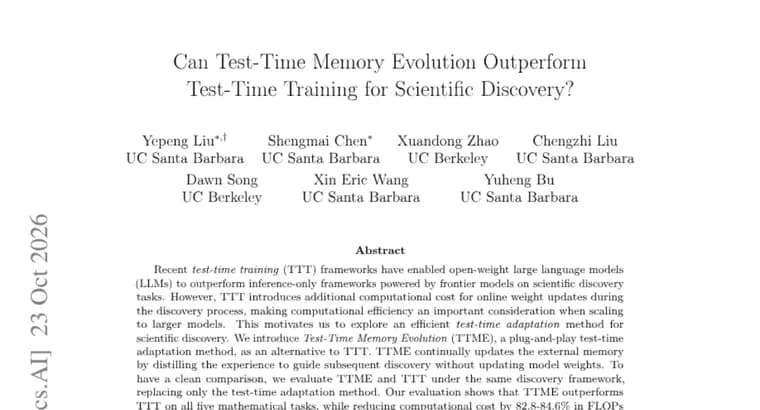
Recent test-time training (TTT) frameworks have let open-weight large language models outperform inference-only frameworks powered by frontier models on scientific discovery tasks. The catch, the paper says, is cost: TTT adds computation for online weight updates during the discovery process, so efficiency becomes a concern as models get larger.
The authors respond with Test-Time Memory Evolution (TTME), a plug-and-play test-time adaptation method offered as an alternative to TTT. Instead of changing the model, TTME continually updates an external memory. It distils the experience gathered so far into that memory, and the memory then guides later discovery. Model weights are never updated.
To keep the comparison clean, the authors run TTME and TTT under the same discovery framework and replace only the test-time adaptation method. On that setup, TTME outperforms TTT on all five mathematical tasks evaluated. It also cuts computational cost by 82.8-84.6% in FLOPs and by 47.7-58.4% in runtime, both ranges relative to TTT and taken across the evaluated tasks.
The authors conclude that these results establish TTME as an effective and computationally efficient alternative to TTT, and they limit that claim to the evaluated discovery settings.
Key facts
- Test-Time Memory Evolution (TTME) adapts at test time by updating an external memory, with no changes to model weights.
- Under the same discovery framework, with only the adaptation method swapped, TTME outperforms test-time training (TTT) on all five mathematical tasks evaluated.
- TTME reduces computational cost by 82.8-84.6% in FLOPs relative to TTT.
- TTME reduces runtime by 47.7-58.4% relative to TTT.
- The authors frame the conclusion as limited to the evaluated discovery settings.
Why it matters
TTT has recently allowed open-weight models to beat inference-only setups built on frontier models in scientific discovery, but it pays for that with extra compute for online weight updates. The paper targets that cost. If memory updates can replace weight updates, the same discovery loop becomes much cheaper: the reported savings are 82.8-84.6% in FLOPs and 47.7-58.4% in runtime, alongside better results on all five math tasks.
Who it affects
Researchers building LLM-driven scientific discovery systems are the direct audience, especially those weighing TTT against cheaper options as they scale to larger models. The paper frames efficiency at larger model sizes as the motivating concern.
How to use it
The authors describe TTME as plug-and-play: it replaces the test-time adaptation step inside an existing discovery framework, and the experiments change only that step. In practice that means keeping the framework and swapping weight updates for a memory that distils experience to guide later discovery. No code release, dataset or publication venue is mentioned.
How solid is it
The evidence is the authors' own evaluation, summarised in a Hugging Face paper page. The comparison is controlled in design, since both methods run in the same discovery framework with only the adaptation method changed. The page is an abstract only. The abstract names no authors or institutions. The five mathematical tasks are not named. It does not say which models or model sizes were used. No accuracy or score figures are given for TTME or TTT, only that TTME is better on all five tasks. It also does not say per task which cost reduction applies; only the ranges are given.
Risks and caveats
The authors limit their conclusion to the evaluated discovery settings, and no claim is made beyond the evaluated mathematical tasks, such as other scientific domains. Because the size of the accuracy gains is not given, "outperforms" says nothing about how large the advantage is. The cost figures are ranges across tasks, so any single task may sit anywhere inside them.
“These results establish TTME as an effective and computationally efficient alternative to TTT in the evaluated discovery settings.”
— Paper abstract, Hugging Face